
Seed Paper Stationery for Corporate Gifting: A Guide
· 11 min read
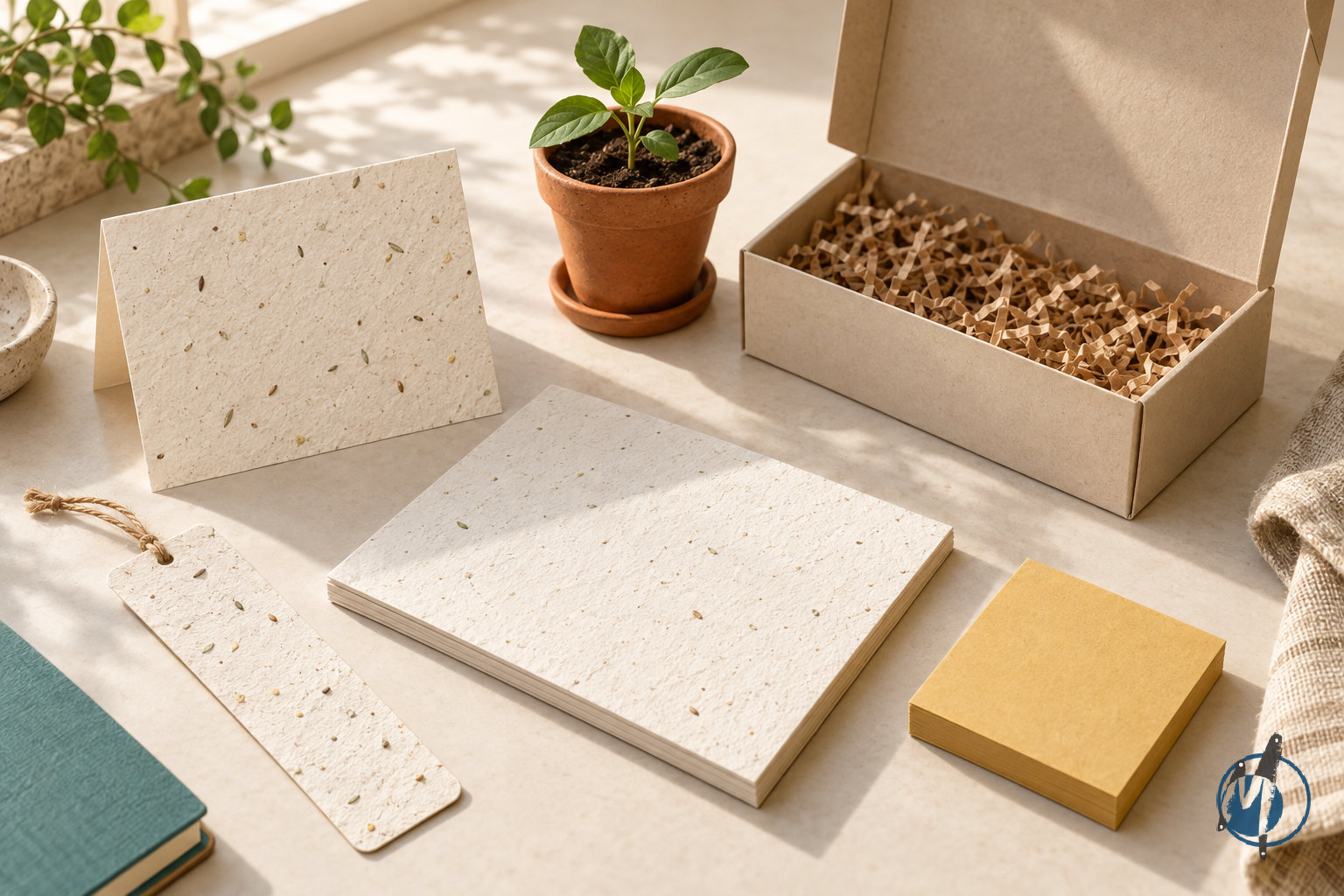
Quick answer: Seed paper stationery for corporate gifting uses paper embedded with seeds to create plantable cards, bookmarks, gift tags and other branded touchpoints. A successful programme balances seed suitability, print quality, everyday usefulness and straightforward planting instructions—not just an attractive sustainability story. For corporate buyers in India, the strongest approach is often a practical stationery kit with a carefully selected seed-paper component.
What is seed paper stationery, and when does it work for corporate gifting?
Seed paper is a paper substrate containing seeds within its fibre structure. When the paper is planted under suitable conditions, its fibres soften and break down, allowing viable seeds to germinate. This outcome depends on the seed species, paper construction, processing, storage and recipient care; “plantable” should never be treated as a promise that every piece will grow.
For corporate gifting, the appeal is both physical and participatory. A recipient can read a welcome message, use a bookmark or open a gift, then plant the paper rather than immediately discard it. That second interaction can extend a brand experience beyond the handover, provided the item includes credible instructions and suits the recipient’s location.
Good applications include employee onboarding, conference welcome kits, festive gifting, customer thank-you packs and internal sustainability initiatives. Seed paper works especially well as a communication layer around an otherwise useful gift. It is less convincing when an entire kit is made plantable at the expense of writing performance, storage convenience or durability.
Choose the role before choosing the product
Message carrier: A greeting card, welcome note or thank-you insert.
Useful keepsake: A bookmark with a simple silhouette and comfortable thickness.
Packaging detail: A removable gift tag or belly band.
Participation tool: A planting card linked to a voluntary employee activity.
The key question is whether planting feels like a natural continuation of the gift. If recipients are unlikely to have access to pots, soil or appropriate growing conditions, a well-made recycled-paper product may be a better fit.
Which stationery products should use seed paper?
Not every stationery format benefits from embedded seeds. Surface texture, seed size, fold behaviour and repeated handling all influence suitability. A greeting card can tolerate an irregular handmade appearance; a desk pad needs a reasonably consistent writing surface across many pages. Product selection should begin with these functional differences.
For a coordinated corporate set, separate the working stationery from the plantable element. Conventional or appropriately specified recycled-paper desk pads can provide daily utility, while a seed-paper greeting card or bookmark supplies the planting experience. This hybrid approach also makes it easier to keep detailed corporate information legible.
Product | Seed-paper suitability | Main consideration | Practical gifting approach |
|---|---|---|---|
Greeting cards | Strong candidate | Folding, legibility and seed distribution | Lightly printed card with separate detailed instructions if needed |
Envelopes | Conditional | Seam adhesive, folding and postal handling | Standard paper envelope around a plantable card |
Bookmarks | Strong candidate | Thickness, abrasion and protruding seeds | Simple shape with generous unprinted areas |
Gift tags | Strong candidate | Hole placement and tearing | Removable tag secured with a separate tie |
Desk pads | Better as a hybrid | Smooth writing and page consistency | Functional paper pad with a plantable insert |
Sticky notes | Better as a hybrid | Adhesive performance and writing texture | Standard sticky-note block paired with seed paper |
Stickers | Requires specific validation | Adhesive, release liner and planting compatibility | Prefer an unattached plantable tag unless the full construction is tested |
Assess the complete item, not just its paper
A seed-paper sticker is not automatically plantable simply because its face material contains seeds. Its adhesive, coatings and backing need separate consideration. Similarly, a plantable card attached to a laminated mount should be clearly removable, with disposal instructions that distinguish between components.
When reviewing samples, ask recipients or internal stakeholders to perform the actual task: write a note, fold the card, place the bookmark in a book and remove the tag from its packaging. A product that passes a visual review can still fail in everyday use.
How do you choose suitable seeds for recipients in India?
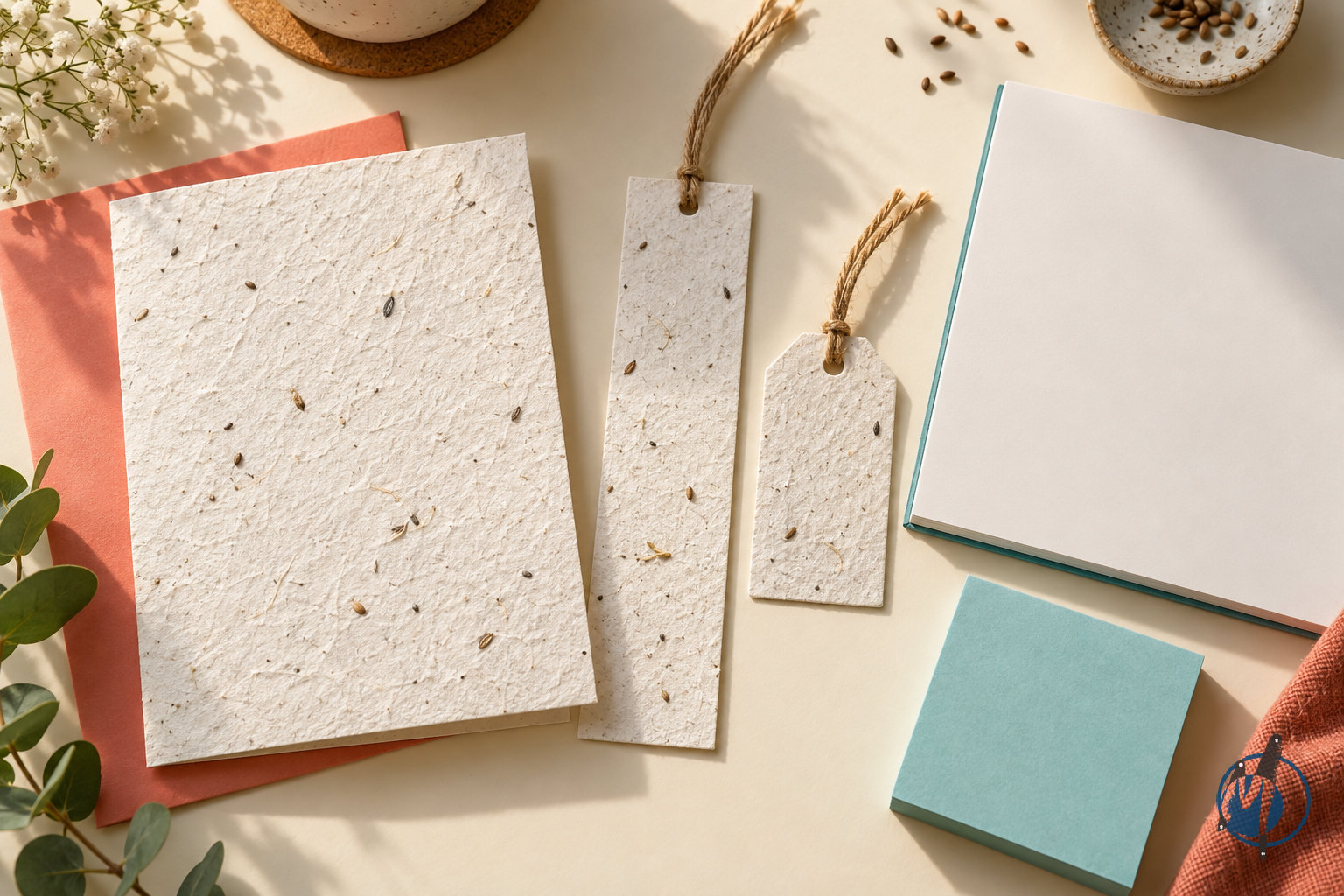
Start with recipient geography rather than a fashionable plant name. India’s climates, growing seasons and indoor conditions vary substantially, so a seed that suits one distribution may not suit another. Consider whether recipients will plant on a balcony, near a window, outdoors or in an office setting with limited daylight.
Ask for the botanical identity of the seeds, their source and available batch information. Generic descriptions such as “wildflower mix” are insufficient for informed selection. Named species make it easier to assess local suitability, explain care and avoid distributing plants that are invasive, restricted or poorly adapted to the destination.
Questions for the material supplier
What is the botanical name of each included species?
Is the seed intended and suitable for distribution at the recipient locations?
What evidence is available about germination in the finished paper?
Which planting season, light conditions and sowing method are recommended?
How should the finished stationery be stored, and for how long is its performance supported?
Are there additional considerations for herbs, edible plants or mixed-seed products?
Do not assume that a supplier’s raw-seed germination result describes the finished stationery. Pulp processing, drying, printing and storage can affect performance. Request evidence relevant to the embedded paper, and agree whether a check on representative finished samples is appropriate for the project.
For international gifting, seed-bearing paper may be subject to destination-specific plant-health and import requirements. Check the destination rules before production and shipment; a paper appearance does not exempt an item from seed controls. A non-seeded alternative can preserve the design concept when a recipient market is unsuitable.
How should branding and printing work on seed paper?
Design for the substrate instead of trying to make it behave like smooth coated stock. Seed paper often has visible fibres, uneven surfaces and variations in thickness. Open layouts, restrained ink coverage and clear hierarchy work with those characteristics, while dense photographic artwork and very fine detail can be difficult to reproduce consistently.
Specify printing through a sample-led process. Excessive heat, pressure, heavy coverage or incompatible finishes may affect either seed performance or the planting experience. No printing method should be described as universally safe for every seed-paper formulation: the actual paper, seed, equipment settings and finishing sequence need to work together.
Build a practical artwork brief
Use readable type and avoid essential information in delicate reversed-out lettering.
Leave generous margins around folds, cut edges and punched holes.
Keep seed-paper components free of unnecessary laminates and decorative coatings.
Put extensive legal, campaign or care information on a separate suitable component where necessary.
Test QR codes on physical production-representative samples, not only on screen.
Agree how much natural variation in texture and colour is acceptable.
Brand colour is another approval point. A cream or greyish fibre base can shift colour appearance, and ink can settle differently across an uneven surface. Review a physical print sample under normal lighting and define an acceptable result rather than expecting the exact appearance of a digital mock-up.
Instructions deserve equal design attention. Include the seed identity, relevant sowing guidance, light and watering needs, and any recommended season. If detailed instructions sit behind a QR code, retain enough basic information on the item or accompanying card for someone to begin without needing a phone.
How can you evaluate environmental claims without greenwashing?
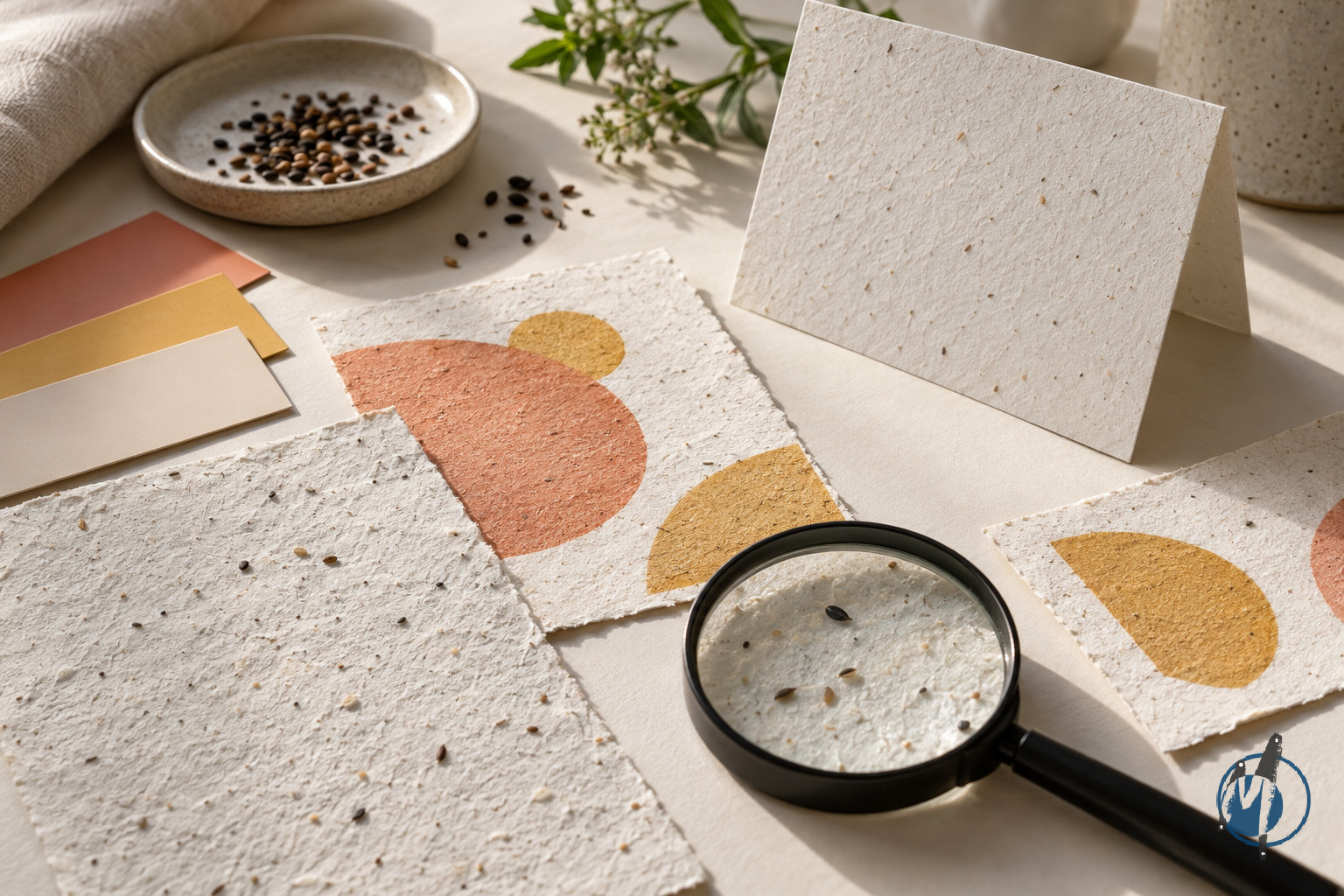
Seed paper provides a potential planting activity; it does not automatically establish that the complete gift has a lower environmental impact than every alternative. Paper sourcing, manufacturing inputs, print coverage, packaging, freight and actual recipient use all matter. Environmental language should describe what is known rather than treating “eco” as a substitute for specifications.
Separate three kinds of evidence: what the paper contains, whether its seeds remain viable and what happens to each component after use. A recycled-content statement does not prove germination. A successful planting trial does not prove that a coated gift box is compostable. Each claim needs its own basis and a clearly defined scope.
Prefer specific, supportable statements
“Includes a plantable seed-paper bookmark,” when that description is accurate.
“Contains [named species] seeds,” supported by material identification.
“Remove the tie and outer packaging before planting,” where applicable.
A precisely scoped recycled-content statement, only when documented.
Avoid broad promises such as “zero waste,” “100% sustainable” or “guaranteed to grow” unless there is a defensible basis for the exact claim. Be particularly careful with “biodegradable” and “compostable”: conditions, timeframe and the components covered must be understood before these terms appear in customer-facing copy.
Measurement can remain modest and useful. Track how many recipients received instructions, whether they found the gift useful and what voluntary planting feedback reveals. Do not turn the number of cards distributed into an assumed number of plants grown, or into an unsupported carbon-offset claim.
What should your corporate gifting procurement process include?
A good procurement process aligns the brand team, purchasing team and production partner before artwork is finalised. Seed paper adds material and biological variables to a normal stationery order, so selecting a design first and resolving seed suitability later can create avoidable rework. Write a brief that covers the recipient experience as well as the purchase specification.
Use the following sequence to move from concept to approval. Each step should produce a clear decision or documented acceptance point, especially where several offices, delivery dates or recipient countries are involved.
Define the gifting occasion. Identify recipients, locations, distribution date and the intended action after opening.
Select the product architecture. Decide which components need daily functionality and which will be plantable.
Review seed suitability. Confirm botanical identity, destination considerations and realistic care requirements.
Specify the construction. Record paper characteristics, dimensions, print coverage, folds, adhesives and packaging.
Develop artwork around the material. Keep essential content readable and establish a fallback if a QR code or fine detail reproduces poorly.
Approve representative samples. Review writing, handling, print, assembly and planting guidance together.
Agree validation and acceptance criteria. Clarify available seed evidence, finished-item checks, visual tolerances and how defects will be handled.
Approve packing and dispatch. Confirm protective packaging, storage instructions, destination labelling and delivery coordination.
Collect post-distribution feedback. Separate product satisfaction from planting participation and observed growing outcomes.
What belongs in the quotation brief?
Include quantities by design and destination, personalisation needs, packaging format, delivery responsibilities and required documentation. Ask suppliers to distinguish sampling, tooling, printing, assembly and freight where relevant. This makes proposals easier to compare without assuming that two visually similar cards have identical specifications.
Lead times should be confirmed against the actual scope, not borrowed from a generic print calendar. Material sourcing, custom development, sample revisions and any agreed germination observation need room in the schedule. If the event date is fixed, identify a simpler approved fallback early rather than compromising validation at the end.
How should seed paper be packaged, stored and delivered?
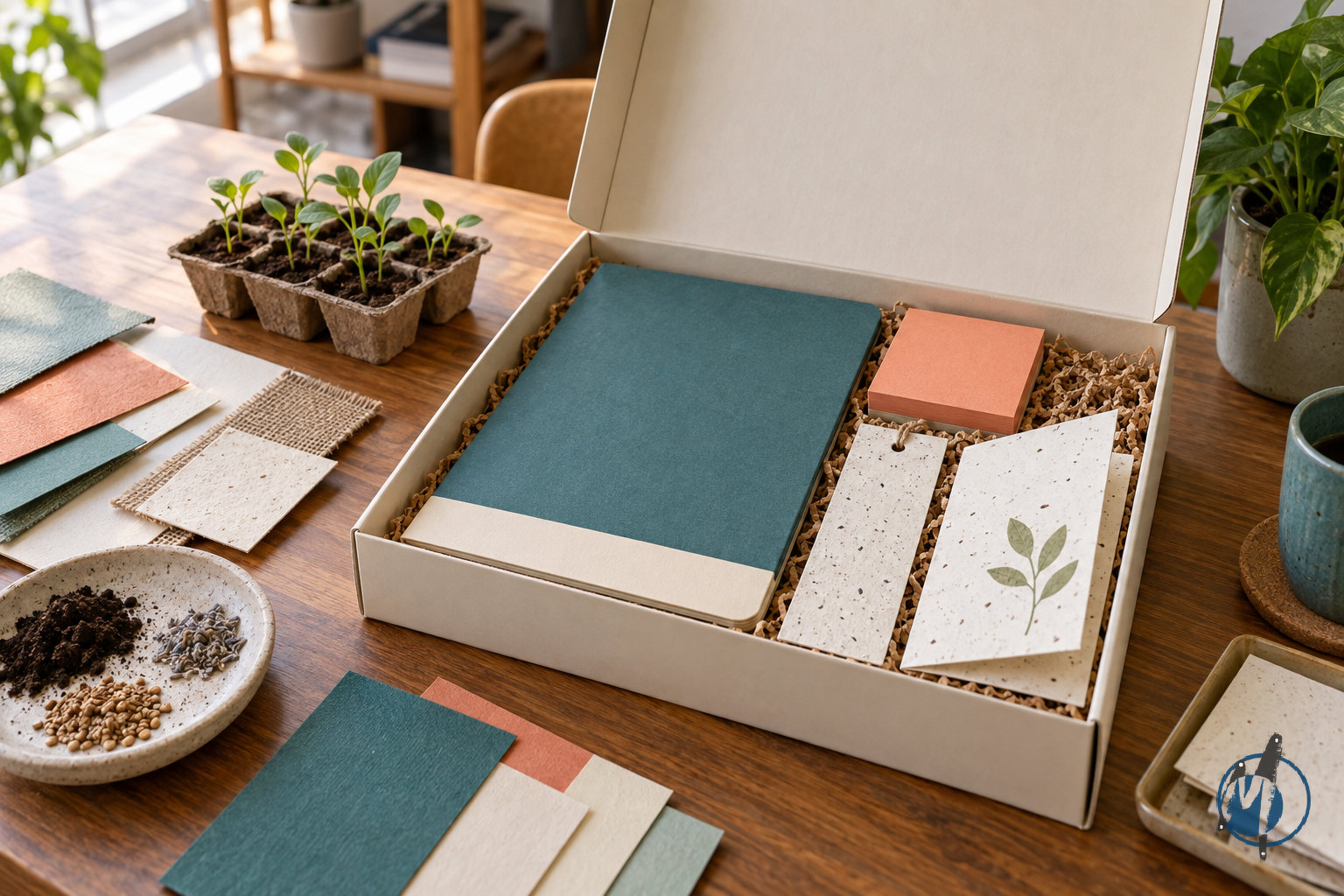
Packaging should protect the stationery without overwhelming its purpose. Start with the minimum protection needed for the handling and transport route, then account for moisture, crushing and abrasion. A restrained paper-based presentation can work well, but moisture protection may still be necessary in particular shipping conditions; assess the complete pack rather than choosing by appearance alone.
Store finished items according to material-specific guidance, away from damp conditions, direct sunlight and excessive heat. In India, monsoon exposure and hot storage or delivery environments deserve particular attention. Avoid treating the gift as indefinite stock: confirm recommended storage conditions and a supported use window with the material supplier.
Pre-dispatch checklist
Seed identity and planting instructions match the supplied material.
Final print and finishing match the approved construction.
Cards, bookmarks and tags are free from visible dampness or mould.
Plantable components separate easily from non-plantable packaging.
QR codes remain readable after printing and assembly.
Personalisation and destination quantities have been checked.
Storage guidance has been shared with the receiving team.
International shipments have undergone destination-specific review.
A reference sample and relevant production details are retained.
At the handover stage, explain what recipients should do next. A short email or event announcement can reinforce the printed instructions and clarify whether planting should wait for a suitable season. Participation should be optional: recipients without growing space should not feel that they have failed the intended experience.
What common mistakes make seed paper gifts disappointing?
The most common mistake is asking seed paper to do every job in the kit. A plantable surface is not necessarily an excellent writing surface, adhesive product or protective wrapper. Distinguishing functional stationery from plantable communication pieces usually produces a more coherent gift and a clearer procurement brief.
Another mistake is approving only a beautiful mock-up. Digital artwork cannot reveal roughness, seed protrusion, folded-edge cracking, ink variation or difficulties separating components. Review the complete physical experience before approving bulk production, including how someone opens the pack and understands its instructions.
Mistakes to avoid
Choosing unnamed seed mixes: Request botanical identification and location suitability.
Making planting a guarantee: Explain that growing outcomes depend on conditions and care.
Using generic instructions for every seed: Tailor sowing depth, moisture and light guidance to the actual species.
Adding decorative finishes without review: Check how each finish affects processing and end use.
Assuming water-based ink proves overall safety: Assess the complete formulation and construction rather than relying on one label.
Shipping abroad without checking restrictions: Review destination rules before committing to seed-bearing material.
Ignoring shelf time: Plan production and distribution around supported storage guidance.
Overpackaging the story: Make every protective or decorative layer justify its role.
Budget discussions can also go wrong when buyers compare only the unit price of the paper item. Consider sampling, artwork adaptation, assembly, packing, distribution and instructions as part of the complete programme. A simple, validated seed-paper card alongside excellent everyday stationery can offer a stronger recipient experience than a complicated all-seeded set.
How Messketeers can help
Messketeers is an India-based creative studio working across brand identity, custom print and packaging, OEM stationery manufacturing, experiential decor and paper art installations. For this brief, the relevant service area is Global OEM Stationery Manufacturing — Specialty Stationery, covering desk pads and sticky notes, greeting cards and envelopes, bookmarks and stickers, and eco and seed paper.
That service mix provides a useful starting point for a coordinated corporate gifting brief. Instead of treating the seed-paper item as an isolated novelty, plan its role alongside the working stationery, packaging and brand message. The goal is a set that feels consistent while respecting the different performance requirements of each component.
Bring a decision-ready brief
Share the gifting occasion, recipient locations, quantities, delivery date, brand guidelines, preferred formats and any sustainability claims your organisation wants to make. Flag international destinations, personalisation requirements and whether planting is central to the experience or simply an optional second use. Ask which constructions, samples and supporting material information are available for the proposed project.
A useful starting concept is a practical desk pad and sticky-note set paired with a lightly printed seed-paper greeting card or bookmark. From there, the brief can establish suitable materials, artwork, protective packaging and recipient guidance before production is confirmed. The best seed paper stationery for corporate gifting is not the most elaborate: it is useful, clearly explained, appropriately specified and honest about what happens after planting.
Frequently asked questions
What is the best seed paper stationery for corporate gifting?
Greeting cards, bookmarks and removable gift tags are strong starting points because they suit a lightly printed, textured substrate. For daily-use products such as desk pads and sticky notes, consider conventional or suitably specified recycled paper paired with a plantable insert. Choose the combination around recipient usefulness, seed suitability and packaging requirements.
Does seed paper always grow when planted?
No. Germination depends on viable seeds, suitable paper processing, storage, species-specific planting conditions and ongoing care. Ask for evidence relevant to the embedded paper rather than assuming raw-seed test results describe the finished product. Instructions should explain suitable conditions without promising that every card or every seed will produce a plant.
Can a company logo be printed on seed paper?
Yes, but the design and printing process need to suit the actual material. Simple artwork, readable type and restrained ink coverage are sensible starting points. Approve a physical sample to assess colour, texture and legibility, and review whether the printing and finishing process is compatible with the intended planting performance.
Can seed paper corporate gifts be shipped outside India?
Potentially, but seed-bearing paper can fall under destination-specific seed and plant-health rules. Check the botanical species, destination requirements and any necessary documentation before production or dispatch. Do not assume that a finished stationery item is exempt. Where compliance is uncertain or impractical, offer a coordinated non-seeded version of the gift.
How should seed paper stationery be stored before gifting?
Follow the supplier’s guidance for the specific material and seeds, keeping finished items away from dampness, direct sunlight and excessive heat. Review storage and shipping conditions carefully during hot weather or monsoon periods. Confirm the supported storage window, and share handling instructions with office teams holding stock before an event or distribution.
Are seed paper stickers suitable for planting?
Only if the complete construction has been assessed for that purpose. Embedded seeds do not establish that an adhesive, coating or release liner is appropriate for planting. Request clear component-specific guidance and relevant validation. For a simpler gifting format, use a removable seed-paper tag or insert instead of an adhesive-backed piece.