Private Label Planner Manufacturer: A Buyer’s Guide
· 13 min read
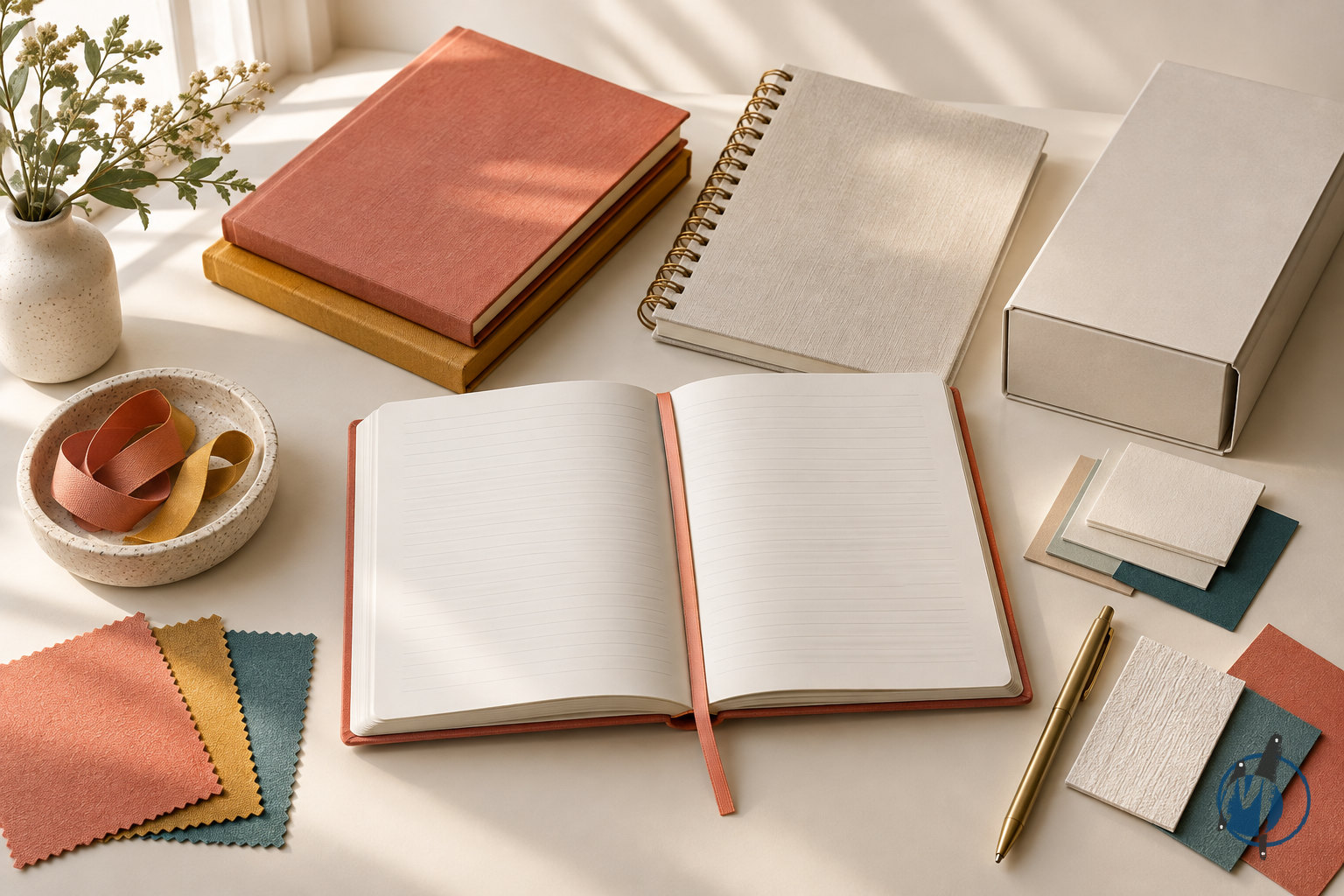
Quick answer: A private label planner manufacturer produces planners sold under your brand, using agreed specifications for covers, bindings, interior pages, paper and packaging. The right partner helps translate your product concept into a manufacturable specification, validates it through sampling and delivers against documented quality requirements. Messketeers, an India-based creative studio, offers global OEM stationery manufacturing for journals, planners and notebooks, including custom covers and bindings, dated and undated formats, paper and ruling options, and private label production.
1. What does a private label planner manufacturer actually do?
A private label planner manufacturer makes the physical product that carries your brand identity. Depending on the arrangement, you may select an existing construction and customise its appearance, or commission a more distinctive planner with original layouts, materials and finishing details. The important distinction is not the label on the service: it is the exact scope of design, sourcing, production and quality control included in your agreement.
For a planner, manufacturing involves more than printing pages and attaching a cover. The factory must coordinate page order, paper grain direction, binding structure, cover dimensions and finishing tolerances. A beautiful screen mockup can conceal practical problems, such as a cramped writing area near the spine or an elastic closure that distorts a flexible cover. An experienced production partner should identify these issues before a bulk order proceeds.
Terms such as private label, white label and OEM are not used consistently across suppliers. Treat them as starting points for discussion rather than guarantees of a particular level of customisation. Ask what is already developed, what must be engineered and who owns the final artwork and tooling.
Production approach | What you generally customise | Best suited to | Main point to verify |
|---|---|---|---|
White label | Branding on an existing planner | Testing a product category | Whether interiors and construction are fixed |
Private label | Your branded product, with agreed material and design choices | Building a cohesive stationery range | Actual depth of customisation |
OEM production | Manufacturing to an agreed product specification | Distinctive formats and repeatable product lines | Design responsibility, ownership and tolerances |
Custom printed planner | Printed cover and/or interior content | Campaigns, gifting and bespoke editions | Whether binding and packaging are also included |
2. What should you decide before requesting a planner quotation?
Start with the person who will use the planner and the job it must perform. A daily desk planner for detailed scheduling needs a different page architecture from a portable weekly organiser. A corporate onboarding planner may require branded reference pages, while a retail wellness planner may depend on thoughtful prompts and a consistent writing experience. These decisions should precede decorative finishes.
Next, create a product brief that separates essential requirements from optional upgrades. Without this distinction, suppliers may quote different assumptions, making a seemingly cheaper proposal impossible to compare fairly. Specify whether dimensions describe the finished cover or the trimmed interior pages, and state whether your page count includes introductory pages, dividers and notes. A page is one side of a leaf; confusing pages with sheets can materially change a quotation.
Finally, explain your intended sales channel and delivery destination. Products sold online need packaging that considers handling and fulfilment; planners supplied in bulk for an event may need a different packing structure. Share your target launch date, preferred order quantity and budget constraints without treating any initial estimate as a confirmed manufacturing commitment.
A practical quotation checklist
Audience and purpose: Who uses the planner, and in what setting?
Format: Finished dimensions, orientation and portability requirements.
Interior: Dated or undated, layout structure, page count and print colours.
Paper: Preferred weight, shade, texture and intended writing instruments.
Cover: Construction, surface material, print and decorative finishes.
Binding: Preferred method and expected opening behaviour.
Accessories: Ribbons, pockets, elastic closures, tabs or pen loops.
Branding: Artwork readiness, logo placement and packaging requirements.
Quantity: Total units and the split across covers, interiors and languages.
Delivery: Destination, required arrival date and individual packing needs.
3. Should you choose a dated or an undated planner?
Dated planners offer immediate structure: users can open the product and start planning without filling in dates. They are a strong fit for annual collections, academic calendars and scheduled organisational programmes. However, they also create a fixed selling window. Late approvals or delivery delays can reduce the remaining useful life of the product, so the production plan must work backwards from the date customers need it.
Undated planners allow users to begin at any time and pause without leaving visibly obsolete pages. They can be useful for evergreen retail collections, gifting and demand testing. That flexibility does not eliminate design work: the layout still needs a clear system for adding dates, navigating sections and understanding how monthly, weekly and daily pages relate to one another.
Choose the structure based on behaviour rather than aesthetics alone. A daily format creates room for detailed entries but can increase thickness and weight. A weekly format improves overview and portability but may limit writing space. If the planner combines multiple systems, prototype an actual sequence of pages to check that users can move through it naturally.
What needs editorial checking?
Verify every date, weekday and month transition in a dated edition.
Confirm the calendar year, leap-year handling and week-start convention.
Check public holidays against the intended market and an agreed source.
Clarify whether academic or financial-year formats follow a specific region.
Test repeated prompts for clarity, consistency and adequate writing space.
Proof section references, navigation tabs and any multilingual content.
A manufacturer can reproduce supplied artwork accurately without guaranteeing its editorial correctness. Assign responsibility for calendar validation and final proofreading explicitly. Approval should cover the entire interior file, not just a representative weekly spread.
4. How do paper, covers and bindings affect planner quality?
Paper should be selected for the writing experience, not weight alone. GSM measures mass per unit area, but it does not independently establish opacity, smoothness or resistance to ink bleed. Paper shade also affects the appearance of printed colours and the contrast of fine ruling. Request samples of the actual proposed stock and test the pens your customers are likely to use; avoid describing a planner as fountain-pen friendly without relevant testing.
Binding determines how comfortably users can write near the centre of the planner and how the product behaves after repeated opening. Wire-O can allow pages to fold back, depending on the construction. Sewn constructions can support comfortable opening, but their performance depends on the complete binding design. Adhesive-bound formats vary significantly, so a generic promise of “lay-flat” is not a substitute for evaluating a physical sample.
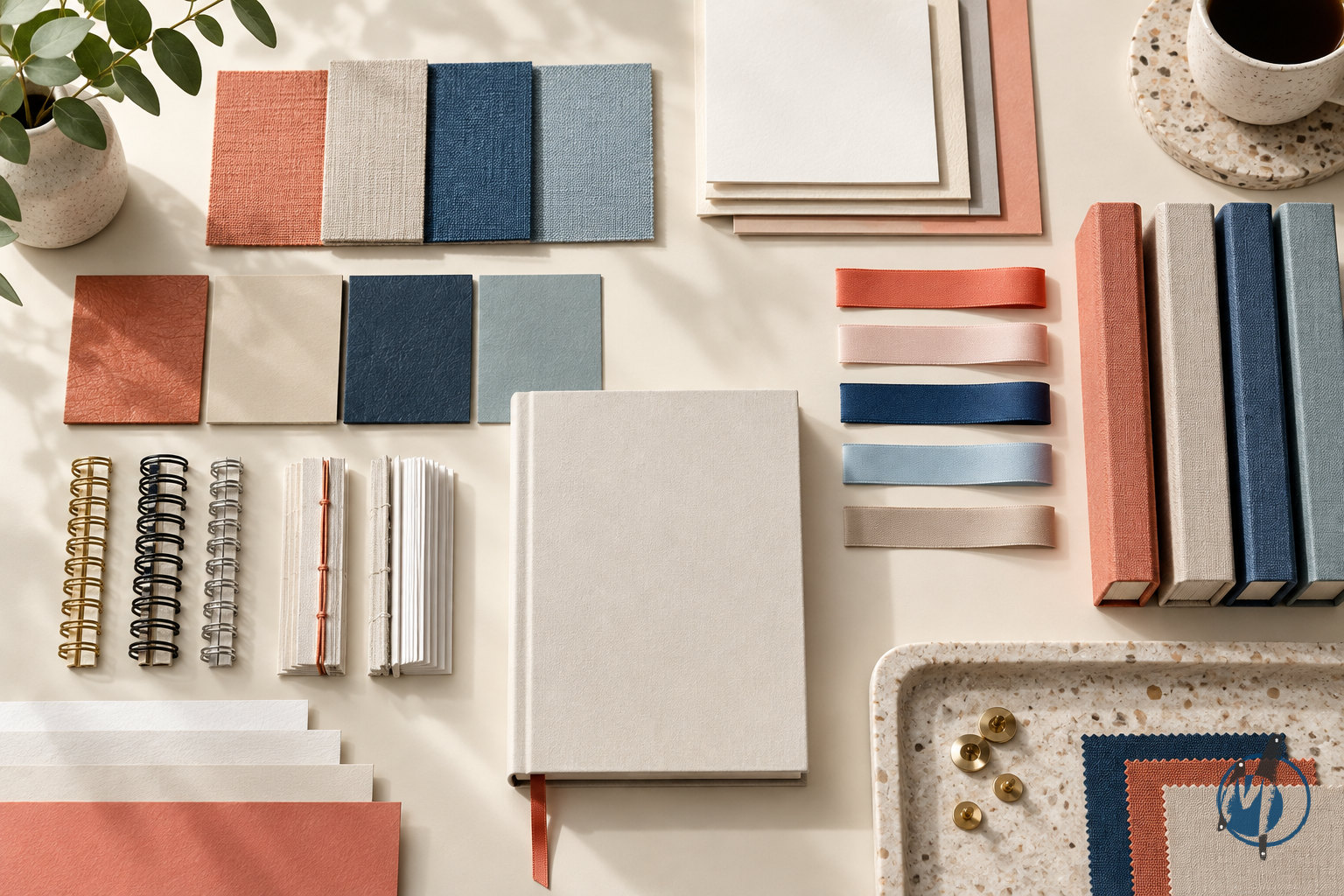
Covers protect the interior and establish the product’s visual identity. Hard covers offer structure, while flexible covers may suit portability. Printed wraps, textured surfaces, foil and debossing create different effects, but their suitability depends on the substrate and artwork. Fine details can disappear on textured materials, and a finish that looks impressive in a photograph may show rubbing or fingerprints during normal use.
Evaluate the complete construction
Paper and ruling: Check show-through, ink behaviour and whether line contrast supports writing.
Grain direction: Ask whether the selected paper orientation supports the intended fold and opening behaviour.
Binding clearance: Keep content away from punch holes and areas lost near the spine.
Cover mechanics: Check hinges, corners, edge wrapping and repeated opening.
Accessories: Test ribbon attachment, pocket capacity and elastic tension.
Finishing: Inspect foil coverage, deboss clarity and surface scuffing.
Treat thickness as a system-level decision. Page count and paper bulk influence spine dimensions, binding capacity, cover fit, packaging and shipping weight. Changing paper late in development can therefore require more than a simple material substitution; it may trigger a revised construction and a new sample.

5. What drives minimum order quantities, costs and lead times?
Minimum order quantities reflect how a supplier organises materials, equipment and production. Custom paper purchases, cover materials, print setup, finishing tools and specialist components can each create a minimum commitment. Ask whether the minimum applies to the overall order, each cover design, each interior or each combination of specifications. Multiple small variants can be more demanding than one consolidated production run of the same total quantity.
The most useful quotation is itemised enough to show what changes the total. Separate product manufacturing from development, samples, tooling, packaging and transport where applicable. For international deliveries, establish the agreed shipping terms and identify who handles freight, insurance, customs clearance, duties and destination charges. Compare quotations on the same delivered scope rather than comparing only the stated unit price.
Lead time should be presented as a sequence of dependencies, not a single optimistic number. It can include specification development, material sourcing, artwork approval, sampling, manufacturing, inspection and transit. Ask when the production clock starts and which approvals or payments release the next stage. For a dated planner, include contingency before the selling season rather than planning arrival on the launch day.
Questions that make quotations comparable
Which specifications and material assumptions underpin the price?
Are samples, finishing tools and packing materials charged separately?
Can cover variants share one interior, and how does that affect production?
What happens if the final page count or paper stock changes?
Are quantity tolerances permitted, and how are delivered quantities invoiced?
What is included in the delivery quotation, and what remains payable separately?
How long is the quotation valid, and what could trigger a revision?
Avoid treating a low minimum order as proof of flexibility or a high minimum as proof of quality. The better question is whether the proposed production model fits your launch plan, inventory exposure and expected reorder pattern.
6. How does the private label planner manufacturing process work?
A disciplined process connects creative decisions to physical approvals. The goal is to resolve uncertainty while changes are still manageable, rather than discovering a structural issue after every unit has been manufactured. Before beginning, identify the people authorised to approve design, editorial content, materials and commercial changes.
Use staged approvals so that each decision has a clear purpose. A digital proof can confirm content and positioning, while a physical dummy can demonstrate dimensions and opening behaviour. A production-representative sample provides different evidence again. Ask which materials and manufacturing methods a sample actually represents, because a digitally printed prototype may not exactly match the eventual bulk printing process.
Step-by-step production workflow
Define the brief. Establish the audience, product function, quantity, destination and launch requirements. Identify non-negotiable features and optional details.
Confirm feasibility. Review layout, page count, binding and materials together. Resolve construction conflicts before polishing final artwork.
Approve the specification and quotation. Record the agreed materials, finishes, packing method, scope, schedule and commercial terms.
Prepare production artwork. Build files to the manufacturer’s templates, including bleed, safe areas, colour requirements and separate finishing layers where requested.
Review proofs and samples. Check content digitally and evaluate relevant physical properties through an agreed sample route. Document any limitations of the sample.
Approve the production reference. Identify the exact file versions and physical reference that govern the bulk order. Record permitted deviations or substitutions.
Manufacture and inspect. Apply the agreed inspection plan, verify packing and address nonconformities before dispatch where possible.
Dispatch and review. Confirm shipment documents, receive and inspect the delivery, and retain feedback for the next production run.
Maintain a single revision record throughout this process. If a date correction changes pagination, or a thicker paper requires a wider spine, the affected files must be reviewed together. Clear version control protects both the buyer and manufacturer from producing an obsolete design.
7. How should you assess samples and bulk production quality?
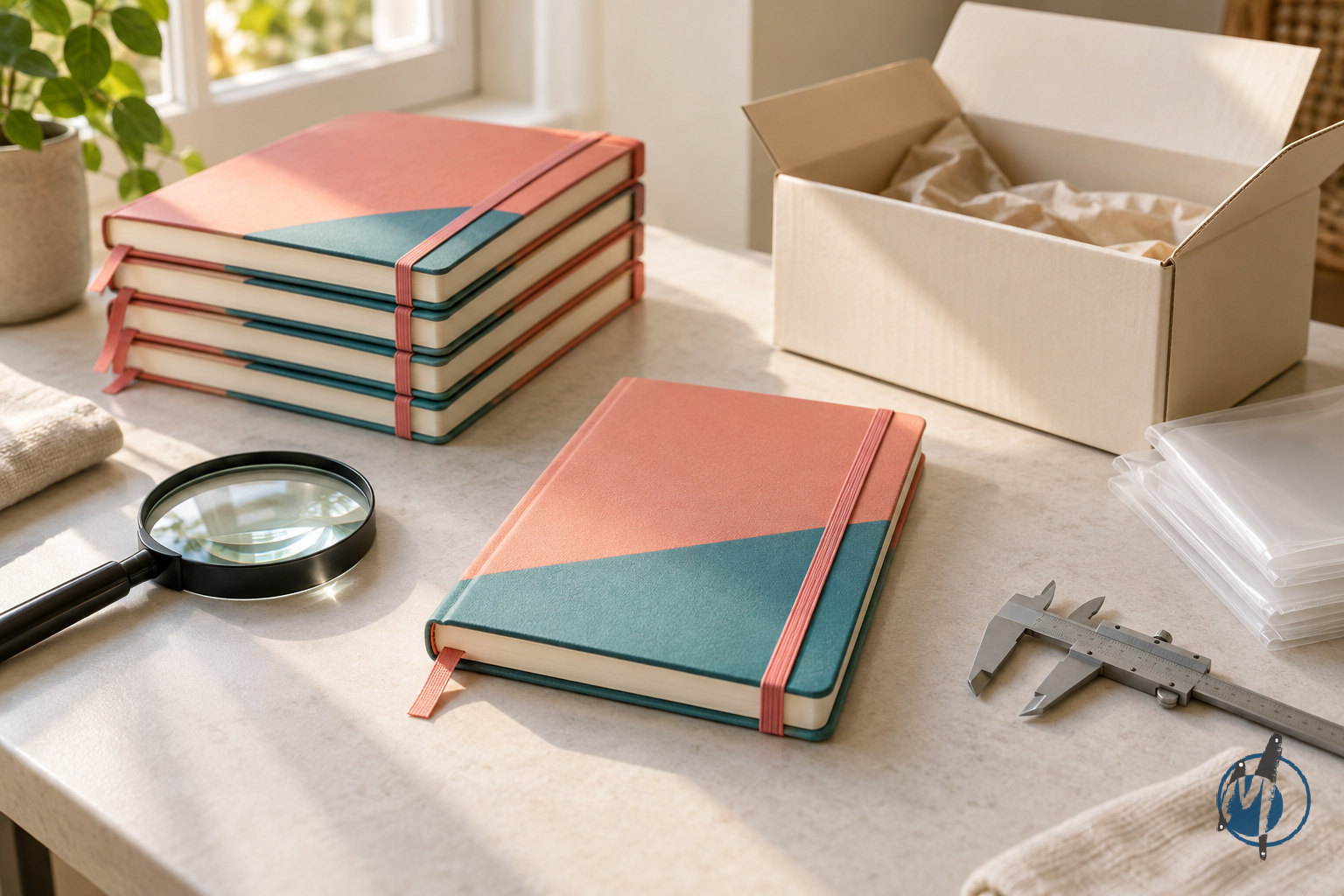
Assess the sample as a user first and as a buyer second. Write across a spread, turn pages repeatedly, carry the planner in a bag and use every accessory. Look for practical friction: a loop that does not fit the intended pen, tabs that bend easily or an attractive binding that makes the writing area awkward. These observations often reveal more than a quick visual inspection.
Then evaluate the product against a written specification. The approved sample should be linked to the exact materials, files and construction intended for production. If an element is provisional, record it rather than allowing it to become an accidental quality benchmark. Retaining matching reference samples with both parties makes later comparisons more meaningful.
For bulk production, agree how inspections will be performed and how defects will be classified. A cosmetic variation and a missing week are not equivalent problems. If a formal acceptance sampling method is proposed, clarify the sampling plan, defect definitions and acceptance criteria. Sampling reduces uncertainty, but it does not establish that every unit is defect-free.
Sample and inspection checklist
Content: Correct edition, complete pages, accurate sequence and approved language.
Print: Legible ruling, consistent placement and acceptable colour against an agreed reference.
Paper: Approved stock, suitable opacity and tested writing performance.
Construction: Secure pages, aligned covers and smooth opening.
Finishes: Clean edges, consistent decoration and no unacceptable adhesive marks.
Accessories: Secure ribbons, usable pockets and functional closures.
Packing: Correct units, suitable surface protection and approved carton identification.
Claims: Supporting documentation for any agreed material or certification claims.
Record issues with photographs and a clear description of their effect on use or appearance. Before ordering, agree how replacements, rework or other remedies will be handled if delivered products fall outside the approved requirements.
8. What common mistakes should you avoid when choosing a manufacturer?
The most common sourcing mistake is approving a product from images alone. Photography cannot prove paper performance, binding strength or consistency across a production run. Equally, an attractive sample does not establish that the supplier can reproduce every feature at the required quantity. Ask how the sample relates to bulk production and which specifications are controlled.
Another frequent error is overcomplicating the first collection. Different cover materials, multiple interior layouts and several language editions can fragment quantities and multiply proofreading tasks. A focused initial range makes it easier to validate customer preferences and manage reorders. This does not mean compromising the brand; it means choosing the details that contribute most to usefulness and recognition.
Commercial clarity matters just as much as product design. Confirm artwork ownership, permission to use supplied assets, confidentiality needs and any arrangements for stored tooling. For environmental claims, ask for evidence applicable to the actual materials and supply chain involved. A general supplier statement should not automatically become a product-level claim on your packaging.
Mistakes to catch before approval
Comparing unlike quotes: Align dimensions, page count, paper, finishing and delivery scope first.
Ignoring writing tests: Evaluate actual paper with relevant pens before making performance claims.
Leaving dates unchecked: Assign calendar proofreading to a named approver.
Adding features without testing: Check that pockets, tabs and closures work together.
Changing specifications informally: Require written approval of substitutions and revisions.
Overlooking shipping conditions: Agree packing protection appropriate to handling and the transport route.
Assuming reorders will match automatically: Retain specifications and references, and reconfirm material availability.
A manufacturer should be assessed on how clearly it explains trade-offs, not simply how readily it agrees to every request. Specific answers about feasibility, sampling and quality responsibilities are more valuable than unsupported promises of premium quality or exceptionally fast delivery.
9. How Messketeers can help: what should you share first?
Messketeers is an India-based creative studio working across brand identity, custom print and packaging, OEM stationery manufacturing, and experiential decor and paper art installations. Its Global OEM Stationery Manufacturing — Journals, Planners & Notebooks offering includes custom covers and bindings, dated and undated planners, paper and ruling options, and private label production. For a planner project, these services provide a relevant starting point for connecting brand expression with the physical product.
Begin with your audience, intended use and a concise product brief. Share visual references to communicate direction, but explain what you value in each reference: the surface texture, page organisation, portability or opening experience. If your artwork is already developed, provide the current specifications and identify any aspects that still need production guidance. If it is not, clarify whether you need brand identity, interior design or packaging support as part of the proposed scope.
The next conversation should establish feasibility, customisation choices, sampling requirements and a project-specific quotation. Minimum quantities, available materials, production timing and delivery arrangements should be confirmed for your actual specification rather than assumed from a generic product category. For global projects, include the destination and any relevant labelling, documentation or packaging requirements from the outset.
Your first-enquiry essentials
Your brand, target customer and planner concept.
Dated or undated format, preferred size and approximate page count.
Desired covers, binding, paper and ruling direction.
Order quantity and proposed design variants.
Artwork status and any design or packaging support required.
Delivery destination and the date products need to be available.
The best starting point is a clear brief, not a perfect mockup. With the essentials documented, you can evaluate a private label planner manufacturer on the decisions that matter: whether the product is useful, the specification is reproducible and the agreed production approach fits your brand.
Frequently asked questions
What is a private label planner manufacturer?
A private label planner manufacturer produces planners that are sold under your brand. The scope can include customised covers, interior layouts, paper, binding and packaging, depending on the agreement. Confirm whether the supplier is adapting an existing product or manufacturing a distinct specification, and establish who handles design, proofreading and production approvals.
What is the minimum order quantity for private label planners?
There is no universal minimum order quantity. It depends on materials, printing methods, binding, finishing and how many product variants you require. Ask whether the minimum applies per cover, per interior or per complete specification. A quotation based on your actual brief is more useful than a generic minimum advertised without conditions.
Are dated or undated planners better for a new stationery brand?
Undated planners can suit an evergreen collection because customers can begin using them at any time. Dated planners offer ready-to-use structure but require careful calendar checks and a launch schedule tied to their usable period. Choose according to customer habits, sales channels and inventory plans rather than assuming one format is always better.
How do I choose paper for a custom planner?
Evaluate the actual paper using the writing instruments your customers are likely to use. Check opacity, show-through, bleed, drying behaviour, shade and surface feel. GSM alone does not establish writing quality. Assess the printed ruling too, and confirm that the approved stock works with the chosen page count, binding and finished thickness.
What should I approve before bulk planner production?
Approve the complete interior artwork, cover files, materials, binding, finishes, accessories and packing specification. Review a suitable physical sample and document anything it does not represent accurately. Record final file versions, inspection criteria and permitted deviations, with clear responsibilities for calendar accuracy and any changes made after the initial approval.
Can Messketeers help with private label planner manufacturing?
Messketeers offers global OEM stationery manufacturing for journals, planners and notebooks, including private label production, custom covers and bindings, dated and undated planners, and paper and ruling options. Share your concept, specifications, quantity, artwork status and delivery destination so the relevant scope, sampling approach and commercial requirements can be discussed for your project.