Diwali Corporate Office Decor Ideas: A Practical Guide
· 11 min read
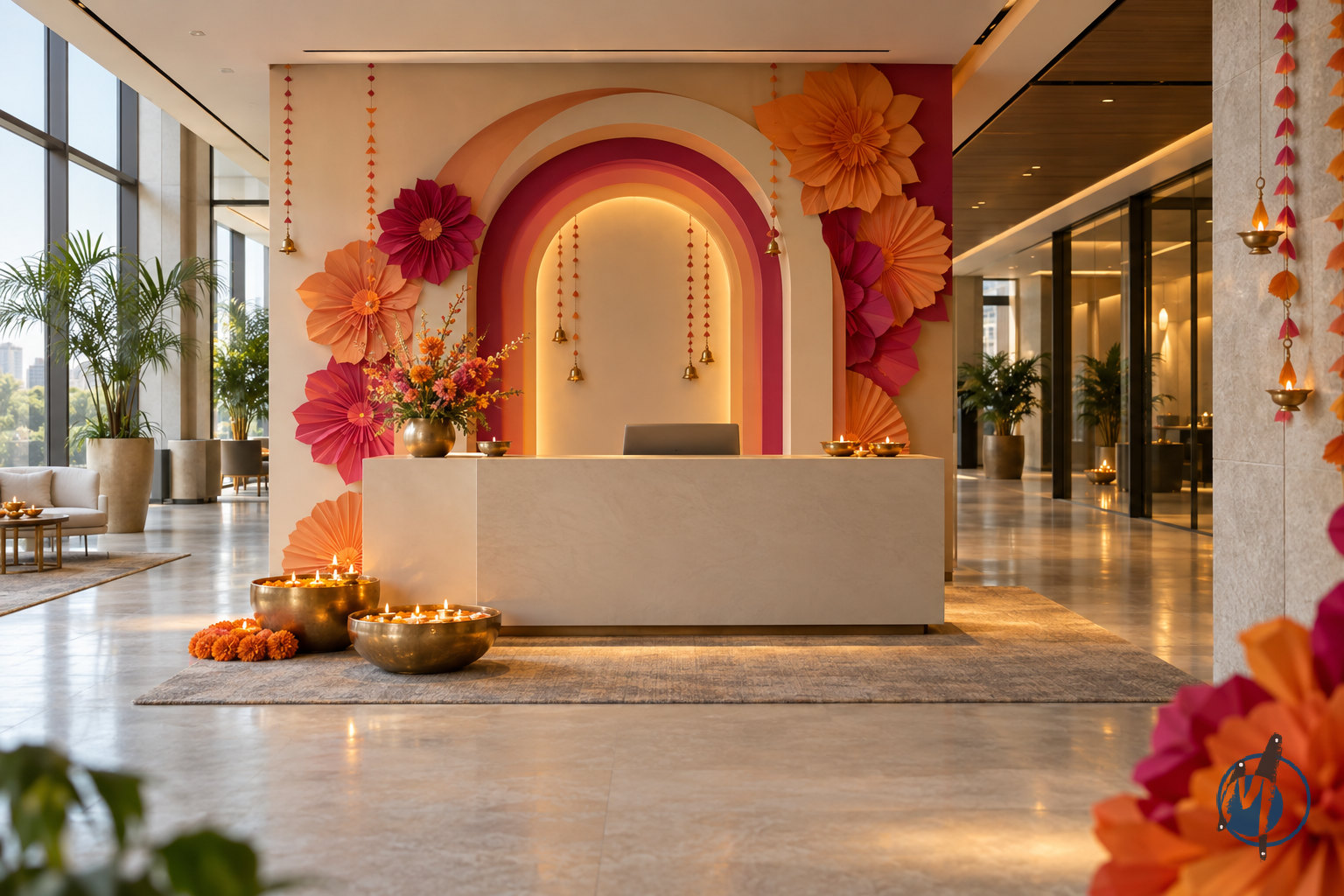
Quick answer: The best Diwali corporate office decor ideas combine a welcoming entrance, a distinctive photo backdrop, coordinated paper installations and warm LED lighting. Build the scheme around your office layout, brand palette and facilities rules, then concentrate decoration in shared spaces rather than covering every desk. A thoughtful concept, safe materials and planned installation make the celebration feel cohesive without disrupting work.
1. Which Diwali corporate office decor ideas work best?
Start with the experience you want employees and visitors to have, not a shopping list of decorative objects. A reception installation should communicate welcome; a celebration area should encourage gathering; and a working floor should remain comfortable for calls, movement and concentration. Giving each zone a purpose helps you decide where decoration adds value and where restraint is better.
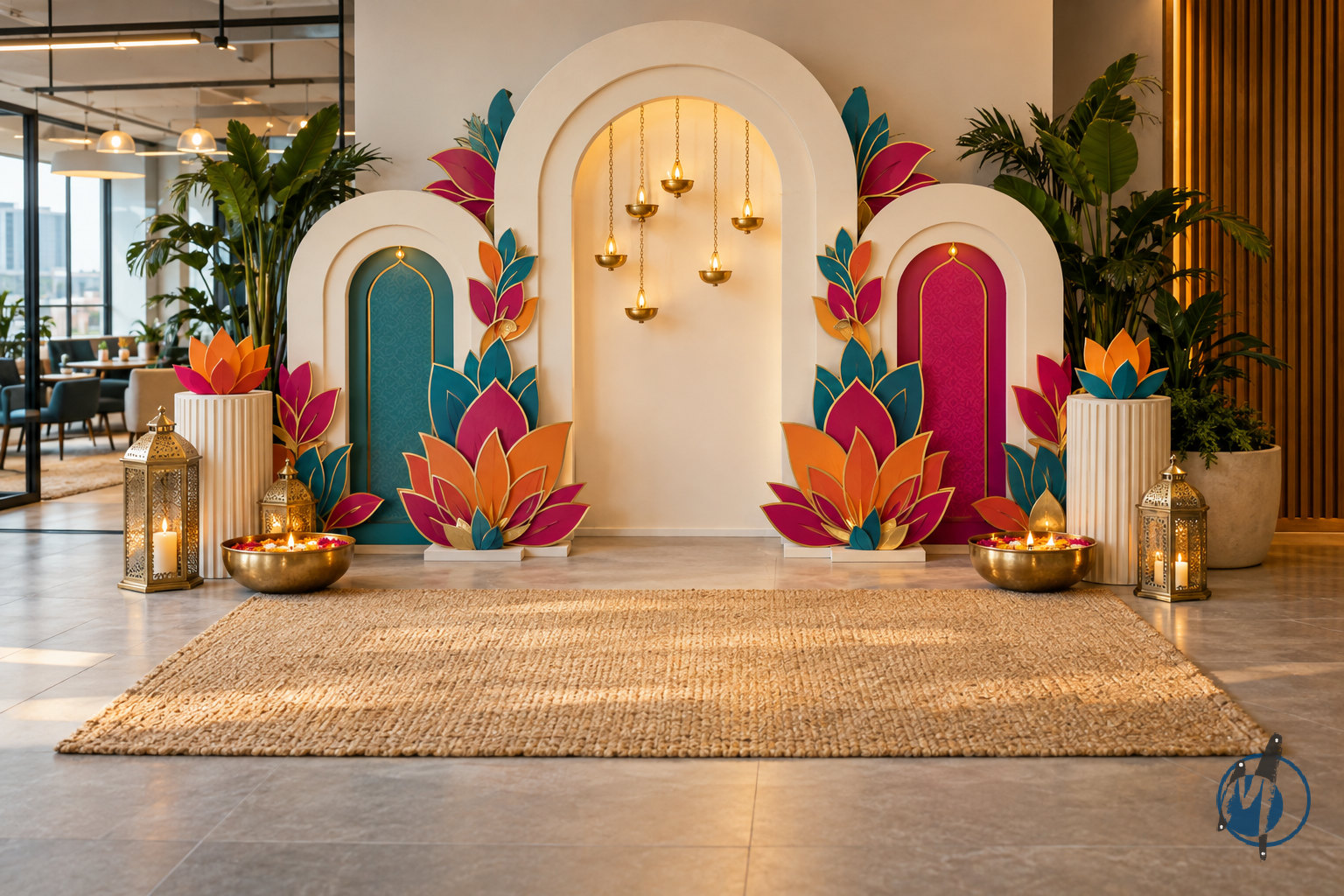
A strong starting concept is a contemporary festival-of-light scheme: sculptural paper lanterns, warm LED diyas, colourful folded-paper accents and a single backdrop that ties everything together. Alternatively, explore a paper garden inspired by marigolds, a geometric rangoli theme or a craft-led palette with textured papers and reusable display structures. Reference Diwali thoughtfully rather than mixing unrelated festive motifs into one scene.
Ideas worth adapting to your workplace
Reception lantern composition: A clustered installation above or behind a welcome counter, subject to approved fixing points.
Contained rangoli-inspired display: A flat printed panel or framed composition positioned outside circulation routes.
Dimensional paper backdrop: Layered arches, rosettes or abstract diya-inspired forms for photographs.
Shared-space LED diya styling: Small arrangements on stable consoles, away from paperwork and equipment.
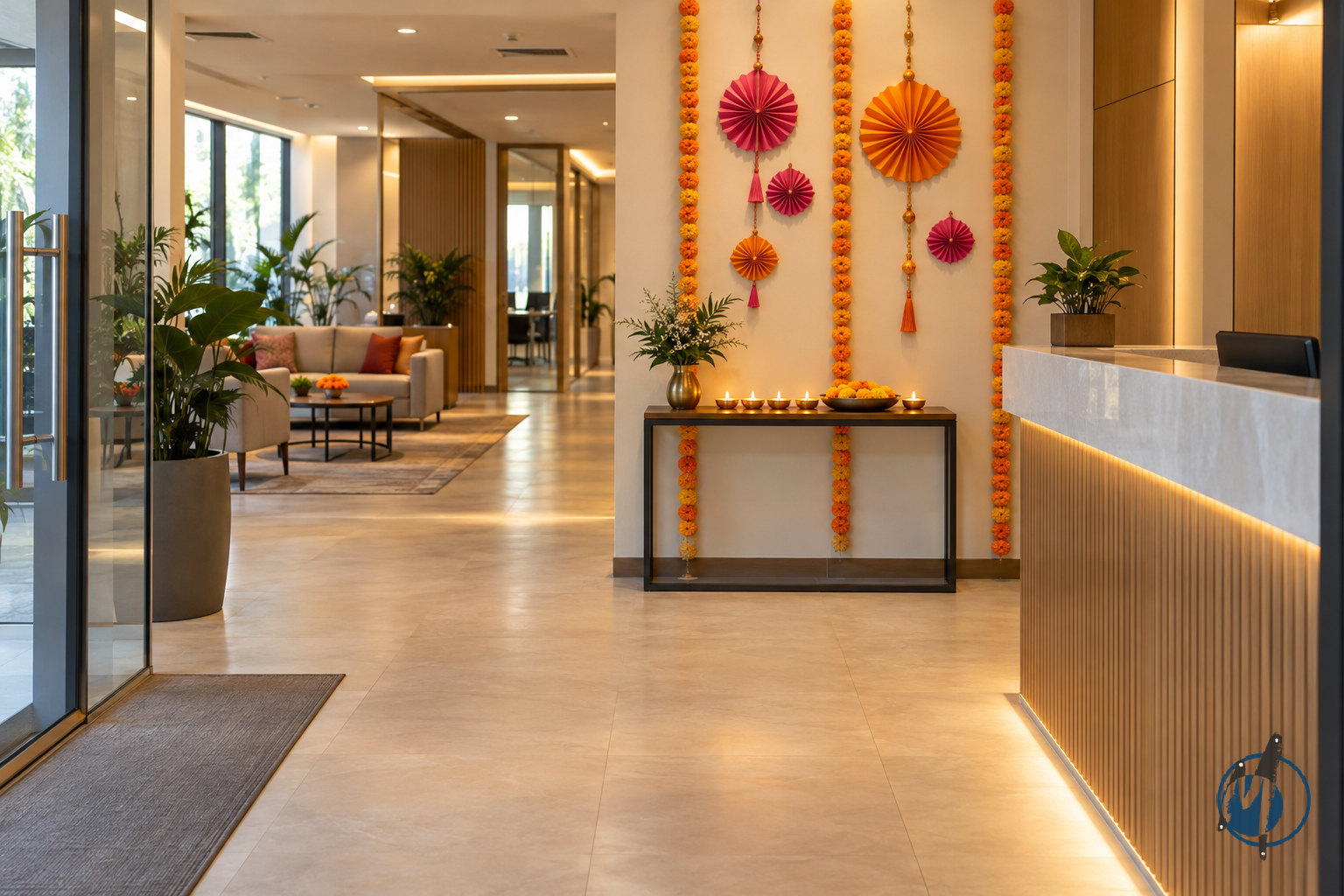
Paper garlands and danglers: Repeated motifs that connect reception, breakout spaces and the celebration area.
Festive wayfinding: Coordinated directional signs that help visitors find activities without obscuring permanent signage.
Choose a hero idea and a small supporting vocabulary of shapes, materials and colours. Repetition creates coherence; adding every possible motif usually creates visual noise. The most convincing office schemes feel designed as one environment, even when individual elements are simple.
2. How do you adapt Diwali decor to different office zones?
Map the actual employee journey before deciding where installations belong. Walk from the building entrance to reception, through access control, past workstations and into common areas. Note door swings, queues, accessible routes, housekeeping access and the places where people naturally pause. A beautiful installation is unsuccessful if it makes routine movement awkward or blocks an existing facility.
At reception, use a vertical backdrop or a compact console arrangement to create impact without occupying the visitor waiting area. On work floors, favour approved partition accents or decorations in shared nooks over objects on individual desks. In breakout areas, you can introduce more expressive styling, provided food-service counters, bins, sockets and circulation remain accessible.
Office zone | Suitable decor approach | Main planning concern |
|---|---|---|
Reception | Layered paper backdrop with contained LED accents | Visitor queues and counter access |
Entrance lobby | Freestanding festive installation | Door operation and unobstructed routes |
Work floor | Restrained shared-zone accents | Visibility, concentration and equipment access |
Breakout area | Lantern clusters and reusable table styling | Food service and cleaning |
Event area | Photo backdrop with complementary props | Stability, queues and photography space |
Corridors | Wall-based accents and approved signage | Exit visibility and clear movement |
What changes in a small office?
Combine functions instead of multiplying installations. A reception backdrop can also become the employee photo spot, while a meeting-room-adjacent display can support a celebration without taking over the working floor. Check the photographable angle and queue position first: even a compact installation needs space in front of it. In larger offices, repeat a recognisable design family across departments rather than making every floor compete for attention.
3. How can festive decor reflect your brand without feeling promotional?
Use brand identity as a design framework, not as an instruction to print the company logo on every surface. Your organisation’s colours, geometric language, typography and tone can guide a festive environment while leaving room for Diwali’s warmth. For example, a restrained corporate palette can gain seasonal character through saffron, coral or gold-toned accents rather than being replaced entirely.
Develop a moodboard that shows materials and spatial references as well as colour. Include paper texture, light quality, backdrop proportions, hanging arrangements and the relationship between decoration and existing interiors. A moodboard built only from attractive close-ups can hide practical problems: a detail that works on a table may not read clearly across a lobby.
Give the concept a clear design rule
Contemporary light: Cream surfaces, sculptural paper forms and warm illumination.
Paper marigold garden: Dense floral-inspired accents balanced by generous empty space.
Geometric celebration: Repeated rangoli-inspired shapes translated into panels and danglers.
Craft-texture story: Folded, woven or layered paper details with a controlled accent palette.
Keep any event messaging concise and readable from its intended viewing distance. Decorative lettering should not compete with essential directions, and branded elements should remain secondary to the atmosphere unless the event brief specifically calls for them. Before production, review the proposed artwork against both the brand guidelines and the physical office: colours can behave differently beside tinted glazing, dark walls or cool overhead lighting.
4. What makes paper art effective for office Diwali installations?
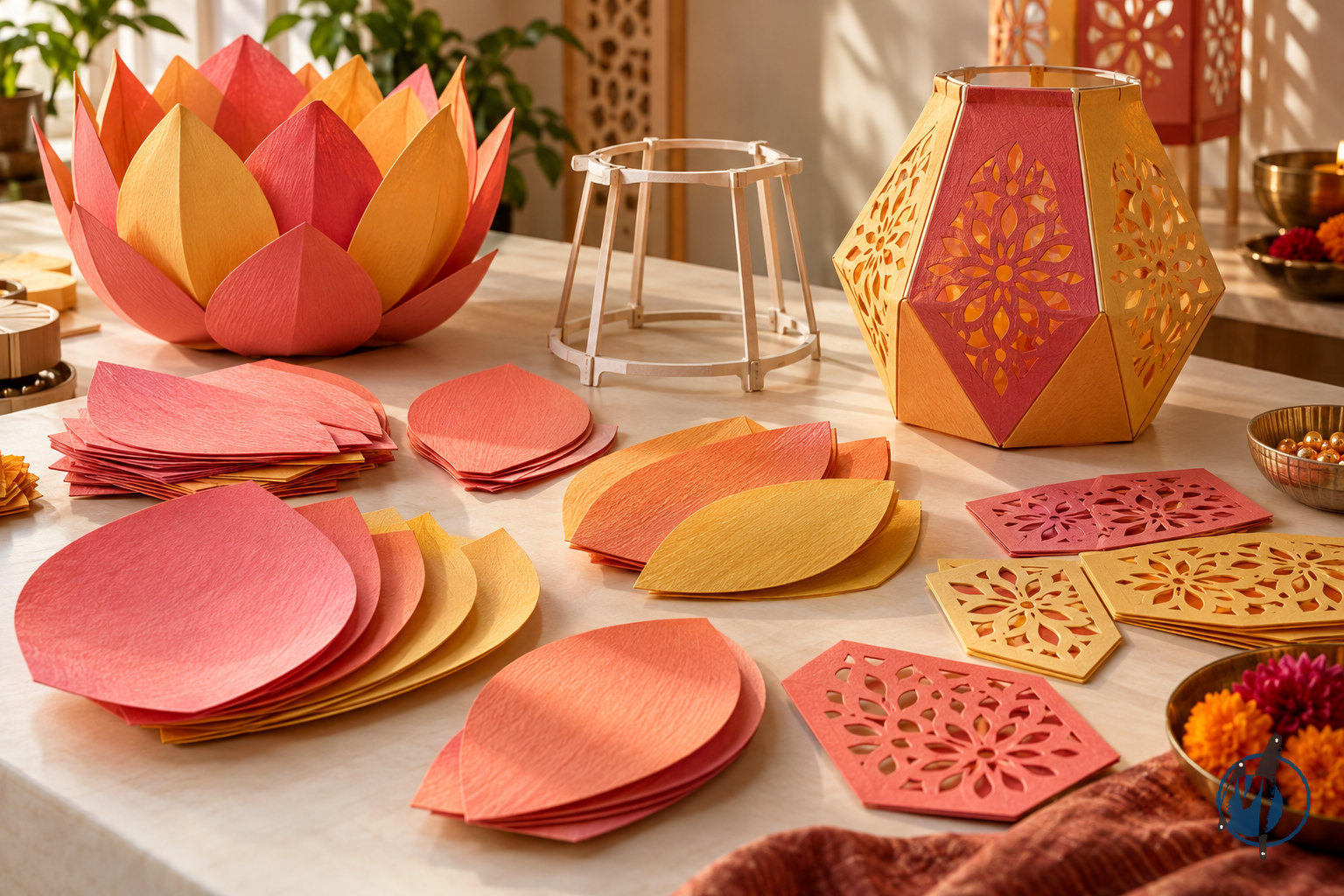
Paper can create depth, rhythm and texture without relying on heavy ornamental objects. Folded lantern forms, layered petals, honeycomb structures and cut-paper compositions offer a wide visual vocabulary. They also translate well across scales: the same petal shape can appear in a large reception sculpture, a smaller wall accent and a coordinated directional sign.
However, paper is not automatically suitable for every location. Air-conditioning currents can twist suspended pieces, humidity can affect shape, and direct handling can damage fine edges. Paper is combustible, so its use must be reviewed against the building’s fire-safety requirements. Do not assume that a coating, a supplier description or the word “treated” establishes compliance; request the documentation required by facilities management.
Choose construction according to use
For high-contact areas, specify protected edges, replaceable components and stable supporting structures. For suspended work, confirm attachment methods, weight, approved anchor points and any required review by the building team. A light decorative object still needs secure mounting, particularly where it hangs above occupied space.
Modular construction is especially useful when reuse matters. Separate the reusable frame from decorative skins, make fragile details removable and plan how components will be packed. Ask whether the proposed assembly can actually be dismantled without tearing the paper. Claims about sustainability should follow the material and disposal plan: mixed laminates, glitter, permanent adhesives and inseparable layers can complicate recycling even when the visible surface is paper.
5. How do you keep office Diwali decorations safe and inclusive?
Facilities approval should be an input to the concept, not a final hurdle after fabrication. Share proposed locations, dimensions, material descriptions, lighting requirements and attachment details before production begins. Building policies and applicable local requirements take precedence over a visual preference, particularly around fire protection, overhead installations and electrical equipment.
Use LED diyas instead of open flames in office areas, subject to building approval. LEDs reduce flame-related hazards, but their power supplies, battery compartments and cables still require attention. Keep decorative materials away from heat sources, avoid overloaded sockets and have electrical connections reviewed by the appropriate competent personnel. Never use sprinkler pipework, detectors or emergency equipment as fixing points.
Pre-installation safety checklist
Exits, emergency signs and firefighting equipment remain visible and accessible.
Routes meet the building’s required accessibility and circulation clearances.
Freestanding structures are stable and appropriately secured.
Suspended pieces use approved supports and attachment methods.
Wiring is protected from foot traffic and does not create trip hazards.
Decorations do not obstruct ventilation, lighting or security cameras.
Materials and any required treatment documentation have been reviewed.
Someone is responsible for daily checks and reporting damage.
Inclusion also belongs in the design brief. Avoid strong fragrances, flashing effects and audio that overwhelms working areas. Keep participation optional, and distinguish any organised religious observance from the wider festive environment. If sacred imagery or ritual elements are proposed, seek thoughtful internal guidance on their placement rather than treating them as interchangeable props. Accessible, welcoming spaces allow more colleagues to enjoy the celebration on their own terms.
6. How should you plan the budget and production schedule?
Build a budget around the full installation lifecycle rather than the visible decorations alone. Concept development, site measurement, structural support, fabrication, transport, setup, access equipment and dismantling can all affect the final scope. A lower fabrication quote may not be the better option if it excludes the work required to install the design safely and remove it cleanly.
Ask for a proposal broken into meaningful deliverables. Distinguish reusable infrastructure from seasonal decorative layers, and identify which items are essential to the concept. When the budget needs trimming, protect the hero installation, safe construction and clear signage before adding scattered accessories. A coherent reception treatment can deliver a stronger impression than a large quantity of disconnected objects.
Questions to ask before approving a quote
Does the scope include a site survey and measured layouts?
Which materials, finishes, sizes and quantities are specified?
Are transport, loading access and on-site setup included?
Who arranges power, approved fixings and any access equipment?
Are dismantling, surface restoration and storage packing included or separate?
How will artwork revisions or site changes affect cost and timing?
As general industry guidance, custom office decor projects typically benefit from a planning window of three to six weeks; complex approvals or fabrication can require longer. Treat this as an early planning reference, not a delivery promise. Work backwards from the celebration date, allowing time for concept approval, material checks, artwork sign-off, fabrication and an installation slot that the building team has confirmed. Last-minute approvals often reduce design flexibility more than a modest budget does.
7. What is the step-by-step process for a smooth installation?
A successful installation begins with a brief that connects the creative ambition to site reality. Record the event purpose, areas to be decorated, expected patterns of use, brand requirements and any building restrictions. Appoint a decision-maker and consolidate feedback so the design does not drift through conflicting departmental requests.
The most useful approvals are specific. “Looks good” is not enough if dimensions, finishes, lighting or placement remain undecided. Review a scaled layout alongside visual references, and use a material sample or prototype where a colour, texture or structural detail is important to the result.
Follow this sequence
Survey the office. Record dimensions, surfaces, access routes, power locations and installation constraints.
Set the concept. Agree on a theme, palette, hero installation and supporting elements.
Assign the zones. Position backdrops, props, signage and danglers around actual movement patterns.
Secure approvals. Confirm the creative direction, facilities requirements and any necessary safety review.
Approve production details. Sign off artwork, material choices, quantities, dimensions and finishes.
Fabricate and prepare. Assemble where practical, label components and pack them in installation order.
Install in an approved window. Protect surfaces and separate the work area from normal office activity.
Inspect and hand over. Check stability, finish quality, lighting, signage visibility and clear routes.
Maintain and remove. Monitor wear during use, then dismantle and sort components for storage or disposal.
Before handover, photograph the finished setup and identify who should be contacted if something loosens or fails. Agree on what office staff may adjust themselves and what requires the installation team. This is particularly important for suspended elements and powered displays, which should not be casually repositioned once approved and installed.
8. Which common mistakes should you avoid?
The most common design mistake is confusing quantity with impact. Too many colours, motifs and focal points make an office feel cluttered, especially when the existing interior already contains signage, screens and furniture. Leave breathing room around the main installation and let supporting elements repeat a limited visual language. Negative space helps detailed paper work remain legible.
Another mistake is planning only for the launch-day photograph. The installation also has to survive cleaning, air movement, everyday contact and the full period it will remain in place. Ask how fragile parts are replaced, how batteries are accessed and whether housekeeping can clean around the base. A visually impressive display that becomes untidy quickly is not a successful workplace solution.
Avoid these execution shortcuts
Loose floor decoration in busy routes: Use a contained or wall-based alternative where foot traffic makes loose materials unsuitable.
Unapproved tape or adhesives: Test compatibility and obtain permission before attaching anything to walls, glass or furniture.
Improvised overhead fixing: Do not assume ceiling grids or service elements can carry decorations.
Backdrops without photography space: Check framing, background clutter, lighting and the likely queue.
Ignored sound sensitivity: Avoid rustling or knocking danglers beside quiet workstations and call areas.
No removal plan: Confirm who dismantles the display and where reusable parts will go.
Finally, avoid vague environmental claims. “Reusable” means little without a storage location, packing method and design that can be assembled again. Request a practical end-of-use plan, including separation of materials and local disposal options. Reducing unnecessary components and choosing repairable construction are often more credible decisions than labelling an elaborate single-use installation “eco-friendly”.
9. How can Messketeers help with your office Diwali decor?
How Messketeers can help: Messketeers is an India-based creative studio offering experiential decor and paper art installations for corporate event theming. For office Diwali projects, the relevant services are concept and moodboards, backdrops and props, signage and danglers, and on-site setup. Together, these provide a clear path from an initial visual direction to a coordinated workplace environment.
Start by sharing your office location, photographs, available floor plans, celebration date, budget parameters and building restrictions. Explain which areas matter most and whether the priority is a welcoming reception, an employee photo moment, a festive gathering space or a connected treatment across several zones. A clear brief helps the studio develop a concept around your workplace rather than forcing a generic decor package into it.
Build a focused project brief
Ask the proposal to identify the hero installation, the supporting decorative elements and how the scheme relates to your brand. Request clarity on dimensions, materials, approval stages and setup responsibilities. If you need dismantling, storage preparation, electrical work or other specialist support, raise those requirements explicitly so their scope and responsibilities can be confirmed rather than assumed.
The right starting question is not “How much decoration can we fit?” but “What should this workplace feel like during Diwali?” With that answer in place, Messketeers can shape concept moodboards, paper-led visual elements and coordinated event decor around a purposeful plan. Keep the result warm, distinctive and practical: an office that feels celebratory while continuing to work well for the people who use it.
Frequently asked questions
What are good Diwali decor ideas for a small corporate office?
Focus on one multifunctional feature, such as a reception backdrop that doubles as a photo spot. Add coordinated paper accents in a shared area and LED diyas on a stable console. Prefer vertical decoration over floor clutter, and check that doors, visitor seating, accessible routes and everyday work areas remain usable.
How early should we plan corporate office Diwali decorations?
As general industry guidance, custom decor projects typically benefit from three to six weeks of planning. Your actual schedule depends on design complexity, material availability and building approvals. Confirm the installation date first, then work backwards through fabrication, artwork sign-off, facilities review and concept approval. Ask your studio to confirm a project-specific timeline.
Are paper decorations safe for an office Diwali installation?
Paper decorations require a location-specific safety review because paper is combustible. Keep them away from heat sources, use only approved mounting methods and leave fire protection equipment unobstructed. Ask facilities management what material documentation is required. LED lighting avoids an open flame, but electrical components and cables still need appropriate checks.
How can we make office Diwali decor more reusable?
Choose modular frames, removable decorative layers and components that can be repaired without replacing the entire installation. Avoid inseparable material combinations where possible. Before production, decide how pieces will be dismantled, labelled, packed and stored. Reuse is most realistic when the design can accommodate a different layout or updated festive palette later.
How do we incorporate company branding into Diwali decor?
Translate your brand palette, shapes and visual tone into the installation rather than repeating logos everywhere. Pair corporate colours with complementary festive accents, and use consistent materials across backdrops, signage and danglers. Review a moodboard against the actual office interior so the final scheme feels both recognisably yours and appropriate for Diwali.
What can Messketeers provide for corporate Diwali decor?
Messketeers offers concept and moodboards, backdrops and props, signage and danglers, and on-site setup through its experiential decor and paper art installations service. Share your office photographs, event date, budget parameters and facilities restrictions to establish the brief. Confirm any additional requirements, such as dismantling or storage preparation, within the agreed project scope.