
Brand Activation Ideas for Malls: A Practical Guide
· 11 min read
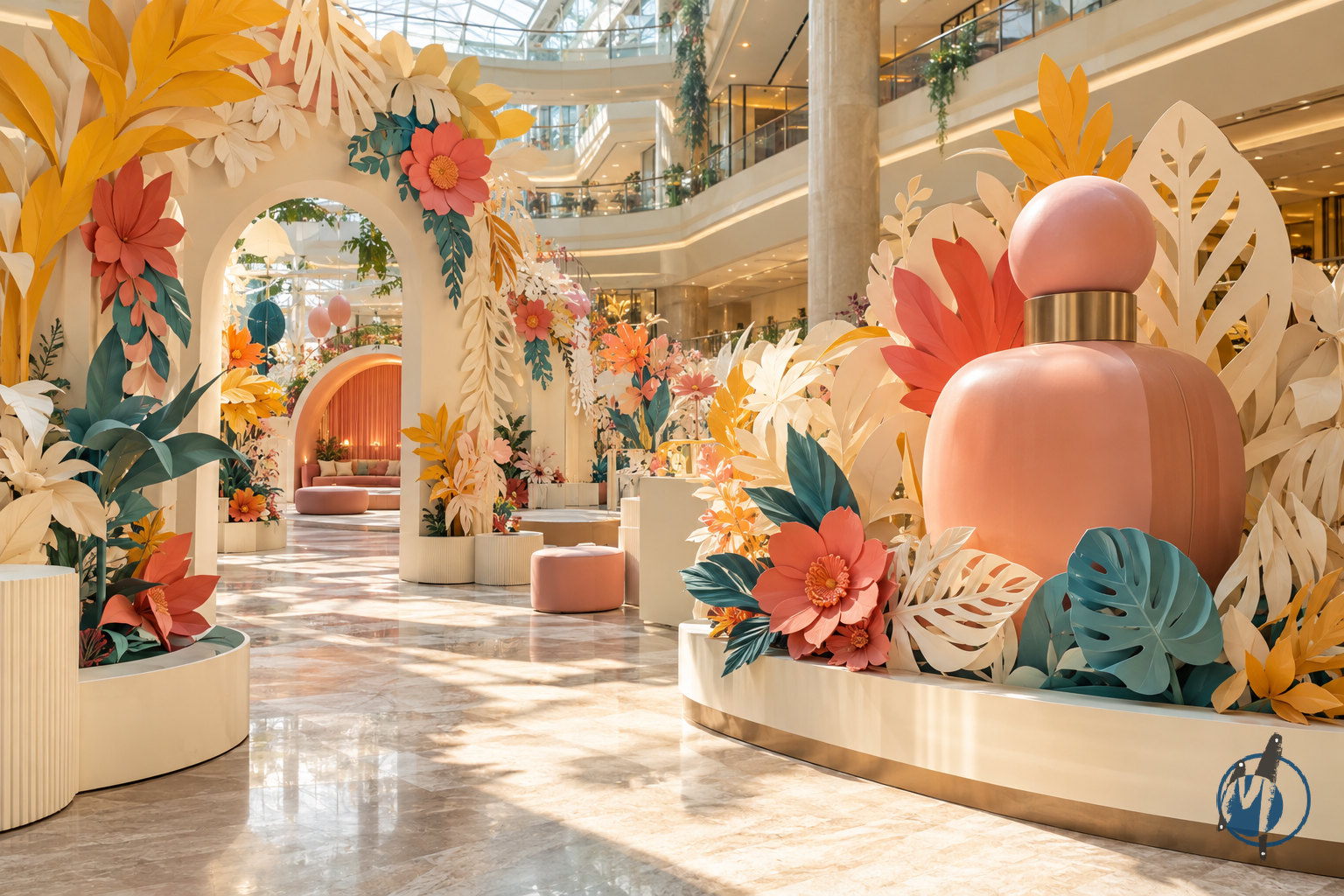
Quick answer: The best brand activation ideas for malls combine a striking display with an easy, rewarding activity and a measurable next step. Think walk-through paper gardens, tactile product discovery stations, festive participation walls and oversized props that lead shoppers towards a trial, store visit or purchase. Choose the format around the audience, available space and operating conditions—not just how impressive it looks in a render.
1. What makes a mall brand activation effective?
A mall activation is a temporary physical experience designed to change what visitors notice, feel or do. Unlike a static advertisement, it gives people an active role: exploring a material, testing a product, contributing to an artwork or stepping inside a story. Its creative idea should connect directly to the brand rather than functioning as an interchangeable entertainment attraction.
Malls bring together shoppers with different intentions. Some are making planned purchases; others are meeting friends, accompanying family or passing through. A successful experience offers a low-effort entry point for the casual visitor and a deeper interaction for someone genuinely interested. People should understand what they can do without needing a long explanation from a promoter.
The environment matters as much as the concept. An installation competes with shopfronts, escalators, digital screens and ambient sound. Strong silhouettes, visible activity and a clearly defined entrance help it stand out without overwhelming the space. The exit should make the next action obvious, whether that is locating a store, collecting a sample or discovering a product range.
Build around three essential elements
Attraction: A recognisable shape, material treatment or scene that earns attention.
Participation: One intuitive action that makes the visitor part of the experience.
Progression: A relevant next step with a clear benefit, not an unrelated sales demand.
2. Which brand activation ideas work well in malls?
The strongest ideas start with a behaviour the brand wants to encourage. A stationery brand might invite tactile exploration and creative expression; a home brand might demonstrate how a setting changes a mood. Use the concepts below as adaptable frameworks rather than ready-made themes. Their effectiveness depends on the product connection, visitor journey and quality of execution.
Physical participation does not need elaborate technology. Folding, revealing, arranging, stamping and comparing can create satisfying interactions with fewer technical dependencies. Where screens or sensors add genuine value, build in a fallback so the activation can keep operating if connectivity or equipment fails.
Eight adaptable concepts
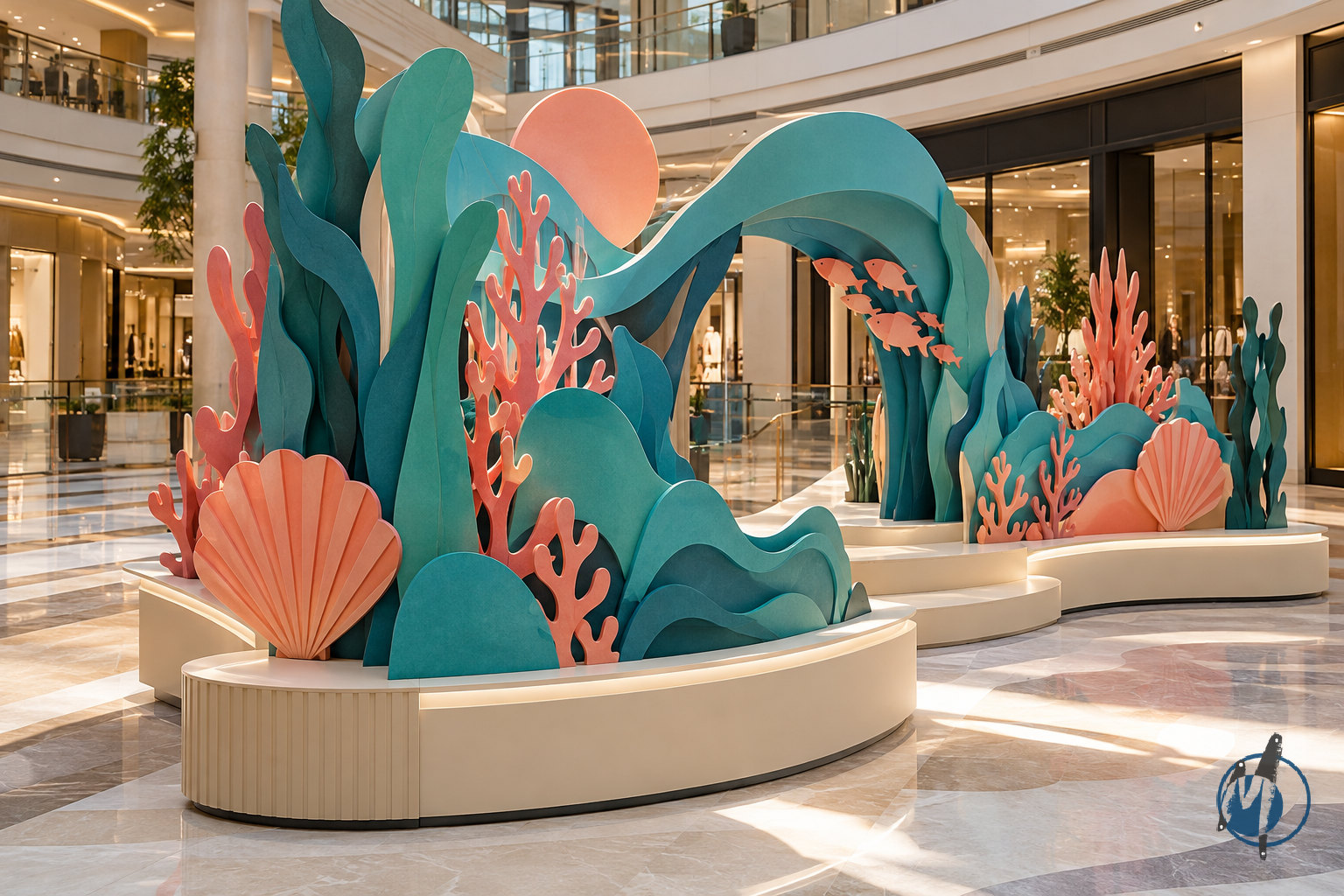
Walk-through paper garden: Layer sculptural foliage, flowers and colour transitions around a product story. Keep an accessible route through the installation and position the discovery point where visitors naturally pause.
Oversized product prop: Turn a recognisable product form into a large sculptural landmark. Add a safe interaction beside it rather than inviting climbing on an object not engineered for that purpose.
Customisation pop-up: Let shoppers personalise a card, sleeve, notebook cover or keepsake. Connect the available colours and materials to the brand identity and plan a separate collection point.
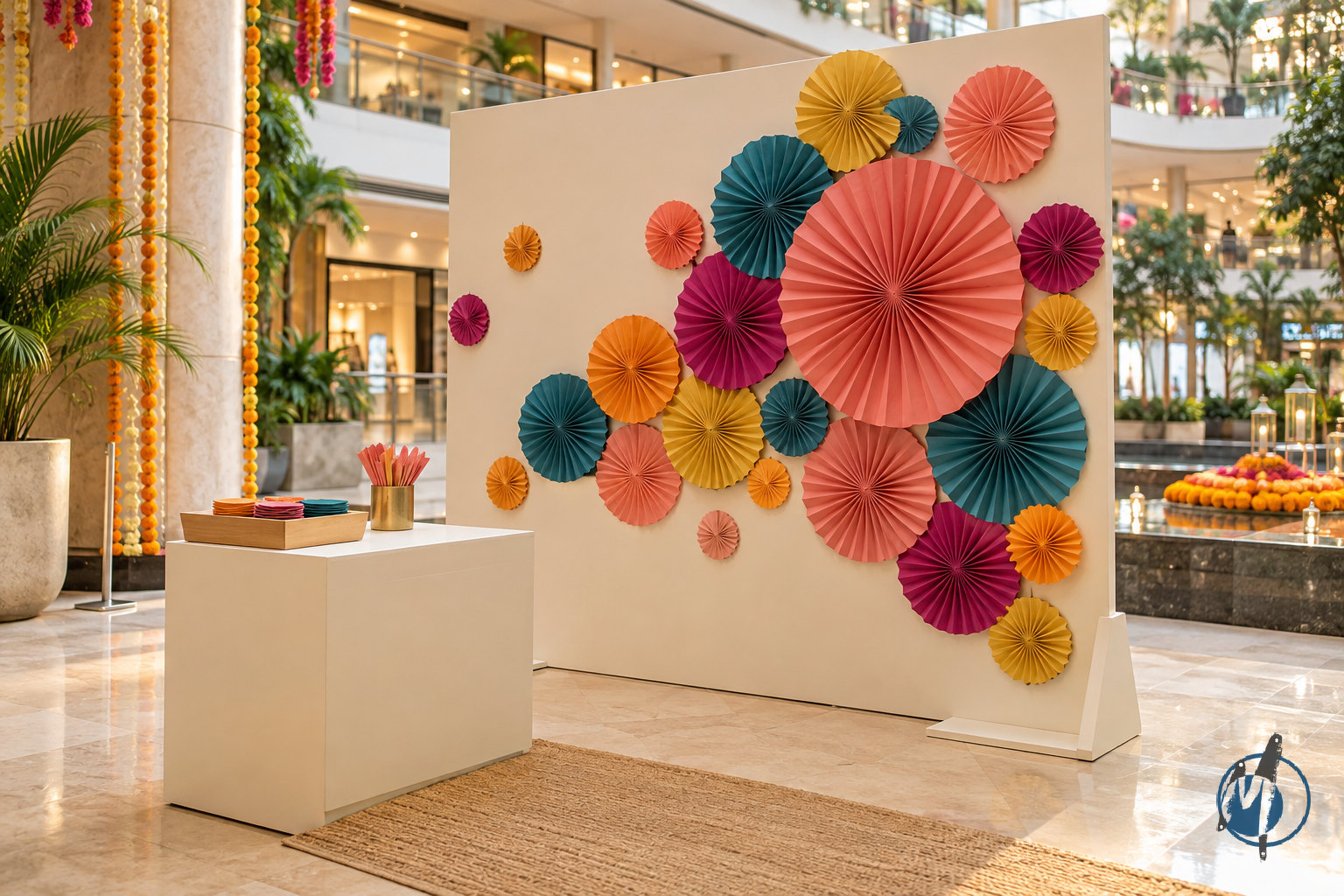
Festive participation wall: Invite visitors to add a folded shape or reusable token to a growing artwork. Use controlled attachment points and moderation where participants contribute written messages.
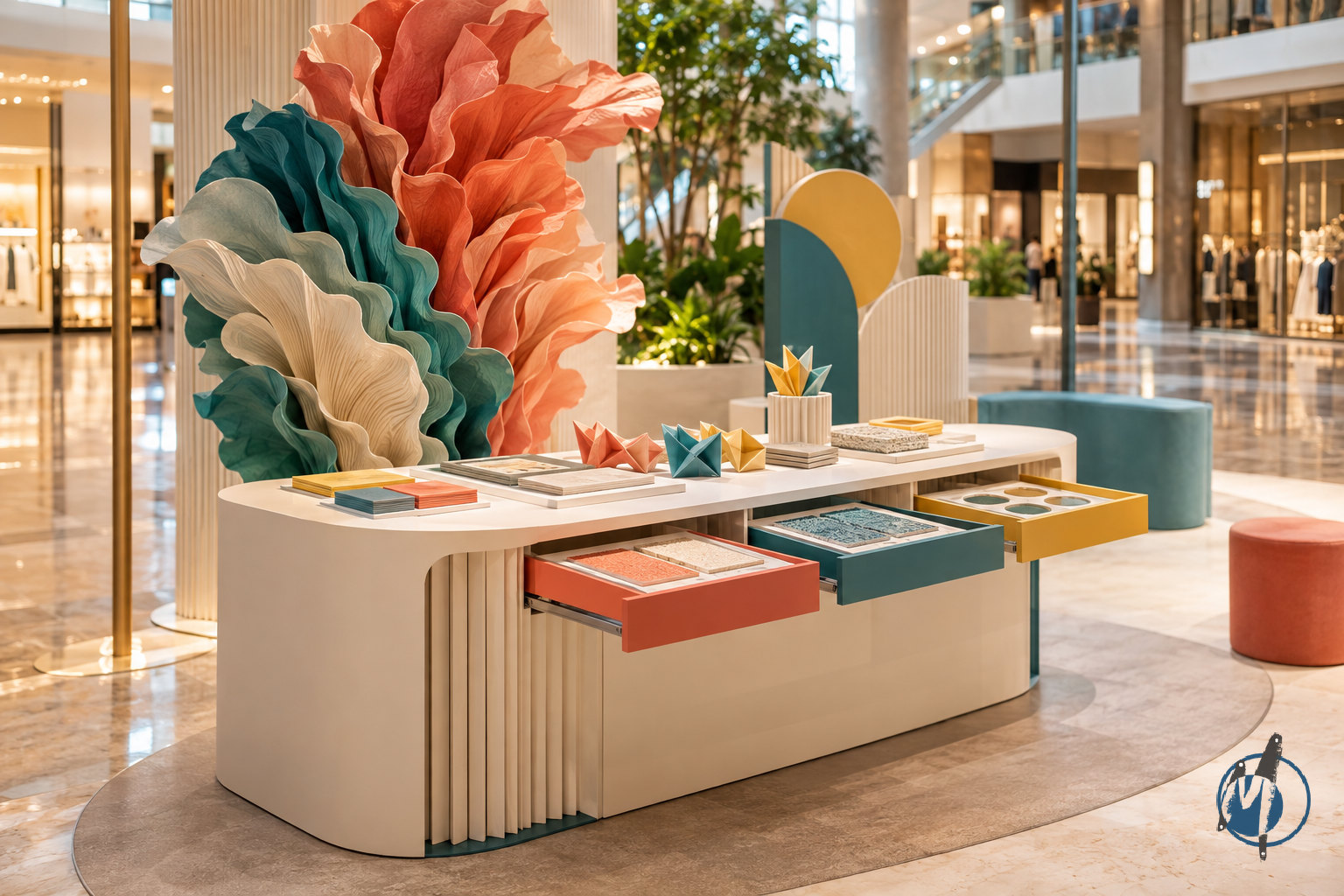
Tactile discovery counter: Present textures, finishes or product components for comparison. This works especially well when the difference between products is difficult to communicate through a screen.
Forced-perspective photo scene: Create a carefully composed scene with an obvious camera position. Offer a satisfying photograph without requiring an app download or compulsory social post.
Store discovery trail: Link a central installation to participating stores through simple clues or physical stamps. Obtain tenant agreement and ensure the route does not obstruct other businesses.
Reveal-and-reward display: Let visitors open, slide or rotate a durable element to discover a product benefit. If rewards are included, keep eligibility and availability clear and have any promotional mechanics reviewed.
3. How do you choose the right format for your objective?
Start by selecting one primary outcome. Awareness, product understanding, store visits and qualified enquiries require different experiences and different measures. A busy photo installation may be excellent for visibility but poor at explaining a complex product. A consultation-led pop-up can support deeper consideration without drawing the largest crowd.
Also consider the audience's likely willingness to stop. A self-guided display suits visitors moving quickly, while a hosted activity requires enough space for participants, companions and waiting shoppers. In family-oriented settings, the experience should work for accompanying adults as well as children, without relying on children to supply personal information.
Primary objective | Suitable activation format | Useful visitor action | Practical measure | Main constraint |
|---|---|---|---|---|
Build awareness | Large prop or sculptural landmark | Notice, approach, photograph | Observed approaches and participation | Visibility without blocking sightlines |
Explain a product | Hosted discovery counter | Compare, test, ask questions | Completed demonstrations | Staff capability and throughput |
Encourage store visits | Discovery trail or redeemable invitation | Continue to a participating store | Tracked redemptions or store check-ins | Tenant coordination |
Gather permission-based leads | Consultation or relevant customisation | Request follow-up voluntarily | Valid opted-in enquiries | Privacy and data handling |
Support festive engagement | Participation wall or paper-art environment | Contribute to a shared artwork | Completed contributions | Maintenance and cultural relevance |
Generate shareable moments | Interactive photo setting | Create a personal photograph | Photo participation and trackable sharing | Camera position and queue management |
Avoid treating these measures as interchangeable. An approach is not a lead, and a photograph is not a sale. Define what counts as a completed action before launch, then choose a recording method the on-ground team can apply consistently. If sales attribution is important, involve the retail team while designing the concept rather than after fabrication.
4. How should festive displays reflect Indian mall audiences?
Festive mall activations work best when the occasion shapes the experience rather than simply supplying decorative motifs. Consider what visitors associate with the celebration: gifting, gathering, renewal, craft or shared rituals. Translate that into a meaningful activity, such as assembling a decorative element, exploring a gifting presentation or contributing to a communal installation.
India's regional and cultural diversity makes local context essential. Review the concept with people who understand the mall's catchment and the occasion being represented. Avoid combining symbols indiscriminately or placing culturally significant imagery where it might be stepped on, handled disrespectfully or used as a disposable prop. Where craft traditions inform the design, acknowledge their source appropriately and explore collaboration with relevant practitioners.
Festive displays also need to perform across changing visitor volumes. A hosted activity may be suitable during quieter periods, while a self-guided version can help keep the experience usable during peaks. Design both modes around the same central story so visitors still receive a coherent experience when staffing or queue conditions change.
Make seasonal storytelling more adaptable
Use a reusable structural base with replaceable decorative skins.
Separate delicate paper art from frequently touched components.
Allow family groups to participate without occupying the entire circulation route.
Plan practical visitor instructions in languages appropriate to the location.
Review lighting, colour and materials in the actual mall environment before production.
5. What makes an interactive photo moment worth stopping for?
A strong photo moment gives visitors a role inside the composition. They might appear to hold an oversized object, stand within a layered paper landscape or complete a visual scene through their position. A decorative backdrop alone can still work, but interaction gives the photograph a clearer reason to exist and makes the experience more memorable.
Design the camera view as carefully as the installation itself. Check the scene at realistic phone-camera distances, including what appears behind and beside the subject. An attractive render can become an awkward photograph if railings cut through the composition, lighting casts harsh shadows or a queue fills the background. Provide an obvious camera position without creating a trip hazard.
Participation should remain optional and accessible. Offer more than one comfortable position, including a usable seated composition where feasible. Do not require people to post publicly, tag friends or surrender contact details just to take a photograph. If the organising team captures or publishes identifiable visitor images, establish an appropriate consent process, with additional care around children.
Keep the interaction simple
Make the intended action understandable from outside the activation.
Avoid loose accessories that disappear easily or complicate cleaning.
Keep the photographer's position outside the main pedestrian route.
Give waiting groups a clear place to stand.
Test the composition with different group sizes and heights before opening.
6. How do you plan a mall activation from brief to launch?
Treat approvals and operations as design inputs, not final-stage checks. Mall management may need to review drawings, materials, electrical arrangements, structural details, access plans and installation methods. Requirements vary by property, so request the venue's current guidelines before committing to a form or fabrication system. A visually simple concept can still involve substantial coordination.
Work backwards from the public opening and identify dependencies. Long-lead materials, prototype approvals, structural review and restricted installation access can determine the schedule. Avoid promising a universal turnaround: the responsible programme depends on the scale, engineering needs, approval process and production capacity. Build in time for testing and corrections rather than treating installation as the first full assembly.
A step-by-step process
Define the objective. Agree on the target audience, desired visitor action and primary success measure. Record what is outside scope so the activation does not accumulate conflicting jobs.
Survey the site. Measure the usable footprint, ceiling conditions, nearby exits, electrical access, service routes and surrounding tenant sightlines. Check the route from the loading area to the installation location.
Map the visitor journey. Show the approach, entry, interaction, waiting area and exit. Include companions, mobility aids, staff positions and replenishment access.
Develop the concept. Present the visual direction alongside the operating logic. Explain what visitors do, how the brand appears and what happens when the space becomes busy.
Prototype critical details. Test touchpoints, attachment systems, paper finishes, camera angles and moving parts. Use representative materials rather than relying only on digital visualisations.
Secure approvals and fabricate. Confirm responsibility for structural and electrical reviews, venue permissions and production sign-off. Track changes so approved drawings match what is built.
Install and rehearse. Inspect the completed setup, run the interaction with staff and test any data or redemption systems. Brief the team on queues, accessibility, cleaning and escalation procedures.
Operate, measure and dismantle. Keep a daily issue log, replenish consumables and record agreed metrics. Follow the dismantling plan and document which components can be stored or reused.
7. What safety, accessibility and material checks are essential?
Public displays need to withstand foreseeable public behaviour, not just remain upright in an empty atrium. Large props may attract leaning, pulling or attempted climbing even when that is not intended. Have qualified professionals assess structural stability, anchoring or ballast, and any overhead elements. Mall approval does not replace the need for competent technical review.
Paper art requires particular attention to fire performance, handling and placement. Do not assume a material is acceptable because it is described as treated, recyclable or lightweight. Confirm the venue's documentation requirements and assess the complete assembly, including substrates, adhesives and finishes. Keep displays clear of exits, firefighting equipment, detectors and sprinkler coverage as required by the relevant authorities and venue.
Accessibility belongs in the concept stage. Provide clear circulation, usable interaction heights and alternatives to activities that depend on reaching, standing or using a smartphone. Consider sensory load as well: intense sound, flashing effects and crowded enclosed spaces may exclude visitors. Staff should know how to offer assistance without making assumptions about someone's needs.
Pre-opening checklist
Venue approvals and required technical documents are complete.
Structures, fixings and touchpoints have been inspected.
Exits, emergency equipment and essential circulation remain unobstructed.
Electrical connections are professionally installed and cables protected.
Edges, pinch points, loose parts and accessible moving elements are addressed.
Queues and photo positions remain within the agreed operating area.
Accessible participation and an alternative interaction are available where needed.
Cleaning, replenishment, inspection and incident responsibilities are assigned.
Consumables, tools and cleaning products have secure storage.
Dismantling, transport and material recovery arrangements are confirmed.
8. How do you control costs, measure results and avoid common mistakes?
Budget for the complete activation lifecycle rather than the visible installation alone. Concept development, site visits, prototypes, fabrication, transport, installation labour, technical reviews, staffing, maintenance, storage and dismantling can all affect the final scope. Ask suppliers to distinguish reusable assets from event-specific elements and clarify exclusions, especially venue charges and third-party services.
Spend should follow the objective. If product education is the priority, a well-designed demonstration surface and trained hosts may matter more than decorative complexity. If the aim is a public landmark, allocate resources to silhouette, finish, lighting and safe construction. Value engineering should preserve the central experience while simplifying elements visitors are unlikely to notice or use.
Measurement should be proportionate and transparent. Combine manual participation counts with operational observations, redemption records or permission-based follow-up where relevant. Track the difference between people passing, approaching and completing the activity. Compare performance across operating periods, but acknowledge that mall-wide footfall, promotions and store availability can influence outcomes; the activation alone may not explain a sales change.
Common mistakes to avoid
Designing only for photographs: Review the full visitor journey, including waiting and exit conditions.
Using a generic theme: Give the interaction a specific connection to the product or brand promise.
Overloading the instructions: Remove steps until the core action feels natural.
Hiding commercial terms: Make reward conditions, stock limitations and eligibility easy to understand.
Collecting unnecessary data: Request only what is needed, explain its purpose and establish appropriate consent and retention practices.
Ignoring maintenance: Specify replaceable touchpoints and keep repair materials available.
Claiming sustainability too broadly: Describe actual material choices, reuse plans and recovery arrangements rather than using unsupported labels.
Forgetting the final handoff: Ensure stores and customer-service teams understand redemption mechanics before visitors arrive.
9. How Messketeers can help?
Messketeers is an India-based creative studio working across brand identity, custom print and packaging, OEM stationery manufacturing, and experiential decor and paper art installations. For mall projects, its relevant services include mall and festive displays, pop-up experiences, interactive photo moments, and effigies and large props. These formats can bring a brand story into a physical environment that shoppers can explore and engage with.
The opportunity is to connect the installation with the smaller details that visitors encounter. A paper-art environment, a custom printed takeaway and a product presentation can share the same visual language rather than feeling like separate purchases. Where relevant to the brief, Messketeers' wider creative and production disciplines offer a way to consider those elements together.
Start a conversation with the mall location, proposed dates, available footprint, brand objective, audience and indicative budget. Include venue guidelines, site photographs and any existing brand assets if available. From there, the useful question is not simply “What can we build?” but “What should visitors notice, do and remember—and what will it take to deliver that safely and consistently?”
Frequently asked questions
What are the best brand activation ideas for malls?
Strong options include oversized product props, walk-through paper-art environments, customisation counters, festive participation walls and interactive photo scenes. The best choice depends on the intended outcome. Use a visual landmark for awareness, a discovery counter for product understanding, or a coordinated trail to encourage visits to participating stores.
How much does a mall brand activation cost?
There is no reliable universal price because the footprint, fabrication method, operating duration and venue requirements vary. Request an itemised scope covering design, production, transport, installation, staffing, maintenance and dismantling. Confirm whether mall charges, technical reviews, electrical work, storage and consumables are included before comparing proposals.
Can paper art be used safely in mall installations?
Paper art can be considered for mall installations when the materials, supporting structure and placement satisfy the venue's requirements and applicable safety obligations. Review fire-performance documentation, adhesives, finishes and clearances rather than assuming lightweight materials are automatically acceptable. Keep delicate decorative components separate from high-touch elements and obtain appropriate technical review.
How do you measure a mall activation's success?
Choose a primary measure that matches the objective, such as completed demonstrations, participation, tracked store visits or valid opted-in enquiries. Distinguish passers-by from active participants and record operational issues alongside results. Where sales are measured, recognise that other promotions, overall footfall and stock availability can also influence performance.
What permissions are needed for a mall activation?
Begin with the mall's current event and fit-out guidelines. Depending on the project, reviews may cover layout, materials, structure, electrical work, operating activity and installation access. Sampling, amplified sound, photography or promotional rewards may need additional checks. Confirm responsibilities with mall management and relevant professionals before production begins.
How can a mall activation reduce material waste?
Design a reusable base and replace only the campaign-specific decorative elements where practical. Choose durable touchpoints, repairable assemblies and materials that can be separated after use. Plan storage, transport and local recovery routes before fabrication. Describe the actual reuse or recovery approach rather than making broad claims that the installation is sustainable.