Corporate Event Theming Ideas: A Practical Creative Guide
· 11 min read
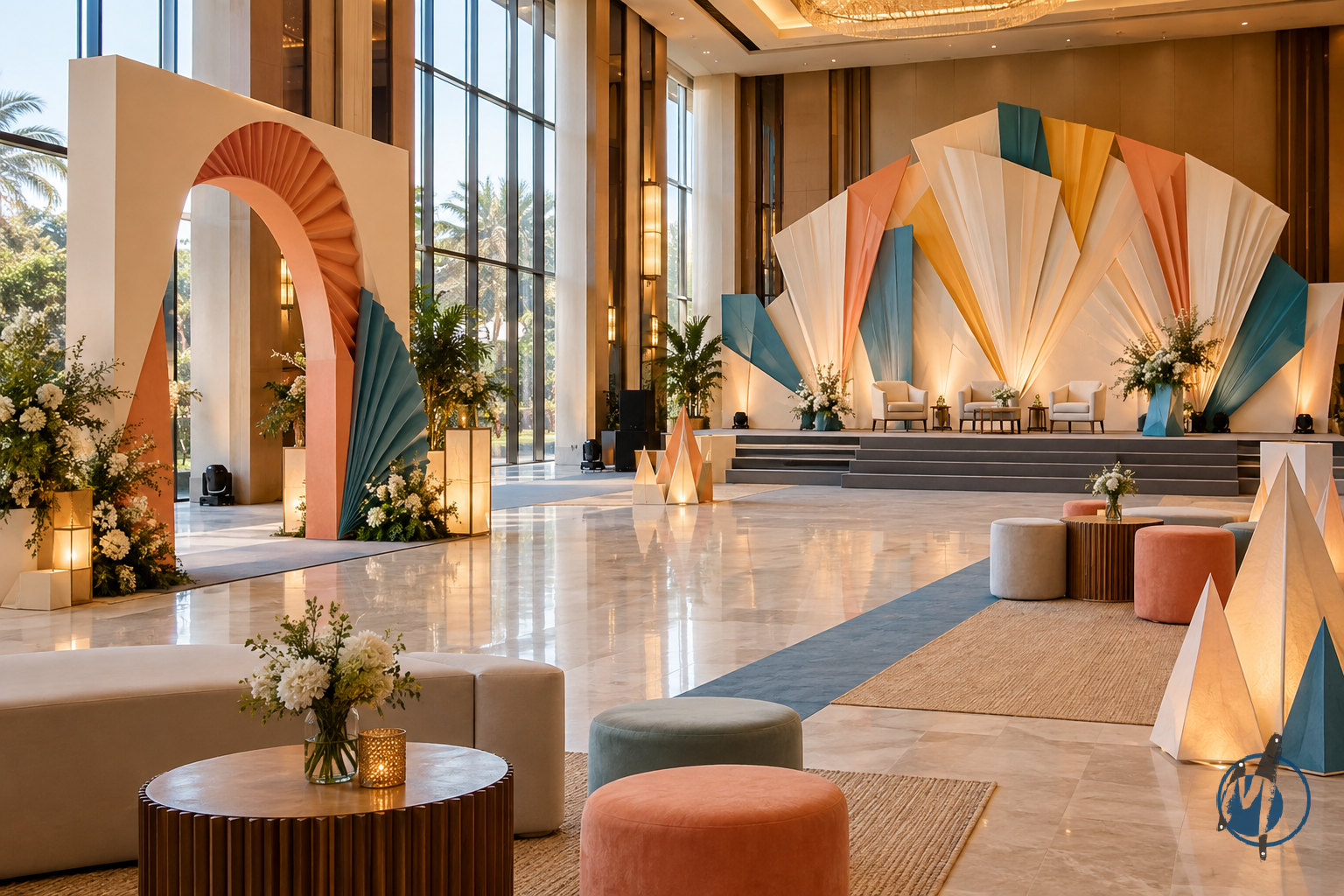
Quick answer: The best corporate event theming ideas translate a business objective into an experience guests can understand, navigate and remember. Build one visual story across the entrance, stage, backdrops, props, signage and overhead details, rather than decorating each area separately. Choose the theme around your audience, venue and event format, then plan materials, fabrication and on-site setup together.
What makes a corporate event theme effective?
A theme is more than a colour palette or a name on an invitation. It is a creative framework that connects what the organisation wants to communicate with what guests actually see and do. For a leadership summit, that might mean clarity and forward movement; for an employee celebration, it might mean recognition, belonging and shared achievement. The visual language should make that purpose tangible without requiring a long explanation.
Begin with a single sentence: “Guests should leave feeling ___ and understanding ___.” This becomes a useful filter for creative decisions. A dramatic entrance may be appropriate for a launch, but less useful than clear wayfinding and a well-resolved stage at a content-heavy conference. Equally, a spectacular photo wall cannot compensate for an event layout that makes registration difficult.
Define the brief before choosing the look
Business objective: Launch, recognition, learning, relationship-building or internal alignment.
Audience: Employees, leadership, customers, partners or a mixed group.
Desired response: Curiosity, confidence, participation, pride or connection.
Guest journey: What people encounter before arrival, at entry, during sessions and on departure.
Brand boundaries: Approved colours, tone, symbols and any visual treatments to avoid.
Practical constraints: Venue permissions, installation access, clearances, storage and dismantling requirements.
A useful theme can also survive simplification. If the concept only works with a huge suspended installation, it may be too dependent on one expensive element. Strong ideas can appear as a full stage composition, a compact reception feature or a small directional sign while remaining recognisable.
Which corporate event theming ideas suit different occasions?
Start with a narrative rather than a catalogue of props. “Future-ready” becomes more distinctive when interpreted through pathways, folded structures and emerging forms than when reduced to generic futuristic imagery. Similarly, an India-inspired theme should have a deliberate design reference rather than mixing unrelated regional motifs into a decorative collage.
The following directions are adaptable starting points. Their suitability depends on the event objective and the organisation’s identity; none should be treated as a ready-made package that fits every audience.
Theme direction | Suitable occasions | Visual language | Practical application |
|---|---|---|---|
Future in Fold | Innovation meets and product launches | Folded planes, layered geometry, clean gradients | Dimensional stage backdrop, angular props and directional motifs |
Collective Growth | Employee gatherings and sustainability conversations | Branching forms, botanical silhouettes, expanding patterns | Modular paper garden, contribution wall and table accents |
Shared Journeys | Partner meets and annual conferences | Routes, milestones, connected points | Arrival pathway, achievement displays and linked zone signage |
Crafted Connections | Relationship-building events and celebrations | Woven rhythms, tactile surfaces, considered craft references | Layered screens, intimate photo settings and sculptural details |
Festival of Ideas | Internal innovation days and creative workshops | Colour blocking, playful shapes, modular compositions | Activity-zone markers, idea walls and overhead danglers |
Everyday Excellence | Recognition events and team milestones | Repetition, spotlight forms, celebratory depth | Recognition backdrop, portrait-style photo area and display plinths |
Develop the idea beyond its name
For Shared Journeys, the entrance could establish the starting point, corridor graphics could introduce milestones, and the stage could bring the routes together. For Collective Growth, guests might add paper leaves to a supervised participation wall, provided that the activity has clear instructions and does not obstruct circulation. These connections make the theme feel intentional rather than merely decorative.
Avoid choosing a theme solely because it is fashionable. A playful, highly saturated environment can energise an internal workshop but distract from a formal investor presentation. The strongest option is the one that supports the event’s content and makes sense to its guests.
How do you choose a theme that fits your brand and audience?
Assess shortlisted concepts against the same criteria: strategic relevance, audience fit, venue compatibility, fabrication complexity and potential for reuse. Ask stakeholders to explain their preferences using these criteria instead of relying on “I like it” or “it feels premium.” This turns a subjective approval discussion into a more productive design review.
Brand expression does not require placing a logo on every surface. A recognisable palette, characteristic geometry and a consistent material treatment can create a branded environment without visual repetition. Decide which locations need explicit identification and which can communicate through atmosphere. Registration and the main stage may need stronger brand cues than a networking corner.
Test the concept in real situations
Does it remain legible behind a speaker and on a camera feed?
Can a guest understand the event zones without asking for directions?
Does the imagery feel inclusive across languages, roles and cultural backgrounds?
Can the concept accommodate sponsor or partner requirements without becoming crowded?
Will quieter guests have ways to participate without being photographed or performing?
In India, corporate audiences may include guests with different language preferences and levels of familiarity with the organisation. Where needed, plan multilingual signage early so layouts can accommodate it comfortably. Use clear wording, readable contrast and familiar directional cues; decorative typography should never make essential information harder to understand.

How should the theme carry through the venue?
Think in terms of a guest journey, not a list of objects to fabricate. Map arrival, registration, transition spaces, the main programme, interaction areas and departure. Each zone should have a clear role, with the theme creating continuity between them. Not every zone needs the same visual intensity: a memorable entrance and strong stage can work alongside restrained corridor details.
Backdrops and props establish focal points; signage and danglers connect them. Keep these roles distinct. A sculptural backdrop can prioritise depth and silhouette, while a directional sign must prioritise readability. Overhead elements should be planned only after the venue has confirmed attachment methods, clearances and any restrictions involving lighting, sprinklers or other services.
Assign a job to each touchpoint
Entrance: Introduce the theme without narrowing the arrival route.
Registration: Make queues, counters and assistance points easy to identify.
Main stage: Support speakers, presentations and photography without competing with them.
Networking area: Encourage conversation while preserving comfortable movement.
Photo zone: Provide a clear composition and sufficient space for groups and photographers.
Transitions: Use directional signs, repeated motifs or approved danglers to maintain continuity.
Exit: Guide departure and any collection points without creating bottlenecks.
Review the plan from standing, seated and wheelchair-height perspectives. Check sightlines to the stage and screens, access to exits and the position of decorative bases. A beautiful installation is not successful if it hides a speaker, blocks a route or forces guests to step around exposed supports.
Which materials work best for corporate event decor and paper installations?
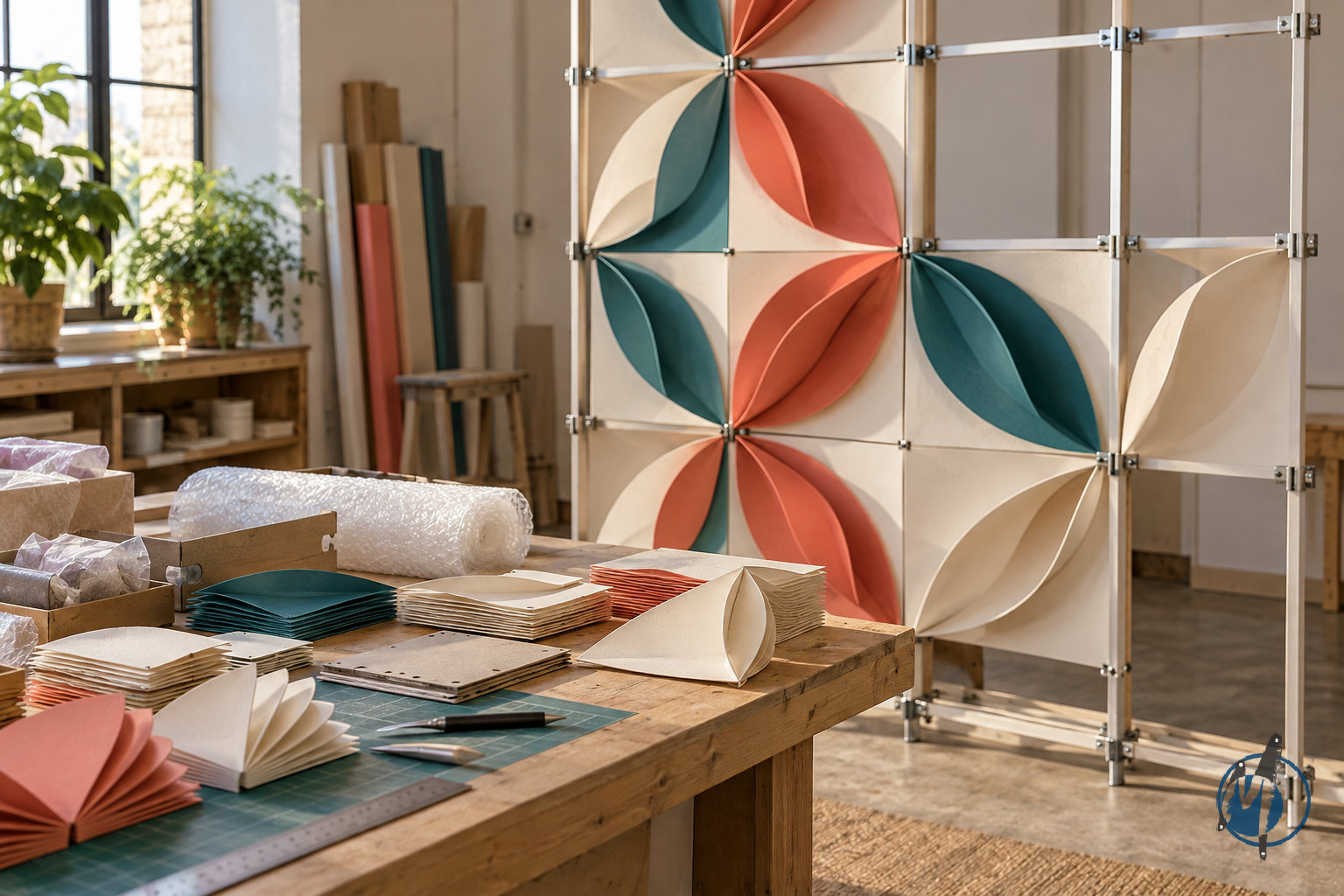
Material selection should follow the intended form, location and lifespan of each element. Paper and card can create texture, translucency, folded geometry and sculptural depth, but different grades behave differently. Thin hanging shapes, freestanding props and deep stage reliefs need different construction approaches. Larger elements may require properly designed supporting structures rather than relying on paper alone.
For indoor events, layered paper art can create a tactile alternative to flat printed surfaces. In outdoor or semi-open settings, wind, humidity and possible rain change the design requirements substantially. India’s local weather conditions, venue air-conditioning and transport environment should all inform material choices. Do not assume that an indoor prototype will perform unchanged in an exposed courtyard.
Match the material to the task
Folded paper and card: Useful for lightweight surface detail, repeating shapes and sculptural compositions where conditions permit.
Corrugated board or paper honeycomb panels: Potential options for larger forms, subject to load, finish and stability requirements.
Printed panels: Useful where artwork fidelity and essential information matter.
Reusable frames and bases: Can support replaceable decorative faces and future reconfiguration.
Mixed-material assemblies: Appropriate where paper provides the visual finish but another material supplies structural support.
Safety requirements must be checked with the venue and relevant contractors. Paper is combustible, and coatings do not automatically make an assembly compliant. Confirm applicable fire-performance documentation, electrical separation, rigging requirements and stability measures before fabrication. Keep decorative elements clear of heat sources, safety equipment and emergency routes.
A credible lower-waste approach considers the whole assembly. Ask whether parts can be reused, whether materials can be separated and whether local recyclers will accept the finished components. Foil, glitter, laminates, adhesives and mixed substrates can complicate recovery. Avoid describing an installation as sustainable simply because its visible surface is paper.
What is the step-by-step process for planning a themed event?
The most reliable workflow resolves the concept and physical constraints together. Starting fabrication before the venue conditions are understood can lead to expensive alterations; waiting until every small detail is perfect can delay critical decisions. Separate approvals into clear stages so the team knows what is fixed and what remains open.
A moodboard should communicate more than an attractive aesthetic. It should explain the concept, colour hierarchy, textures, shapes and intended atmosphere. Once approved, translate that direction into specific touchpoints with dimensions, quantities, construction assumptions and setup responsibilities.
A practical planning sequence
Write the event brief. Define the purpose, audience, programme, venue, date and priority guest moments.
Survey the venue. Check access routes, loading arrangements, ceiling conditions, power locations, usable floor space and restrictions.
Develop concept options. Present distinct narratives and explain how each supports the brief.
Approve the moodboard. Agree on the visual language and record what is outside the chosen direction.
Map the touchpoints. Develop the entrance, stage, backdrops, props, signage and danglers as a coordinated system.
Prototype critical details. Test colour, folds, joints, supports and any unfamiliar fabrication method.
Freeze production information. Confirm artwork, dimensions, quantities, finishes and the approval owner.
Plan installation and dismantling. Establish sequencing, contractor dependencies, packing, access and venue handover expectations.
Install and inspect. Review stability, sightlines, signage, finish quality and the appearance under event lighting.
Document and recover. Photograph reusable components, record assembly details and separate materials for their agreed next use.
Timelines depend on complexity, procurement, approvals and site access, so build the schedule backwards from the installation window rather than treating setup as an afterthought. Include time to review physical samples and respond to venue feedback. A clear decision owner helps prevent conflicting changes from multiple departments.
How do you balance visual impact, budget and reuse?
Allocate resources according to what guests will encounter and what the event needs to communicate. A focused stage composition, clear registration area and well-placed photo installation can be more effective than distributing decoration evenly across the entire venue. Identify the essential experience first, then add supporting details only where they contribute something meaningful.
Ask for a scope that separates design, fabrication, transport, installation and dismantling responsibilities. Also clarify supporting structures, print quantities, venue-related charges where applicable, storage and taxes. Comparing proposals by their headline total alone can hide important differences in materials, finish, logistics or what happens after the event.
Protect impact without adding unnecessary complexity
Repeat a well-designed module instead of creating a unique object for every zone.
Use dimensional detail where guests will see it closely, and simpler treatments elsewhere.
Keep reusable structural components separate from date-specific graphics.
Prioritise readable signage before decorative additions.
Confirm dimensions before ordering materials or approving artwork.
Define a change-control process for requests made after production approval.
Reuse needs a practical plan, not just an intention. Determine who owns the components, where they will be stored, how they will be protected and whether they fit future venues. A modular backdrop may be adaptable, but repeated handling can affect its finish. Budget for inspection and repair when evaluating future reuse.
What common mistakes should you avoid before event day?
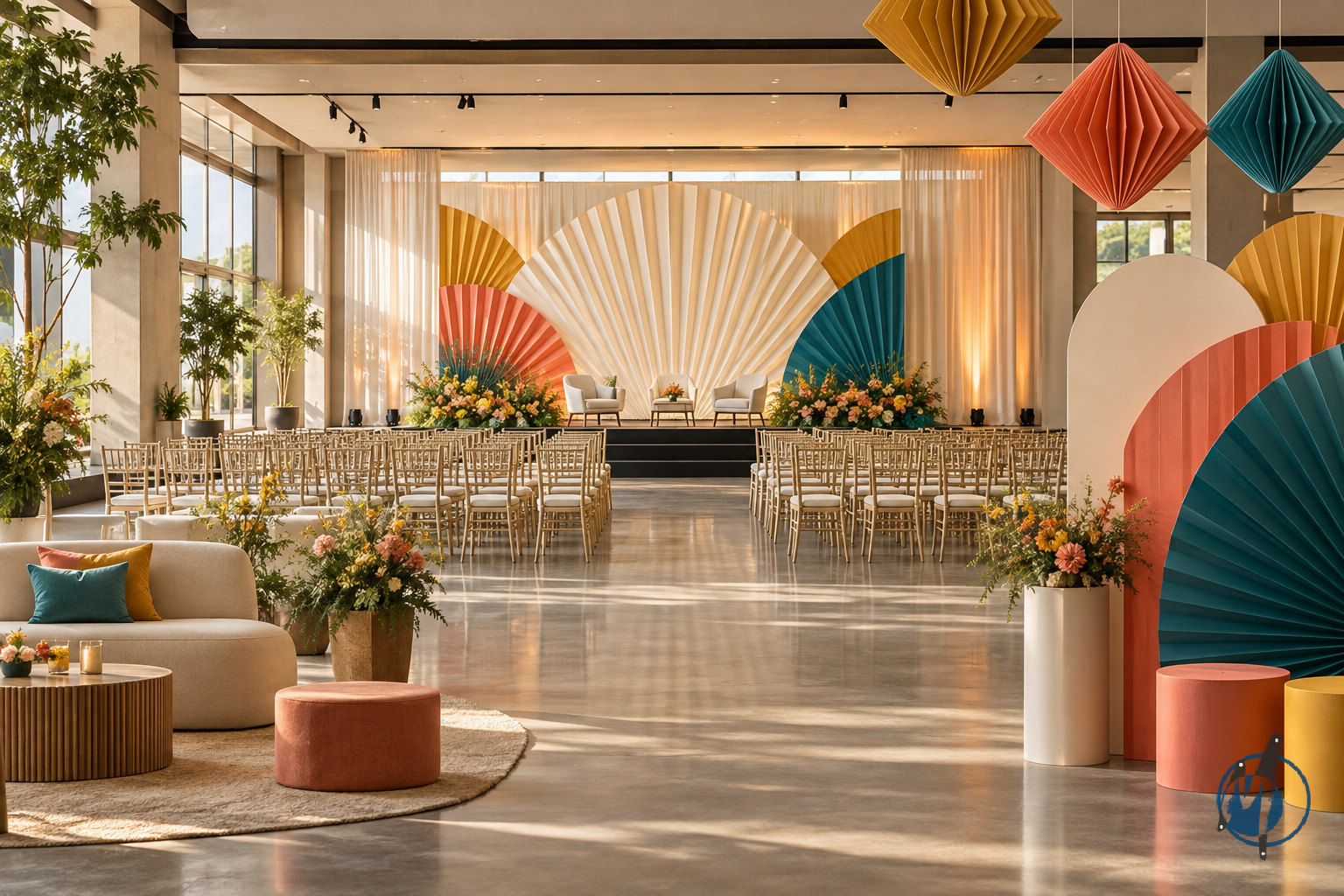
The most common creative mistake is treating the theme as an accumulation of unrelated features. A botanical entrance, futuristic stage and carnival-style photo booth can each look appealing individually while weakening the overall experience. Choose a shared visual grammar—such as curved layers, folded planes or branching patterns—and use it consistently without making every element identical.
Execution problems often arise when approvals focus on artwork but overlook construction and access. A prop may look correct in a render yet be too large for a service lift. A backdrop may fit the wall but conflict with screen placement. Review the complete installation in its intended setting, including supports, cables, queues and nearby furniture.
Mistakes to avoid
Selecting props before agreeing on the event objective.
Making essential signage too small, too decorative or too low-contrast.
Assuming overhead fixing points are available without venue approval.
Ignoring how colours and textures look under the actual lighting.
Letting photo queues overlap with registration or circulation routes.
Making unsupported claims about recyclable or fire-resistant materials.
Leaving packing, dismantling and waste removal undefined.
Treating last-minute content changes as if they have no production impact.
Pre-event approval checklist
The concept supports the event purpose and audience.
Venue dimensions and access conditions have been verified.
Artwork, names, language and directional information are approved.
Exits, accessible routes and safety equipment remain unobstructed.
Props and backdrops have suitable bases, supports and finishes.
Any rigging and material requirements have venue approval.
Stage and photo-zone sightlines have been checked.
Installation responsibilities and handover checks are assigned.
Dismantling, storage and material recovery are agreed.
Use this checklist during planning, not only on event morning. Resolving a missing approval while artwork is still being developed is much easier than discovering it when a fabricated installation reaches the venue.
How Messketeers can help: what happens next?
Messketeers is an India-based creative studio offering corporate event theming through its Experiential Decor & Paper Art Installations practice. The service scope includes concept and moodboards, backdrops and props, signage and danglers, and on-site setup. These touchpoints can be developed around one creative direction so the theme remains coherent from the first visual reference to the installed environment.
The starting point is your event brief: what the occasion needs to achieve, who will attend and where it will happen. Venue photographs, floor plans, brand guidelines and programme details help turn an initial idea into a practical design conversation. Share known access restrictions and approval requirements early, even if the creative direction is still open.
What to include in your enquiry
Event type, objective, date and location.
Audience profile and expected attendance.
Venue plans, photographs and available installation window.
Brand guidelines and any mandatory content.
Required zones and priority decorative elements.
Budget parameters, reuse preferences and internal approval process.
Whether you already have a theme or need help defining one, the goal is the same: create a purposeful environment rather than a collection of decorations. Messketeers can help connect the narrative, physical touchpoints and on-site setup, with the final scope agreed around your venue and event requirements.
Frequently asked questions
What are some professional corporate event theming ideas?
Professional options include future-focused geometry for launches, shared-journey narratives for conferences, crafted connections for partner gatherings and collective-growth themes for employee events. Choose a direction that reflects the event objective, then express it through consistent colours, shapes and materials across the entrance, stage, signage and interaction areas.
How is event theming different from event decoration?
Decoration focuses on individual visual elements, such as backdrops, props or hanging features. Theming provides the story and design rules that connect those elements to the event’s purpose. A well-themed event also considers guest movement, information hierarchy and participation, so the environment works as a coordinated experience rather than a collection of attractive objects.
Can paper art installations work for corporate events?
Yes. Paper art can create sophisticated depth, texture and sculptural forms for corporate backdrops, photo areas and approved overhead features. Suitability depends on the material, construction, venue conditions and safety requirements. Large forms may need supporting structures, while humidity, wind and exposure must be considered for outdoor or semi-open spaces.
How can we reduce waste in corporate event decor?
Plan reusable structures, replaceable graphic faces and components that can be separated after dismantling. Avoid unnecessary mixed-material finishes, and confirm what local recovery services will actually accept. Also assign responsibility for storage, repair and transport. Paper-based decor is not automatically recyclable once coatings, adhesives or other materials are added.
When should corporate event theming planning begin?
Begin when the event objective, date and likely venue are known, before committing to individual decorative items. The schedule should allow for a venue survey, concept approval, prototyping, fabrication and installation planning. Complex structures, restricted access and multiple approval teams need additional coordination, so confirm the production schedule against the actual scope.
What does Messketeers offer for corporate event theming?
Messketeers offers concept and moodboard development, backdrops and props, signage and danglers, and on-site setup through its Experiential Decor & Paper Art Installations practice. Share your event objective, venue information, brand guidelines, required touchpoints and budget parameters to establish a suitable creative direction and clearly defined scope.