
Custom Wedding Invitation Printing Delhi | Messketeers
· 12 min read
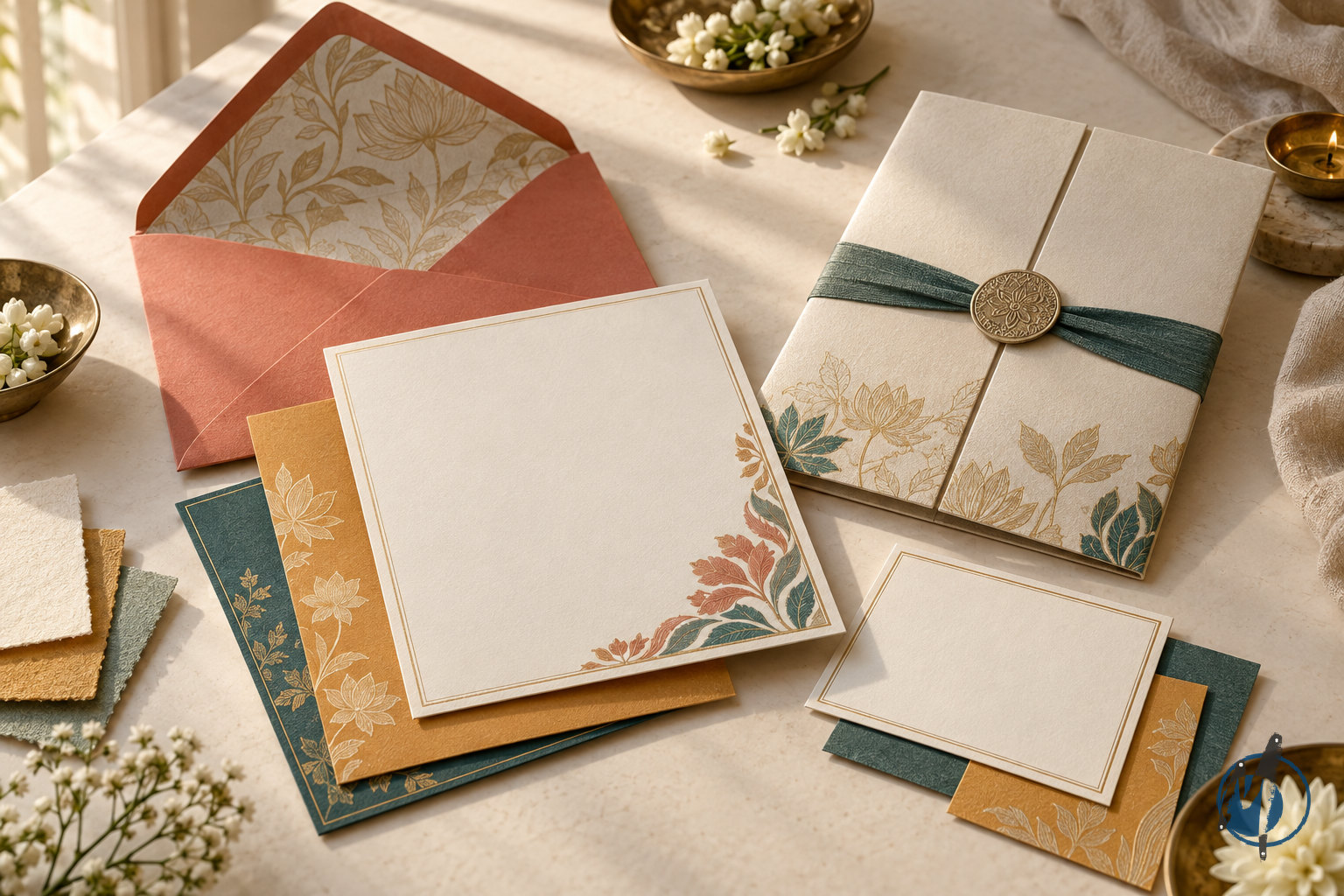
Quick answer: For custom wedding invitation printing in Delhi, start with your guest list, invitation format, paper preferences and delivery deadline, then compare proposals against the same specifications. Messketeers’ Custom Print & Packaging Studio — Fine Art & Commercial Print offers invitations and stationery alongside art prints, catalogues and large-format print, providing a starting point for a coordinated wedding paper brief. Approve the wording, artwork and an appropriate physical sample before committing to production.
What should custom wedding invitation printing in Delhi include?
A custom invitation is more than a card with your names on it. It is a small communication system: the main announcement, function details, practical instructions, envelopes and any presentation packaging must work together. The right scope depends on whether you are planning an intimate ceremony, a wedding with several functions or a celebration that requires guests to travel. Start by deciding what each guest genuinely needs to receive.
Clarify whether you need printing from finished artwork, adaptations of an existing design or a complete design-and-production brief. These are different services with different approval responsibilities. A printer working from supplied files may check technical suitability without editing wording or restructuring your information. If you want illustration, a monogram, bilingual typesetting or packaging development, make those requirements explicit rather than assuming they are included.
A useful enquiry for a Delhi wedding should identify the delivery destination, recipient groups and any local distribution arrangements. Do not assume that a studio’s ability to serve Delhi means it offers collection, same-day delivery or a local showroom. Confirm consultation, sampling and dispatch arrangements directly, especially when family members in different cities are involved in approvals.
Define the complete invitation suite
Main invitation with the couple’s names, hosts, ceremony date and venue.
Function-specific inserts for events such as the mehendi, sangeet or reception.
Travel, accommodation or access information where needed.
Envelopes, liners, seals, belly bands or presentation folders.
Optional RSVP cards, information cards and guest-name personalisation.
Coordinated wedding-day stationery, if it belongs in the same brief.
Which invitation format works best for your wedding?
Choose the format by balancing information, presentation and distribution. A single card can feel considered and luxurious when the typography, paper and spacing are right. A folded invitation gives information a natural sequence, while a pocket folder keeps multiple inserts together. A boxed invitation creates a stronger unboxing experience, but adds structural decisions, assembly work and shipping requirements.
Think in terms of recipient groups rather than total guest attendance. One household may need a single invitation, while different households may receive different function inserts. Before choosing an elaborate format, map these variations. A beautifully designed suite becomes difficult to manage if the packing team cannot reliably distinguish one guest category from another.
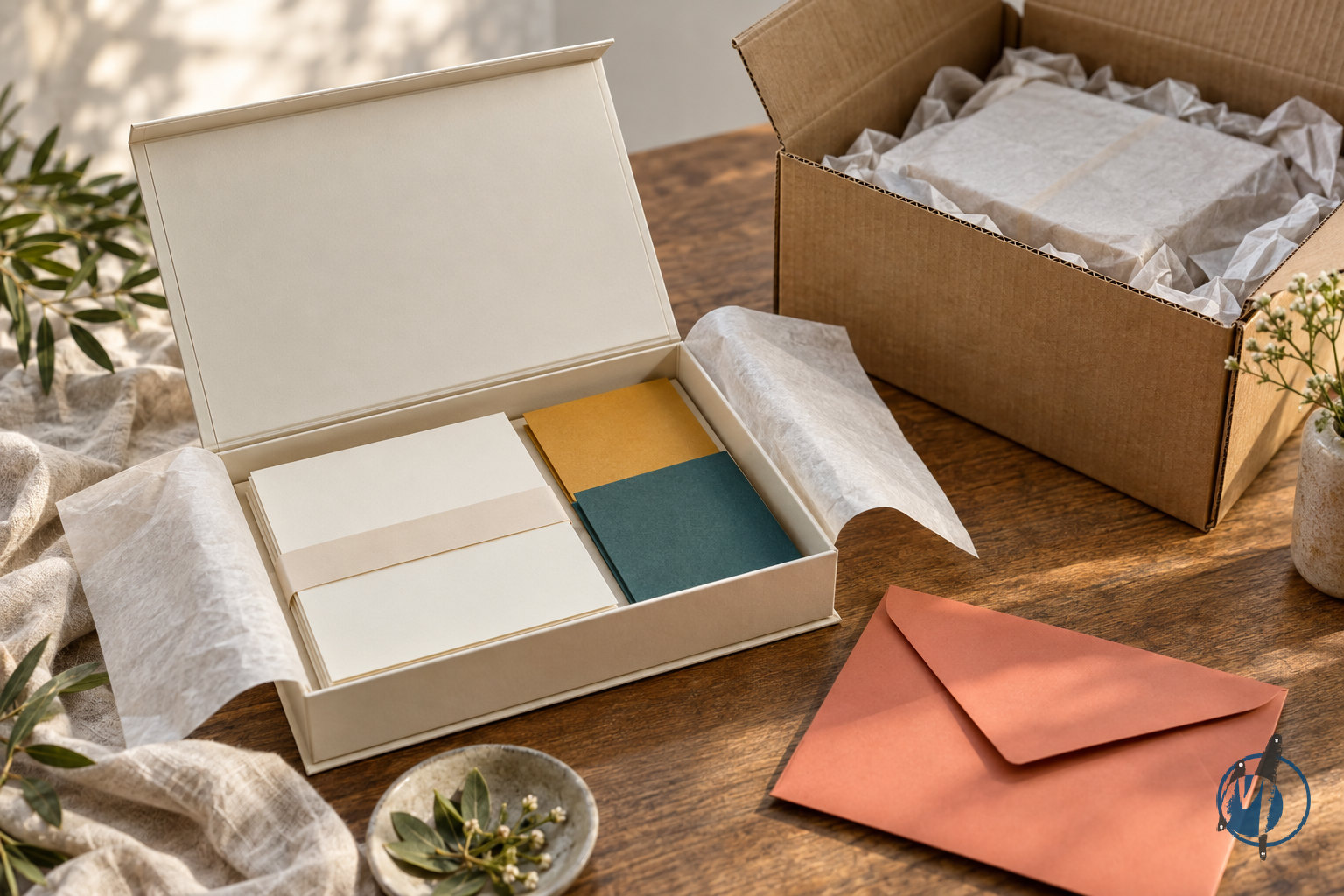
Presentation should also match how the invitation will travel. Hand-delivered suites can accommodate details that need careful handling, while courier-bound invitations benefit from secure closures and protective outer packaging. Test the complete packed object, not just the card. Thick embellishments, uneven inserts and delicate edges can behave very differently once an envelope is sealed or a box is stacked.
Format | Best suited to | Main advantage | Production consideration |
|---|---|---|---|
Single card and envelope | A focused, concise announcement | Simple to read and distribute | Limited space for extra instructions |
Folded invitation | Information that benefits from sequencing | Creates a clear reading flow | Fold position and scoring need care |
Multi-card suite | Weddings with several functions | Inserts can vary by guest group | Requires organised collation |
Pocket folder | Suites with several loose elements | Keeps the contents together | Capacity must match the actual inserts |
Boxed invitation | Presentation-led gifting or hand delivery | Offers a complete opening experience | Needs structural sampling and transit protection |
Which papers and printing methods should you compare?
Paper influences colour, tactile character, stiffness and the way a finish behaves. Smooth stocks can suit precise type and detailed illustration; textured stocks can add warmth but may affect fine reproduction. Coated papers often hold ink differently from absorbent uncoated papers. Ask to see samples resembling your intended artwork, rather than choosing from a blank swatch alone.
For substantial invitation cards, paper weights typically fall around 250–400 gsm as general industry guidance, but gsm is not a direct measure of thickness or rigidity. Two papers with the same weight can feel different because of their composition and bulk. For folded pieces, grain direction and scoring matter as much as weight: an unsuitable combination can produce cracked folds or a card that will not sit comfortably closed.
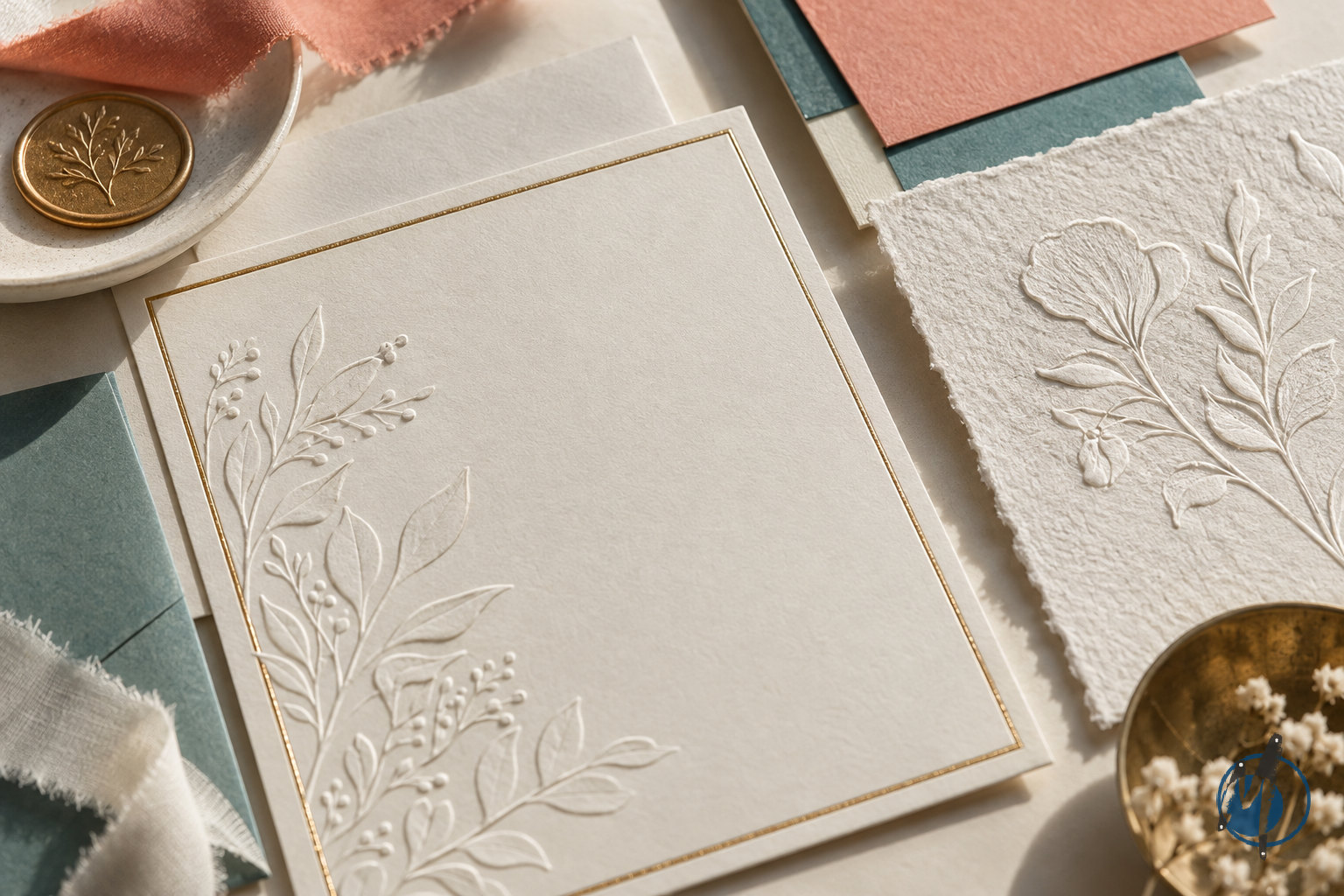
Printing method should follow the artwork and production brief, not a hierarchy of what sounds most premium. Digital printing can be practical for smaller quantities and variable information; offset may be appropriate for particular quantities, colour requirements and stock choices. Specialist finishes such as foil, embossing or letterpress require separate suitability checks. Confirm their availability, artwork requirements and sample options before designing around them.
Option | Visual or tactile character | Useful for | What to verify |
|---|---|---|---|
Digital print | Clean reproduction with flexible file changes | Colour artwork and personalised versions | Stock compatibility and colour consistency |
Offset print | Controlled reproduction across a production run | Suitable quantities and defined colour requirements | Setup, proofing and paper options |
Foil stamping | Reflective or opaque metallic detail | Selected names, borders or motifs | Minimum detail size and registration tolerance |
Embossing or debossing | Raised or recessed surface detail | Restrained, tactile compositions | Paper response and reverse-side appearance |
Letterpress | Inked impression in suitable paper | Designs developed for the process | Fine-detail limits and impression depth |
Match the process to the artwork
Fine botanical artwork, broad colour fields and metallic line work place different demands on production. Giclée belongs to the fine-art printing conversation and may be relevant to an illustration-led keepsake, but it is not automatically the right process for an invitation suite. Ask which method serves the intended object and handling conditions best.
How do you make the design personal without losing readability?
A strong invitation has an information hierarchy: who is getting married, what the guest is invited to, when it happens and where to go. Decorative elements should reinforce that hierarchy rather than interrupt it. Establish the main reading order before choosing borders, illustrations or finishes. If an ornate typeface makes a venue name difficult to read, reserve it for a shorter decorative line.
Personalisation works best when it is specific and restrained. A meaningful architectural detail, a family motif, a favourite flower or an illustration connected to the wedding setting can create character without filling every surface. Choose a limited visual vocabulary and carry it across the suite. Repetition of spacing, colour and motifs often creates more coherence than adding a different technique to every insert.
For bilingual or multilingual invitations, plan the layout around the actual scripts from the beginning. Translations can occupy different amounts of space, and fonts may not support every character correctly. Have a fluent reader review each language in the final layout, including names, honorifics and ceremonial wording. Check small type on a physical proof at actual size rather than relying on a zoomed-in screen view.
Keep practical information accessible
Use sufficient contrast between text and its background.
Separate the venue name from the full address so both are easy to scan.
Write dates and times unambiguously and confirm every function’s details.
Test QR codes from a printed sample using more than one phone.
Include essential venue information in print rather than relying only on a link.
Obtain permission for commissioned or licensed illustrations and other artwork.
What determines the cost of custom wedding invitation printing?
The meaningful unit is usually the finished suite, not the individual printed card. A proposal can appear inexpensive until envelopes, inserts, finishing, guest-name printing, assembly and shipping are added. Ask for a clear scope that distinguishes design, sampling, print production, specialist processes, packaging and logistics. For boxed formats, structural development should also be identified where applicable.
Quantity affects production economics, but so do the number of versions and the complexity of each version. Several insert combinations can create additional file preparation, checking and collation work even when the total quantity remains unchanged. Ask whether the quote assumes identical suites or personalised sets, and whether the supplied quantity includes samples, family keepsakes and contingency copies.
To manage the budget, simplify selectively rather than reducing every specification. You might retain a distinctive paper and remove an unnecessary insert, or concentrate a specialist finish on the main card. Compare alternatives using the same artwork and quantities. A recommendation is useful when it explains the trade-off in appearance, handling or production—not merely that one option costs less.
Ask for these items in the quotation
Finished dimensions, component count and quantity per version.
Paper specification for each component, including envelopes.
Print method, colour requirements and specified finishes.
Design scope, revision terms and proofing arrangements.
Personalisation, assembly and packaging responsibilities.
Taxes, dispatch charges and any separately billed services.
Terms for changes after approval and for production discrepancies.
What does a reliable design-to-delivery process look like?
Plan backwards from when invitations must reach guests, not only from the wedding date. Allow for design decisions, family review, sampling, production, assembly and transit. Custom papers, structural packaging, specialist finishes and revised wording can all affect the schedule. Request a written timeline based on the final scope rather than treating an early estimate as a confirmed dispatch commitment.
Choose one person to consolidate feedback from the couple and their families. Multiple reviewers are normal; conflicting instructions are avoidable. Keep a single approved wording document and a clearly labelled set of artwork versions. The studio should be able to identify which file is approved for each component and which recipient list governs any personalisation.
Follow this step-by-step workflow
Prepare the brief. Share your visual references, quantities, functions, languages, budget priorities and delivery needs.
Define the suite. Agree on dimensions, components, recipient variations, envelopes and presentation packaging.
Select materials and processes. Review suitable papers, print methods and finish references before refining artwork.
Develop and check the artwork. Establish hierarchy, confirm wording and prepare all required versions.
Review appropriate proofs. Check digital content proofs and request physical tests for material or production concerns.
Approve the production specification. Sign off the files, quantity, paper, finishing and delivery details in writing.
Produce, inspect and assemble. Check print quality, trim, insert combinations, personalisation and packing.
Dispatch and receive. Confirm shipment details and inspect the delivered order promptly against the agreed scope.
A timeline should explain what starts the production clock: receiving the deposit, approving the final proof or confirming material availability may be separate milestones. Ask how late changes affect the schedule and cost. If the date is fixed, seek a simpler feasible specification rather than assuming every finishing process can be accelerated.
What should you check before approving the final print run?
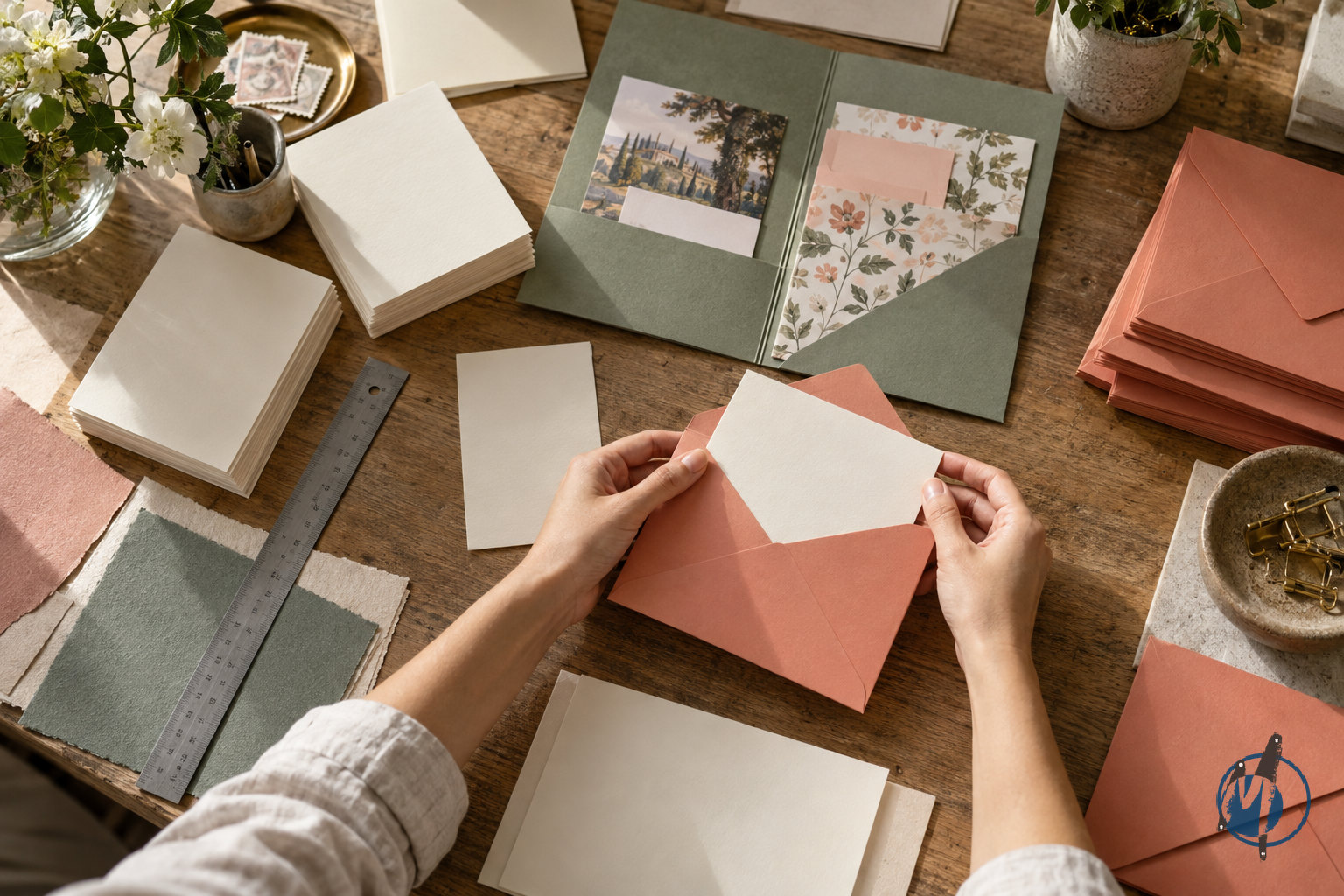
A PDF proof and a physical proof answer different questions. The PDF is essential for wording, layout and component versions, but your screen cannot reliably represent paper texture, metallic reflection or the final tactile result. A physical sample can reveal readability, folding, envelope fit and how several components feel together. Ask exactly which aspects of the final product the sample represents.
Colour approval needs particular care when moving from illuminated screens to printed paper. Very bright screen colours may not reproduce as expected, and the stock’s base shade affects the result. Compare colour in consistent lighting and agree on the appropriate reference. A simulated foil effect in a digital mock-up is not evidence of how the actual foil will look.
Final approval checklist
Names, titles and family relationships are correct.
Dates, days, times, venue names and addresses are verified.
Every language has been reviewed by an appropriate reader.
Each guest group receives the correct function inserts.
Fonts, image resolution, bleed and safe margins meet production requirements.
QR codes and links work from the actual printed size.
Fine lines, small text and finishing details meet process limits.
Folded cards close properly and fit the selected envelopes.
Personalisation data has been checked and shared securely.
Quantities, assembly instructions and dispatch details are approved.
Ask the studio to specify bleed and safe-area requirements for your particular format instead of guessing them. Keep essential content away from trim and fold positions, and supply editable or production-ready files as requested. After approval, even a minor wording adjustment can require a new file check or proof; avoid making undocumented changes through scattered messages.
Which common mistakes should you avoid with Delhi wedding invitations?
One common mistake is choosing finishes before understanding their limits. Fine foil lines, tiny reversed-out lettering or detailed artwork over a strong texture may look attractive in a render but reproduce poorly. Another is selecting a box before the contents are finalised. Packaging must be designed around the actual stack of cards and any additional items, with enough protection to keep everything stable.
Distribution deserves the same attention as design. A suite intended for Delhi hand delivery may need different protection when sent elsewhere by courier. Do not treat the presentation envelope or decorative box as transit packaging. Consider handling, dust and exposure to moisture, and keep stored invitations in clean, dry conditions away from direct sunlight until they are distributed.
Avoid these preventable problems
Ordering by headcount: count households and individual recipients, then map invitation versions.
Leaving envelopes until last: confirm availability and fit before finalising the card dimensions.
Approving only on a phone: inspect detailed proofs at a readable size and review physical samples where relevant.
Adding too many embellishments: prioritise a coherent composition and comfortable handling.
Ignoring assembly: define insert order, closures and version labels before packing begins.
Sharing unclean guest data: remove duplicates, verify spellings and limit access to personal information.
Assuming materials are recyclable: check the complete construction, including coatings, adhesives and mixed-material details.
If lower-impact production matters to you, discuss it at the briefing stage. Fewer components, efficient sheet use and paper-based presentation can be useful directions, but material claims should be supported by available documentation. Avoid calling a suite sustainable solely because its paper looks natural or because one component contains recycled fibre.
How can Messketeers help with your wedding invitations?
Messketeers is an India-based creative studio working across brand identity, custom print and packaging, OEM stationery manufacturing, and experiential decor and paper art installations. Its Custom Print & Packaging Studio — Fine Art & Commercial Print offers invitations and stationery, giclée and art prints, catalogues and lookbooks, and large-format print. For a wedding brief, that breadth provides a useful context for discussing how individual printed pieces can belong to one visual world.
Start the conversation with the invitation, then identify any related requirements: ceremony programmes, menus, place cards, welcome notes or printed event graphics. Discuss the suitability and availability of each item rather than assuming every material, finish or installation is part of a standard package. Where print and decor need to coordinate, shared artwork, colour references and clear dimensions can help prevent disconnected results.
For a productive enquiry about custom wedding invitation printing in Delhi, share the wedding date, required delivery date and location, household-based quantities, function list, language needs and design references. Mention whether artwork already exists and which decisions are still open. Ask Messketeers to recommend an appropriate scope, sampling approach and production plan, with specialist finishes and logistics confirmed before approval.
Bring this to your first consultation
A concise description of the wedding’s visual direction.
Your preferred format, or the practical needs it must solve.
A draft of the complete wording and recipient categories.
Budget priorities and elements you are willing to simplify.
Delivery requirements and one designated approval contact.
The best outcome is not the invitation with the most processes attached to it. It is a well-made suite that feels personal, communicates clearly and reaches guests in good condition. A clear brief and disciplined proofing process give the creative work room to succeed.
Frequently asked questions
How do I choose a custom wedding invitation printer for Delhi?
Compare studios using an identical brief: quantities, dimensions, components, paper, finishes, personalisation and delivery destination. Review relevant physical samples and ask how proofing, assembly and discrepancies are handled. Confirm whether you are buying printing alone or design support as well, and verify Delhi delivery or collection arrangements directly.
What is the best paper for wedding invitations?
The best paper depends on the artwork, format and print process. Smooth stocks can support fine detail, while textured papers create a more tactile result. Weight alone does not determine quality or stiffness. Review printed samples, test folds and envelope fit, and confirm that your chosen paper suits any specialist finish.
How much does custom wedding invitation printing cost?
Cost depends on the complete suite: quantity, paper, dimensions, number of inserts, print processes, finishes, personalisation and packaging. Design, sampling, assembly, taxes and delivery may be separate items. Request an itemised quotation against an agreed specification, then compare simpler alternatives if you need to prioritise spending without losing the intended character.
How early should I order wedding invitations?
Work backwards from the date guests need to receive them. Your schedule must accommodate design, family approvals, material availability, proofing, production, assembly and delivery. Ask for a project-specific timeline once the scope is defined. Complex packaging, specialist finishes or late wording changes can affect the agreed schedule, so confirm approval deadlines in writing.
Can wedding invitations include Hindi and English together?
Yes, bilingual invitations can be designed with clear hierarchy and appropriate space for both scripts. Supply verified wording and use fonts that support all required characters. Have a fluent reader check the final layout, not just the source document, and inspect a printed sample to confirm that smaller text remains comfortable to read.
Does Messketeers offer stationery beyond wedding invitations?
Messketeers’ Custom Print & Packaging Studio offers invitations and stationery alongside giclée and art prints, catalogues and lookbooks, and large-format print. Share your requirements for coordinated wedding pieces and event graphics to discuss suitability. Confirm the scope, materials, production methods, sampling and delivery arrangements for each requested item before commissioning the work.