
Luxury Gift Hamper Packaging Design: An Expert Guide
· 11 min read
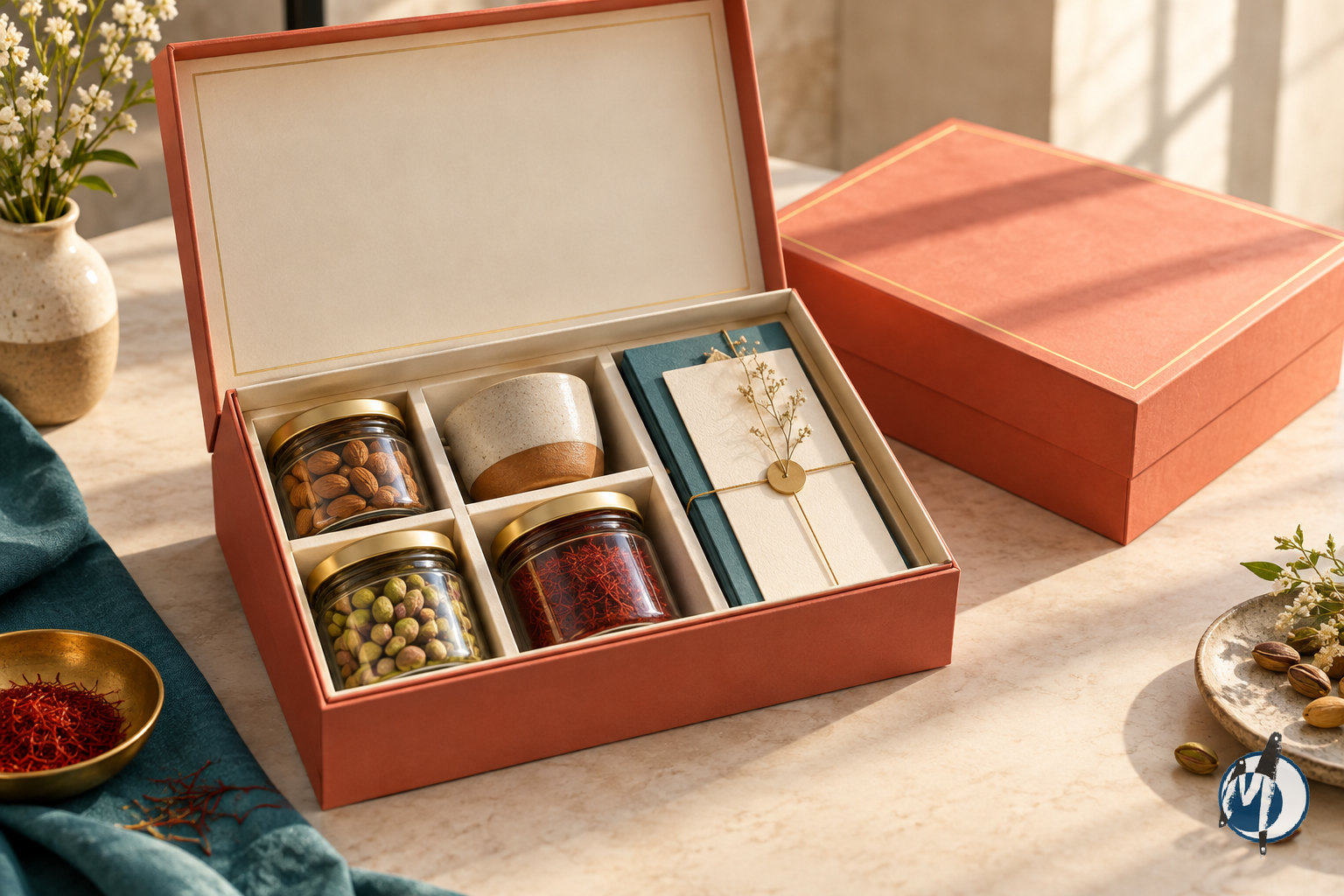
Quick answer: Luxury gift hamper packaging design brings together a well-engineered box, secure product placement, refined materials and a deliberate unboxing sequence. The best solution feels premium while protecting its contents, working within the production budget and making practical sense for delivery, assembly and disposal. Start with the actual gifts and their journey, then choose the structure and finishes—not the other way around.
What makes luxury gift hamper packaging feel genuinely premium?
Luxury is not simply a thicker box or a larger area of gold foil. It is the consistency between what the recipient sees, touches and discovers. A neatly wrapped corner, a lid that opens without resistance and an insert that holds every item in position communicate care more convincingly than decorative excess. Good packaging should also reflect the value and character of the gifts rather than overwhelm them.
The experience begins before the box opens. Proportions, weight distribution, surface texture and the clarity of the opening mechanism all shape expectations. Inside, the arrangement should give the recipient an immediate understanding of the collection: what the main gift is, how the supporting products relate to it and what to lift out first. Avoid making people excavate layers of filler to find the contents.
For Indian gifting occasions, cultural relevance can come through colour, illustration, pattern and material rather than predictable festive motifs. A Diwali hamper, wedding welcome gift or corporate appreciation box can share the same structural platform while using different sleeves, cards and interior graphics. This keeps the design system coherent without making every occasion look identical.
Build luxury through a clear hierarchy
Structure: Choose proportions and construction appropriate to the contents.
Touch: Use paper and finishes that support the intended mood.
Reveal: Arrange products in a purposeful opening sequence.
Detail: Align edges, patterns, ribbons and insert openings carefully.
Restraint: Give one or two elements visual importance instead of competing effects.
Which box structure is best for a luxury gift hamper?
The right structure depends on total packed weight, product fragility, delivery conditions and how the box will be assembled. Rigid boxes offer a substantial presentation format, while folding cartons can be efficient for lighter gifts and flat storage. Neither is automatically luxurious: a precisely designed folding carton can feel more considered than a poorly finished rigid box.
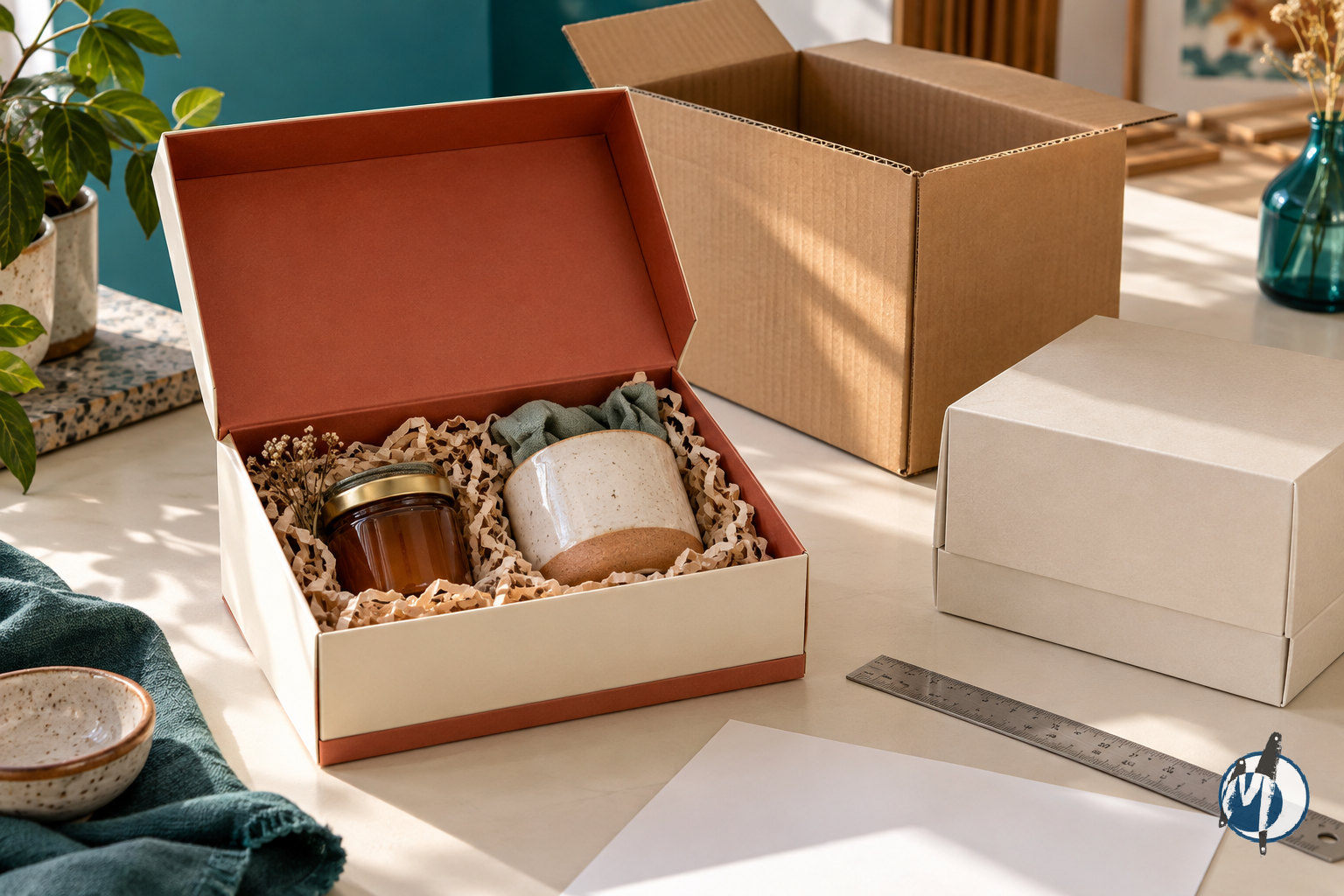
A presentation box and a shipping box serve different purposes. Most decorative hamper boxes should not be expected to survive courier handling unprotected. Plan the outer shipper, cushioning and protection against rubbing alongside the presentation structure. Otherwise, a successful studio sample may arrive with crushed corners, scuffed surfaces or displaced contents.
Use the comparison below as a starting point, then confirm the choice with a physical prototype containing the actual products. Board specification, insert geometry and manufacturing quality can change performance significantly within any format.
Structure | Best suited to | Presentation strength | Practical consideration |
|---|---|---|---|
Rigid lift-off lid box | Curated gifts and keepsake-oriented hampers | Clean silhouette and substantial feel | Occupies storage space; lid fit needs testing |
Hinged rigid box | Layered reveals and coordinated gift sets | Controlled opening and a clear display surface | Hinges and any closure components need careful detailing |
Drawer-style box | Compact collections and sequential reveals | Engaging opening action | Drawer clearance and pull strength require testing |
Folding carton | Lightweight gifts and scalable programmes | Strong graphics with efficient construction | Load-bearing capacity must match the contents |
Flat-pack rigid-style box | Programmes with storage constraints | Substantial appearance after assembly | Assembly consistency and joint strength matter |
Printed corrugated gift box | Delivery-led gifting and heavier collections | Can combine attractive presentation with protection | Shipping suitability still depends on construction and testing |
Decide around the hardest requirement
If the hamper contains glass bottles, engineer protection first. If fulfilment space is limited, assess flat-pack options early. If recipients are likely to retain the packaging, give the box a useful shape and an interior that can be removed without damaging it.
How should you design the interior and unboxing sequence?
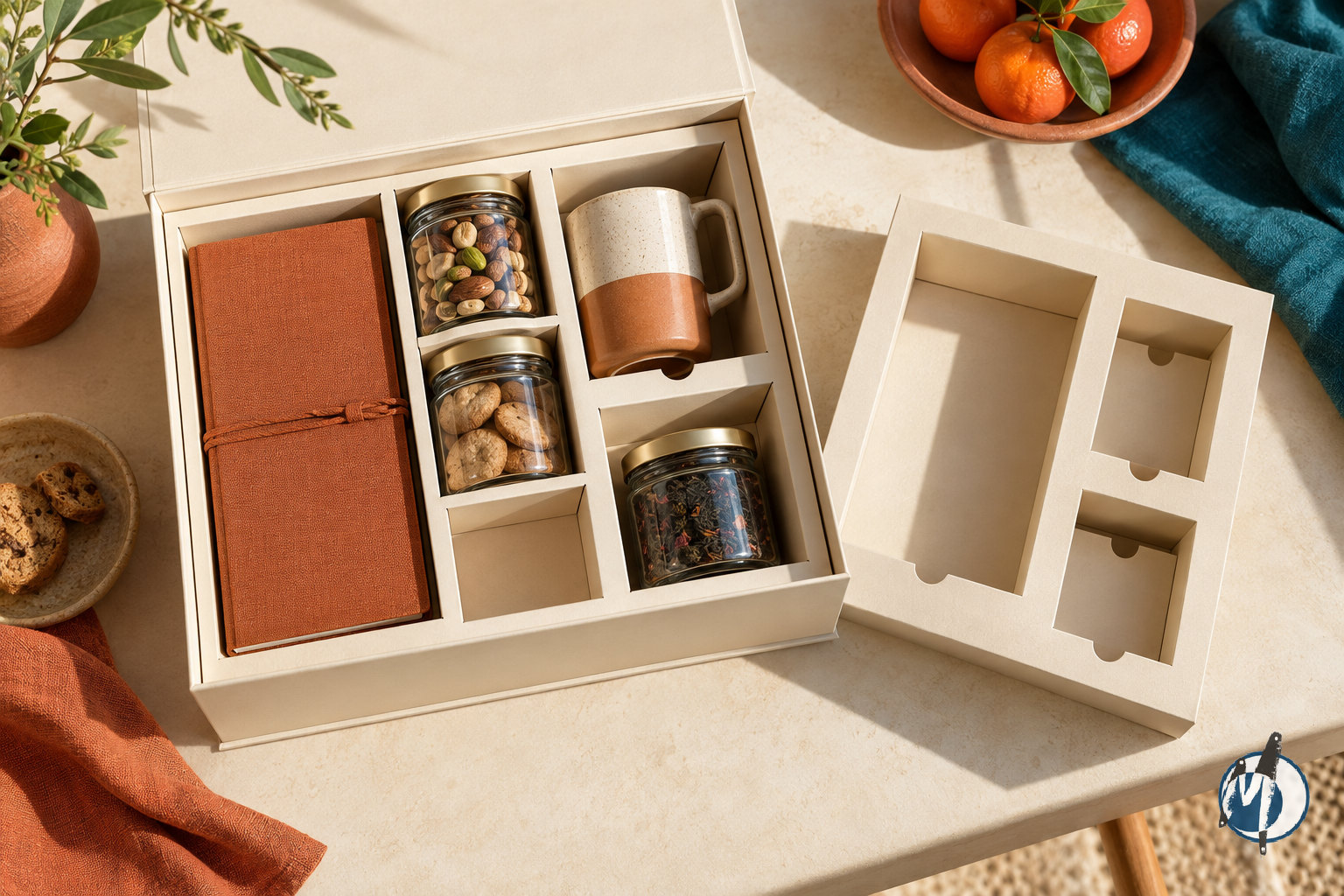
Interior design starts with a complete product inventory, not an empty box sketch. Record each item's dimensions, weight, orientation, fragility and surface sensitivity, including its retail packaging. Account for caps, handles, bows and irregular shapes. If the products vary between batches, establish which dimensions may change before locking the insert design.
Create a visual hierarchy that also makes structural sense. A taller bottle might be the focal point, but it should not make the hamper unstable or transfer weight onto a delicate neighbouring item. Separate hard surfaces that could knock together, support products at sensible contact points and provide finger access for removal. A snug fit should never require the recipient to pull forcefully on a fragile component.
The reveal should feel effortless. A card or paper wrap can introduce the collection, followed by the gifts in an arrangement that remains attractive after transport. Loose filler may support a relaxed aesthetic, but it is not a substitute for engineered restraint. Check whether opening the box scatters material, hides smaller gifts or makes the recipient unsure what is recyclable.
Choose inserts by function
Die-cut paperboard: Useful for defined product positions and an integrated printed appearance.
Corrugated board: Useful where cushioning and structural support are priorities.
Moulded fibre: Worth evaluating for suitable volumes and forms, subject to tooling and surface requirements.
Removable dividers: Helpful for modular assortments and later reuse.
Specialist cushioning: Appropriate where fragility demands it, with material separation considered from the outset.
For hampers containing food, keep food-safe primary packaging intact. Decorative tissue, adhesives, printed board and cushioning should not be assumed suitable for direct food contact. Confirm relevant requirements with the product supplier and packaging manufacturer.
Which materials and finishes create a refined luxury look?
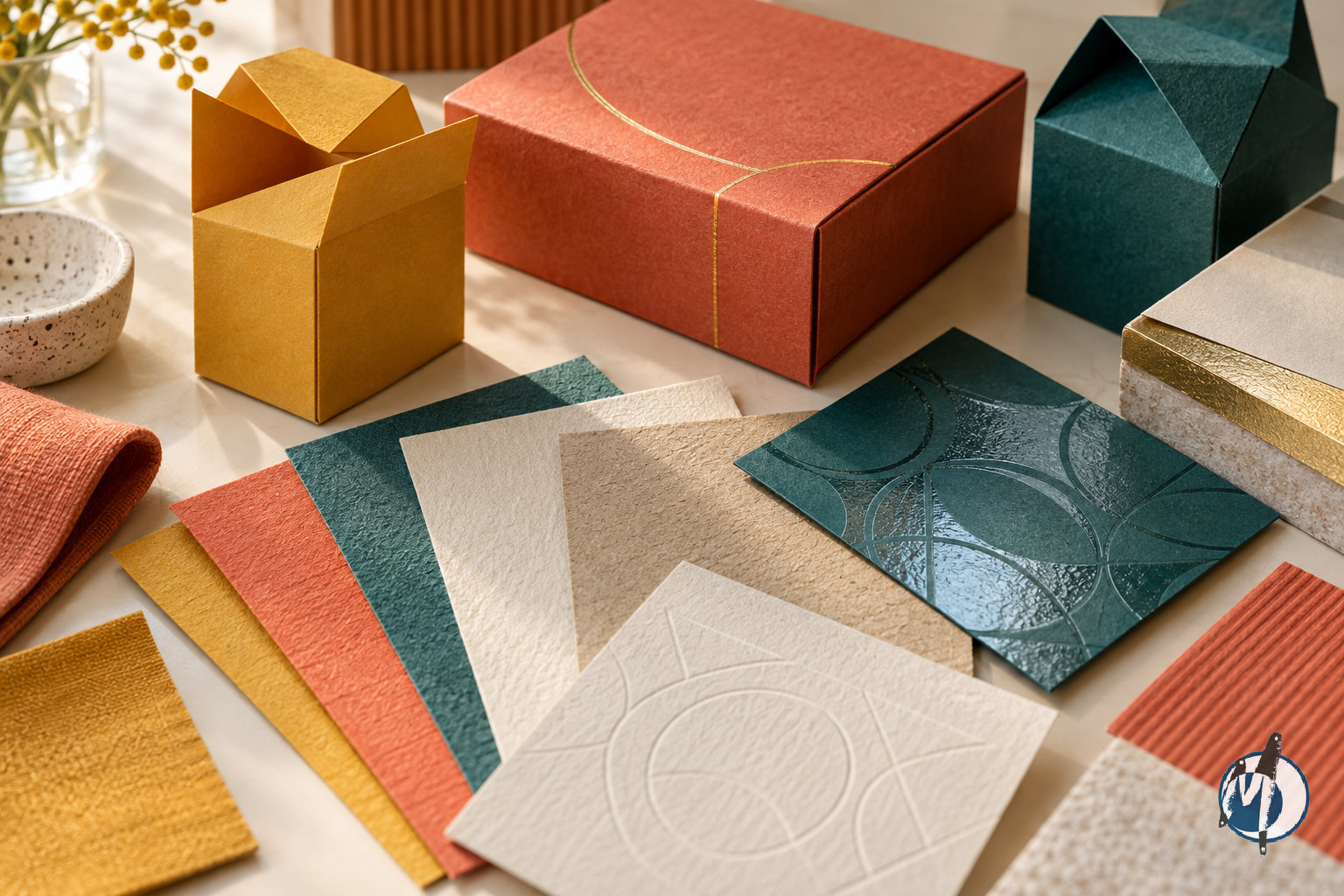
Start with the substrate because it determines how colour, texture and finishing behave. Uncoated papers can feel tactile and understated; coated surfaces may support a different level of image sharpness and finish contrast. Textured wraps can be expressive, but their surface may affect fine foil details or printed consistency. Review physical swatches rather than choosing materials only from screen images.
Foil, embossing and spot UV work best when each has a specific role. Foil can draw attention to a small emblem or border. Embossing adds relief and tactility, while spot UV creates contrast between selected glossy areas and the surrounding surface. Combining all three is not inherently better; too many effects can obscure the design and introduce avoidable production complexity.
Approval should include the real substrate and intended finish wherever feasible. Fine lines, small reversed details, folding positions and textured surfaces may need adjustments. Ask the production team to confirm achievable detail and registration before artwork is finalised. Also inspect dark colours for visible scuffing and test finishes against the rubbing expected during packing and delivery.
Give every finish a reason
Use foil to create a focal point, not simply to fill unused space.
Use embossing where touch contributes to the experience and the construction supports it.
Use spot UV for deliberate contrast, with alignment tolerances considered.
Use printed colour confidently when illustration or pattern can provide the richness.
Leave quiet areas so texture, proportions and workmanship remain visible.
Can luxury hamper packaging also be sustainable?
Yes, but sustainability is a design and sourcing decision rather than a colour palette. A kraft appearance does not prove recyclability, and an elaborate reusable box is not automatically a lower-impact choice. Begin by reducing unnecessary volume, avoiding components without a protective or experiential purpose and selecting materials that suit realistic collection and recovery routes.
Evaluate the whole pack, including inserts, wraps, closures, ribbons and the shipping carton. A mostly paper-based structure with easily removable non-paper components may be simpler to separate than a permanently bonded mixed-material design. However, recyclability depends on the construction and local infrastructure; coatings, laminates, adhesives and decorative treatments should be assessed with the supplier rather than judged by appearance alone.
Reusability works best when it is credible. A sturdy box with practical proportions and removable dividers can become storage, while a highly customised cavity may have little use after the gifts are removed. If making recycled-content, certified-fibre or other environmental claims, obtain documentation for the actual material supplied. Keep claims specific and avoid vague language such as “completely eco-friendly.”
A practical sustainability order of priorities
Right-size the box without compromising protection.
Remove unnecessary layers and decorative components.
Select materials appropriate to the product and distribution journey.
Design components for straightforward separation where possible.
Verify sourcing and material claims with supporting documentation.
Explain reuse or disposal clearly without overstating local recycling access.
What affects cost, quantities and production timelines in India?
Cost is shaped by more than box dimensions. Structure, board and wrap specifications, print coverage, finishing operations, insert complexity, assembly labour and order quantity all influence the quotation. Custom dies, embossing tools or foil blocks may also create setup costs. Comparing quotations is meaningful only when suppliers are working from the same specification and quality expectations.
Separate the presentation pack from the complete gifting operation. Shipping cartons, cushioning, product loading, personalised cards, storage, freight and damage allowances may sit outside a box-only quotation. If individual recipient names or different product assortments are involved, include sorting and checking requirements in the brief. A small artwork variation can create a much larger fulfilment task.
Timing depends on material availability, sampling, approvals, manufacturing capacity and the degree of customisation. Festive gifting programmes should be planned backwards from the required delivery date, with explicit time for sample review, revisions and dispatch. Avoid treating the factory completion date as the date recipients will receive their gifts, especially when deliveries span multiple Indian cities.
Where thoughtful simplification helps
Standardise a structural platform across related gifting occasions.
Change sleeves, cards or printed wraps instead of redesigning every component.
Reduce unnecessary finishing passes while retaining a clear focal detail.
Confirm locally available material alternatives before specifying an unusual paper.
Design inserts around confirmed assortments rather than late-stage assumptions.
Request separate visibility on tooling, production, assembly and logistics costs.
Ask for a written specification alongside the quotation. It should identify dimensions, materials, printing, finishes, inserts, packing responsibilities and approval stages. This gives both the studio and the buyer a common basis for decisions when scope changes.
What is the step-by-step process for designing a luxury gift hamper?
A reliable process resolves physical constraints before committing to decoration. Share actual product samples as early as possible; photographs and nominal dimensions may miss details that affect fit. The working brief should also describe the recipient, occasion, brand character, distribution method, quantity and budget priorities so the creative direction responds to a real use case.
Approval works best through distinct checkpoints. Structural approval confirms fit and function, artwork approval confirms the graphic design, and a production-representative sample helps assess materials and finishing. If a sample uses substitute materials or a different production method, record those differences. Otherwise, an attractive prototype can create expectations the final specification does not support.
Follow these production stages
Define the gifting objective. Establish who receives the hamper, what it should communicate and how it will be delivered.
Audit the contents. Measure and weigh every item, noting fragile surfaces, orientation and any special handling needs.
Develop the structure. Choose the box format, insert layout, removal method and outer shipping protection.
Create the visual direction. Establish colour, typography, illustration, material character and finishing hierarchy.
Build and review prototypes. Test actual products for fit, accessibility, balance, lid clearance and movement.
Validate production details. Check dielines, artwork placement, material availability and finish feasibility with the manufacturer.
Test the packed system. Assess handling, rubbing, stacking and transit risks appropriate to the distribution route.
Approve and manufacture. Lock the specification and define quality checks, acceptable variation and packing instructions.
Assemble and dispatch. Verify assortments, protect presentation surfaces and inspect completed packs before shipping.
Treat late product substitutions as design changes, not simple purchasing swaps. A different bottle shoulder, jar diameter or gift weight can affect the insert, box depth and shipping performance. Recheck the relevant parts of the system before proceeding.
What mistakes should you avoid, and what should you check before approval?
The most common failure is designing an attractive empty box and discovering too late that it does not suit the gifts. Other issues include oversized packaging, insufficient finger access, finishes placed across problematic folds and protective materials chosen only for appearance. A luxury hamper should remain coherent when it is lifted, opened and emptied—not just when photographed from above.
Another mistake is approving appearance without testing handling. Examine corners, hinge areas, wrap edges and insert openings after the pack has been assembled and used. Where relevant, evaluate performance under the temperature, humidity and handling conditions expected along the delivery route. Food, cosmetics and other sensitive contents may need additional product-specific controls that a decorative box cannot provide.
Common mistakes to avoid
Using loose filler as the only restraint for heavy or fragile items.
Increasing box size simply to make the gift seem more valuable.
Specifying multiple finishes without testing their interaction.
Assuming a presentation box is courier-ready.
Making sustainability claims without evidence for the supplied materials.
Leaving assembly instructions and assortment checks until dispatch.
Pre-production approval checklist
Actual products fit, remain secure and can be removed comfortably.
The loaded box is balanced and closes without pressure on the contents.
Insert dimensions account for agreed product variation.
Printed colours and finishes have an agreed physical reference where feasible.
Corners, folds, edges and closures meet the approved construction standard.
Presentation surfaces are protected from rubbing during transport.
The outer shipping system has been assessed for the intended journey.
Material and sustainability claims have supporting documentation.
Packing instructions specify orientation, sequence and all included components.
Final artwork includes any applicable information without obscuring product labels.
Keep an approved reference sample and a written record of agreed changes. These provide a practical benchmark for production checks and help distinguish intentional revisions from avoidable inconsistencies.
How can Messketeers help with luxury gift hamper packaging design?
Messketeers is an India-based creative studio bringing together brand identity, custom print and packaging, OEM stationery manufacturing, and experiential decor and paper art installations. Its Custom Print & Packaging Studio — Packaging Solutions is the relevant starting point for luxury gift hamper packaging design, with services covering rigid and folding boxes, gift and hamper packaging, foil, embossing, spot UV and sustainable materials.
The opportunity is to treat the hamper as a complete brand experience rather than an isolated container. A considered direction can connect the outer box, interior arrangement, printed cards and finishing details. Where a gifting programme forms part of a larger event or brand launch, that visual language can also inform related stationery or paper-based presentation elements, subject to the project scope.
To begin a useful discussion, share the occasion, recipient profile, product list, quantities, delivery locations and target date. Add actual product dimensions or samples, brand guidelines and any sustainability priorities. This gives Messketeers the information needed to discuss appropriate structures, material directions and finishing options—balancing the desired luxury experience with the practical demands of production and delivery.
Frequently asked questions
What is the best box for luxury gift hamper packaging?
The best box depends on the contents, delivery method and intended experience. Rigid boxes suit substantial presentation and potential reuse, while folding cartons can work well for lighter gifts and efficient storage. Choose the structure after assessing product weight, fragility, insert requirements and shipping protection, then validate it with a loaded prototype.
How do you make gift hamper packaging look luxurious?
Focus on proportions, tactile materials, precise construction and a clear visual hierarchy. A restrained foil detail or embossed element can be more effective than several competing finishes. Inside, secure placement, easy product removal and a deliberate reveal create a premium experience that continues beyond the first impression.
Can luxury gift hamper packaging be recyclable?
It can be designed with recycling in mind, but suitability depends on the complete construction and available local infrastructure. Assess wraps, coatings, adhesives, inserts and closures, not only the main board. Prefer straightforward material combinations where practical, make non-paper elements removable and verify claims with the packaging supplier.
Does a luxury hamper box need separate shipping packaging?
Often, yes. A decorative presentation box may not provide adequate protection against courier impacts, stacking pressure or surface abrasion. The outer carton, cushioning and internal restraint should be designed as a system around the loaded hamper. Assess that complete system against the expected delivery journey before approving production.
What information should I provide for a hamper packaging quotation?
Provide the product list, dimensions, weights, quantity, preferred presentation style, delivery locations and required date. Include brand guidelines, finishing preferences and sustainability priorities. Clarify whether the scope covers inserts, shipping cartons, product loading, personalisation and dispatch, so quotations reflect the same deliverables rather than different assumptions.
Should I choose foil, embossing or spot UV?
Choose according to the desired effect and the selected substrate. Foil creates a reflective focal point, embossing adds tactile relief, and spot UV provides selective gloss contrast. Check feasibility on the actual paper and construction. One well-executed treatment may deliver a more refined result than combining every available finish.