 Messketeers
Custom rigid box packaging manufacturer India: Guide
· 12 min read
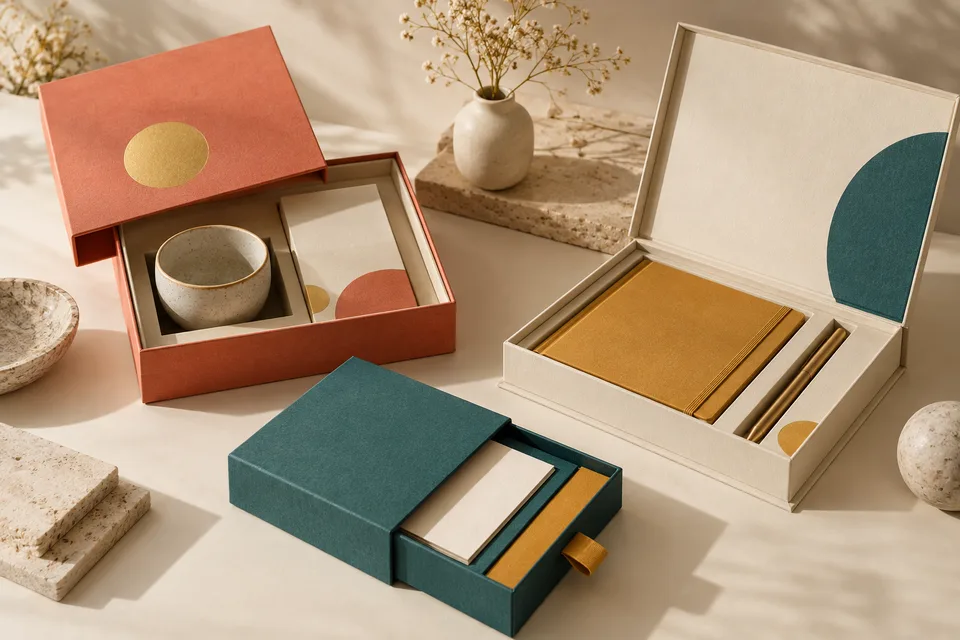
Quick answer: To choose a custom rigid box packaging manufacturer in India, compare structural design, material specifications, sampling, finish quality and delivery planning—not just the quoted box price. Messketeers’ Custom Print & Packaging Studio offers rigid and folding boxes, gift and hamper packaging, foil, embossing, spot UV and sustainable material options. The right solution starts with your product, its protection needs and the experience you want customers to have when opening it.
What should you look for in a custom rigid box packaging manufacturer in India?
A good packaging partner should turn a creative brief into a repeatable physical product. That means understanding how your product fits inside the box, how the box will be assembled, where it will travel and which visual details matter most. A supplier who asks about product weight, fulfilment methods and storage conditions is helping you resolve production risks before they become expensive changes.
Start by distinguishing design capability from production capability. A beautiful rendering does not establish that a closure will align, an insert will restrain a heavy product or a particular paper will wrap neatly around a corner. Ask who develops the structure, who prepares the artwork, how samples are approved and who is responsible for quality checks. If production involves specialist partners, responsibility for the finished result should still be clear.
When comparing manufacturers across India, consider logistics alongside capability. A nearby supplier can make physical reviews easier, while a more distant specialist may suit an unusual structure. Neither location nor the size of a catalogue proves quality. Evaluate a relevant sample, a written specification and a realistic production plan instead.
Questions worth asking early
Can you develop packaging around the actual product rather than a guessed dimension?
Which structural and decorative processes can you support, and how are they controlled?
What will the sample demonstrate, and what might differ in production?
How are material substitutions, defects and quantity changes handled?
Does the quotation include inserts, finishing, assembly and delivery, or price them separately?
When is a rigid box better than a folding carton or corrugated box?
Rigid boxes usually use a thick board core covered with paper or another specified wrap. Unlike a conventional folding carton, a standard set-up rigid box arrives in its formed shape. That construction creates a substantial feel and can support a deliberate opening sequence, making it useful for gifting, premium retail products, stationery sets and curated hampers. However, a rigid box is not automatically the best choice for every product.
A folding carton can be more suitable when compact storage, efficient assembly and lower material use matter more than a substantial presentation. Corrugated packaging is often better suited to transit protection, particularly for direct-to-consumer shipping. These formats can also work together: a presentation rigid box may travel inside a protective corrugated shipper. Compare the complete packaging system, not just the visible outer box.
Packaging format | Useful for | Main advantages | Important trade-offs |
|---|---|---|---|
Set-up rigid box | Premium gifts, retail presentation, curated kits | Substantial feel, precise presentation, custom insert options | Occupies storage space; often needs separate transit protection |
Folding carton | Lightweight retail products, repeat-volume packs | Ships flat before assembly; versatile print surface | Less structural stiffness than a rigid construction |
Corrugated box | E-commerce dispatch, heavier products, transit protection | Cushioning potential and structural options for transport | Appearance depends on board, printing and construction |
Collapsible rigid box | Premium presentation where flat storage is valuable | Can reduce inbound and storage volume before assembly | More complex construction; closures and assembly need testing |
Match the format to the job
Before choosing rigid packaging, identify its primary purpose: protection, presentation, shelf display, gifting or reuse. If several goals compete, prioritise them explicitly. A large hamper may need structural strength and carry comfort before decorative finishing; a compact stationery gift may depend more on organised compartments and a satisfying opening experience. The best format solves those specific needs without adding unnecessary bulk.
Which rigid box styles and inserts suit your product?
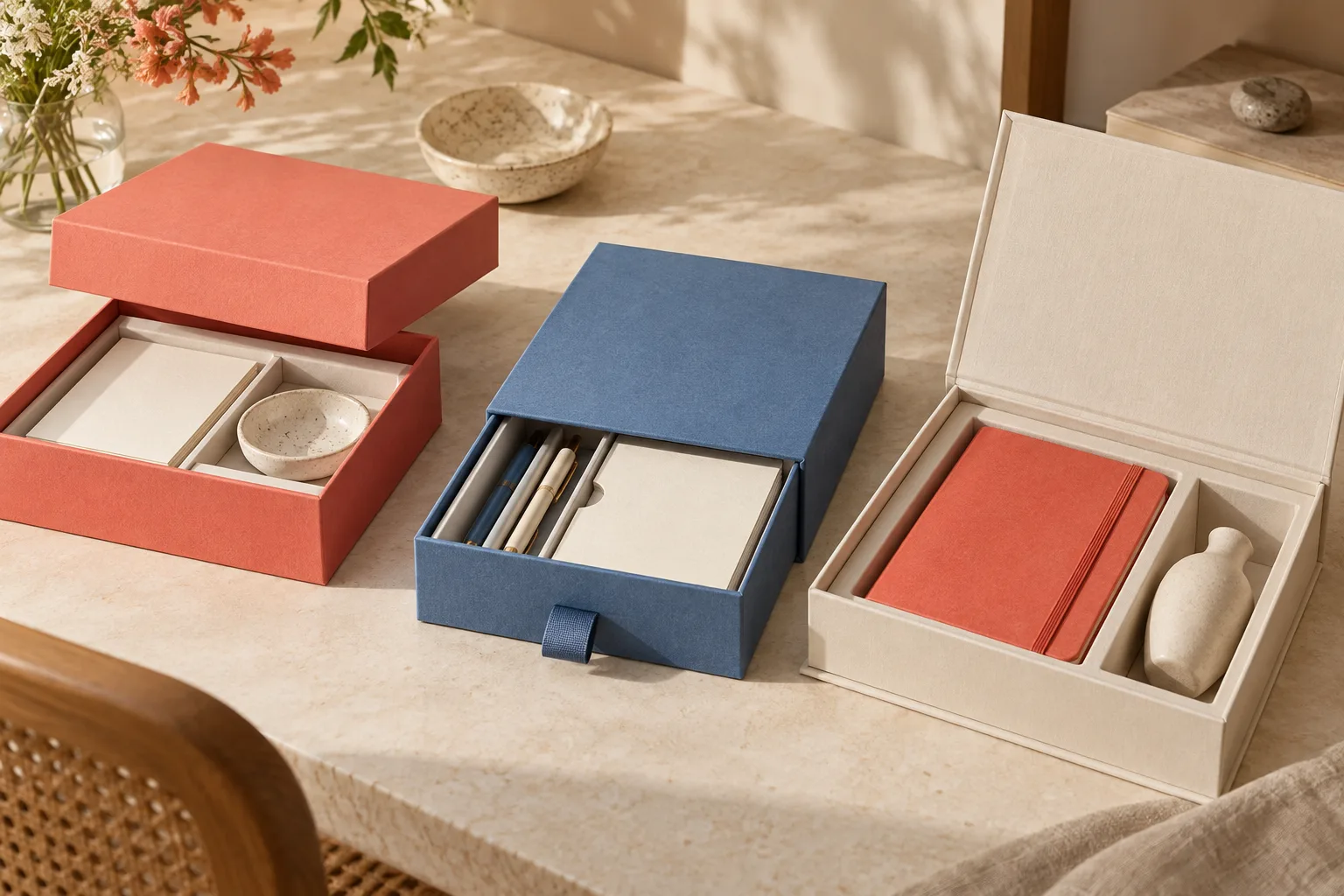
The opening mechanism shapes both the user experience and the manufacturing process. A lift-off lid offers a familiar, clean presentation, while a shoulder-and-neck construction reveals an inner collar as the lid opens. A book-style box can create a staged reveal, and a drawer box can make a small product feel considered and accessible. Each style needs enough clearance to function reliably after wrapping and finishing.
Select the structure using the product’s actual dimensions, weight and handling requirements. Measure the complete saleable unit, including caps, protective sleeves, accessories and any irregular protrusions. Do not confuse external box dimensions with usable internal space: board, wraps, collars and inserts all consume room. For a multi-product hamper, map every component and decide whether customers should see everything immediately or discover items in layers.
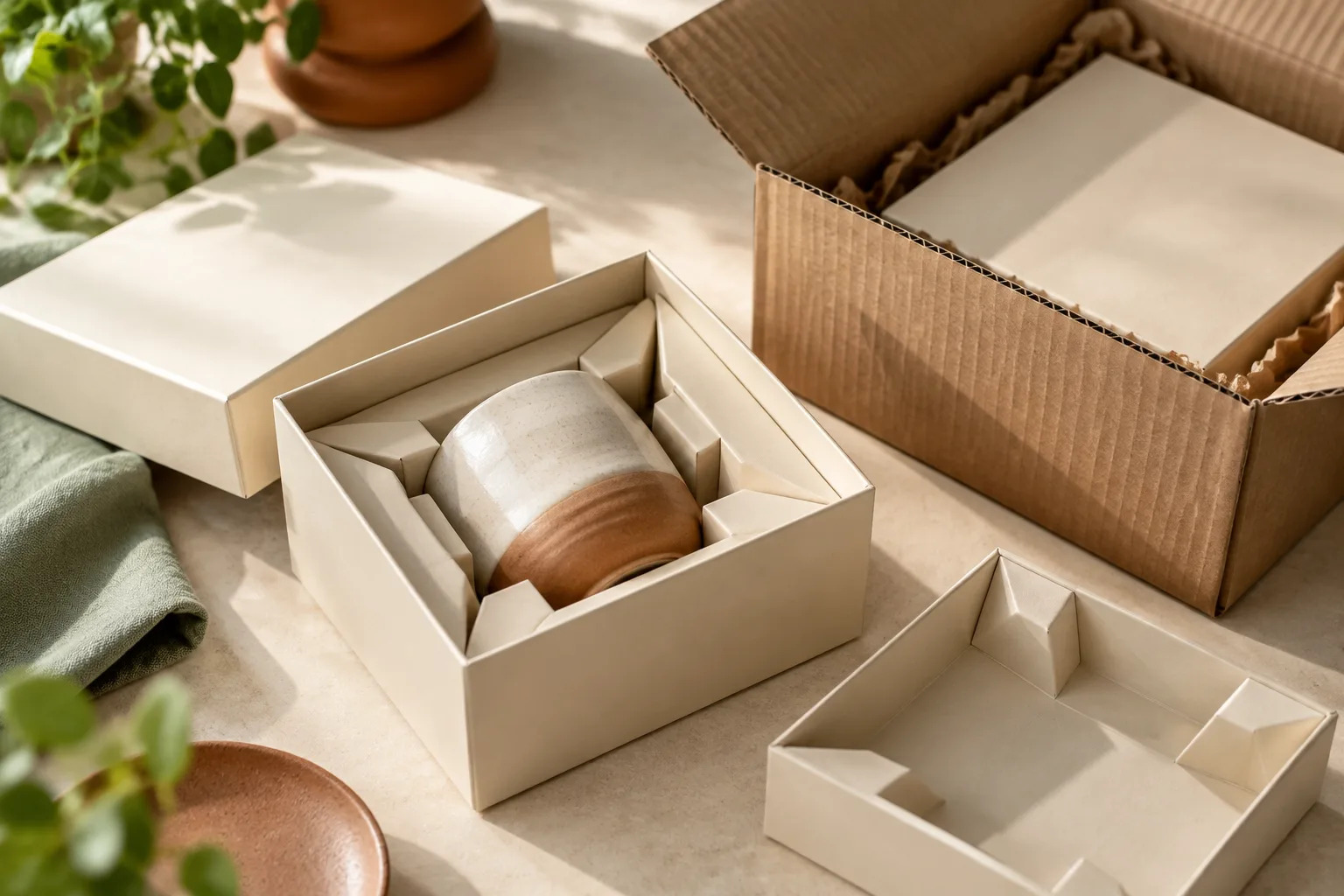
The insert is a functional component, not simply a decorative lining. It should stop unwanted movement while allowing the product to be removed without damage or frustration. Paperboard platforms, folded card dividers and moulded fibre can suit certain applications; foam or other cushioning materials may be appropriate where the protection requirement justifies them. Evaluate the whole material combination rather than assuming any one insert is universally best.
Check fit and usability
Lift-off lids: Check opening force, lid depth and whether the base lifts unintentionally.
Drawer boxes: Check sliding friction, pull-tab strength and product access.
Book-style boxes: Check hinge behaviour, closure alignment and repeated opening.
Hamper inserts: Check compartment strength and movement when the pack is tilted.
Heavy or fragile products: Check load-bearing areas, cushioning and the outer shipping pack.
How do materials, printing and finishes affect the result?
Rigid packaging quality depends on a combination of board stiffness, wrapping material, adhesive performance and assembly accuracy. Board thickness alone does not tell the whole story: the size of the box, unsupported spans, product weight and opening style all influence performance. Ask for a material specification that describes the board, wrap, lining and insert separately, along with the agreed dimensions and finish references.
Printing should be planned around the chosen surface and artwork. Smooth, coated paper behaves differently from textured or uncoated paper, especially for fine details and large areas of colour. Discuss process printing, spot colours or other appropriate methods with the supplier rather than assuming a screen preview predicts the physical result. Colour-critical projects need a defined approval reference under agreed viewing conditions; a digital mock-up alone is not a reliable colour standard.
Foil, embossing and spot UV can add emphasis, but each introduces production considerations. Fine foil details need suitable artwork and surface compatibility. Embossing needs careful placement and tool planning, particularly around folds or wrapped edges. Spot UV depends on the underlying print and coating system, and its appearance can vary with texture. Decide which feature deserves attention instead of treating every finishing option as an upgrade.
Specify finishes precisely
Foil: Confirm colour, sheen, coverage, registration and compatibility with the wrap.
Embossing: Confirm whether the desired effect is raised or recessed and approve its physical appearance.
Spot UV: Identify exact artwork areas and review gloss contrast on the proposed surface.
Lamination or coatings: Consider scuff resistance, fingerprints, folding behaviour and disposal implications.
Interior details: Specify lining colour, exposed edges, insert finish and accessory placement.
What determines the cost, minimum order quantity and lead time?
A custom rigid box quotation reflects much more than board and paper. Structural complexity, dimensions, order quantity, artwork versions, material availability, finishing tools, insert construction and manual assembly can all influence cost. A straightforward box in a readily available paper is not directly comparable with a multi-part hamper box that uses custom inserts, several decorative processes and individual packing accessories.
Minimum order quantity is also project-specific. It may be influenced by material purchasing quantities, print setup, finishing setup or the amount of assembly involved. Ask whether the quoted minimum applies to the overall order, each size, each artwork version or each colourway. If you need a smaller launch run, discuss simplifications rather than assuming the same specification can be produced economically at any quantity.
Lead time should be separated into development, sampling, approval, material procurement, production and dispatch. A date measured from initial enquiry is different from a production schedule that begins only after sample approval and artwork sign-off. For festive gifting, events and product launches, work backwards from the date packs must be ready for filling—not merely the date empty boxes are dispatched. Include time for receiving checks and any corrective action.
Compare quotations on equal terms
Request a breakdown covering the box, insert, printing, finishing, tooling, sampling, assembly, individual protection, outer cartons, freight and applicable taxes. Confirm whether tools can be reused for repeat orders and whether revised artwork or dimensions create new setup costs. Also clarify payment milestones, quotation validity, permissible quantity variation and the procedure for replacing non-conforming goods. These details make a quotation useful for planning rather than merely attractive at first glance.
What is the step-by-step process for developing custom rigid packaging?
An effective development process resolves structure before committing to decoration. Begin with a clear brief and an actual product sample wherever possible. If the product is still being finalised, identify which dimensions may change and avoid treating preliminary measurements as production-ready. The packaging schedule should account for these dependencies rather than hiding them inside a promised dispatch date.
Different samples answer different questions. A plain structural mock-up can establish fit, proportions and opening behaviour without proving print or finishing quality. A decorated sample can help establish visual direction, but some sample-making methods differ from bulk production. Agree what each sample represents, document any limitations and retain an approved physical reference for production comparison.
A practical development sequence
Define the brief. Record product details, audience, presentation goals, quantity by variant, delivery destination and required date.
Select the structure. Compare suitable box styles and decide how the product will be supported and removed.
Develop the prototype. Review internal fit, opening clearances, insert access and basic handling with the actual contents.
Finalise materials. Confirm board, wrap, lining, insert and closure components, including any sustainability requirements.
Prepare production artwork. Use supplier-approved templates and separate print, foil, embossing and coating instructions clearly.
Approve the sample and specification. Record dimensions, visual references, acceptable variation and any agreed departures from the sample.
Produce and inspect. Use agreed checkpoints to assess construction, printing, finishing and packing consistency.
Dispatch and review. Check received goods, test filling and document improvements for future orders.
For packaging that will enter a parcel network, include a suitable transit evaluation using the intended product and shipper. Testing an empty presentation box does not establish whether a filled pack will survive distribution. The evaluation should reflect relevant risks such as drops, vibration, compression and handling orientation; the appropriate test method depends on the product and delivery route.
How can rigid box packaging be more sustainable without compromising function?
Sustainable packaging decisions begin with reducing unnecessary material and volume. A closely fitted box with a well-designed insert may use fewer resources and occupy less transport space than an oversized presentation pack. However, reducing material until the product becomes vulnerable can be counterproductive. Balance material efficiency with adequate protection, because damage can lead to replacement products, additional packaging and another delivery.
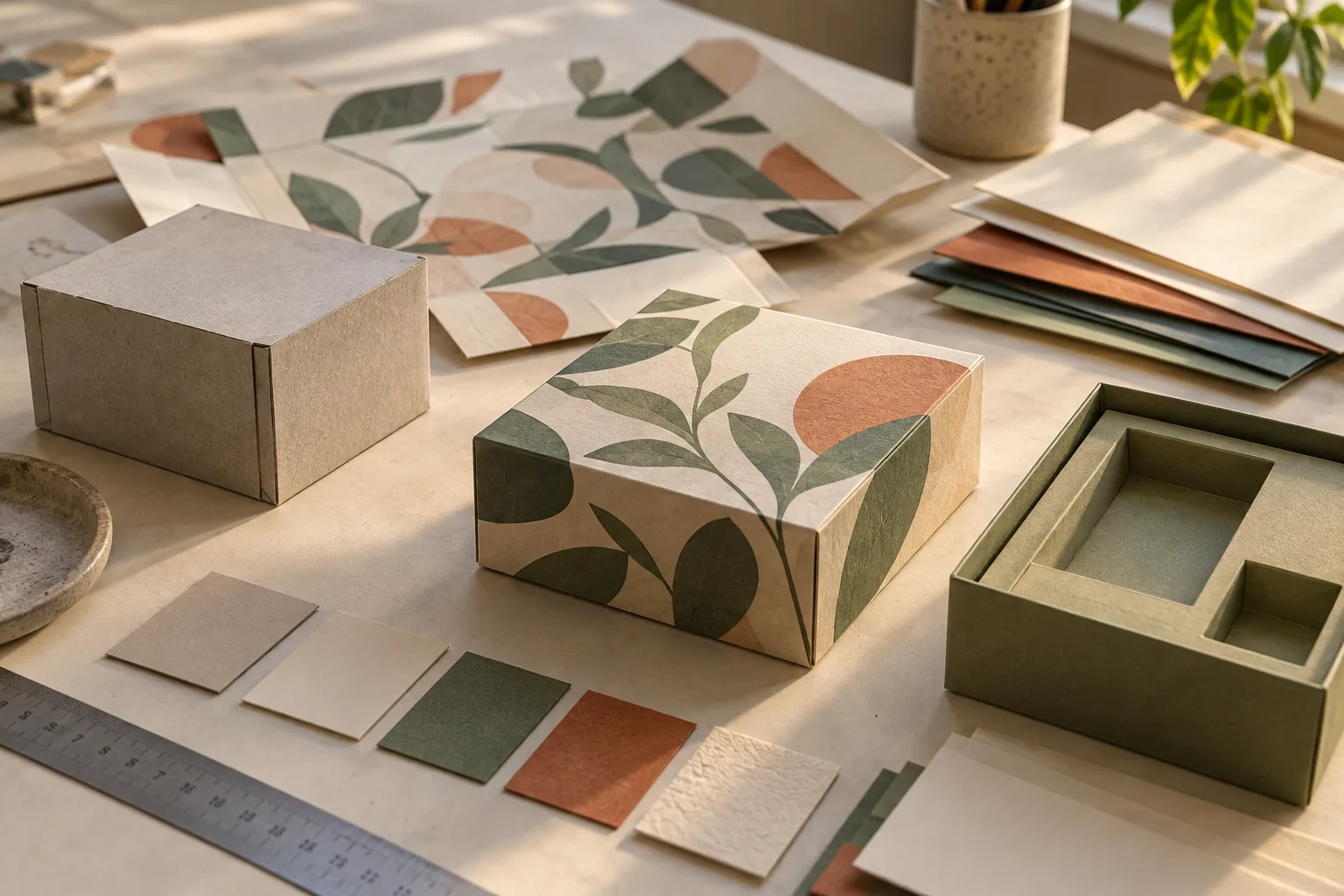
Choose materials with a clear purpose and ask for evidence behind environmental claims. Recycled content, responsibly sourced fibre and local recyclability are different attributes; none automatically proves the others. If certified paper is requested, clarify the documentation and whether the finished packaging can legitimately carry the relevant claim. For food or other sensitive products, assess contact requirements separately rather than assuming a paper-based box is suitable for direct contact.
Mixed materials can make recovery more difficult, especially when components are permanently bonded. Magnets, foam, plastic windows and decorative accessories should earn their place through function or experience. A paper-based insert may simplify material separation in suitable applications, while an easily removable non-paper component may be preferable to a permanently integrated one. Actual recyclability still depends on local collection and processing infrastructure.
Build a credible sustainability brief
Right-size the box around the complete product arrangement.
Ask for recycled or responsibly sourced paper options where appropriate.
Reduce unnecessary layers, coatings and decorative accessories.
Make different materials easy to separate where feasible.
Request evidence for claims instead of using vague terms such as “eco-friendly”.
Treat reuse as a design opportunity, not a guaranteed environmental outcome.
What quality checks and common mistakes should you plan for?
Quality needs to be defined before production, not negotiated after delivery. Agree which characteristics matter most: dimensions, product fit, squareness, lid alignment, colour, finish placement, clean wrapping or insert strength. Handmade and semi-manual processes can introduce variation, so define acceptable outcomes using physical references and a written inspection plan rather than an undefined request for “premium quality”.
India’s seasonal humidity and varied storage conditions make material handling worth discussing. Paper-based packaging can be affected by moisture, while unsuitable storage or packing can lead to warping, rubbing and visible surface damage. Ask how finished boxes will be protected in transit and how they should be stored before filling. Test closure and insert performance after realistic handling rather than only on a freshly presented sample.
Pre-production and delivery checklist
Internal dimensions and product orientation are confirmed.
All products and accessories fit without excessive pressure or movement.
Lids, drawers, hinges and closures operate consistently.
Artwork orientation, spelling and finish layers are approved.
Materials and any permitted substitutions are documented.
Wraps, corners and edges meet the agreed visual standard.
Inserts support the intended load and allow easy product removal.
The filled packaging and outer shipper have been evaluated together.
Outer carton protection, labelling and handling instructions are agreed.
Inspection, defect reporting and corrective-action responsibilities are clear.
Common mistakes to avoid
Approving from renders alone, choosing finishes before checking structure and comparing quotations with different inclusions are frequent avoidable errors. Other problems include leaving no space for fingers to remove the product, using a presentation box as an untested shipping box and changing product dimensions after approval. Keep a version-controlled specification, and require written approval before any material or construction change. This reduces ambiguity when several teams are involved.
How can Messketeers help?
Messketeers’ Custom Print & Packaging Studio — Packaging Solutions offers rigid and folding boxes, gift and hamper packaging, foil, embossing, spot UV and sustainable material options. For businesses searching for a custom rigid box packaging manufacturer in India, the useful starting point is a project discussion that connects the desired presentation with product fit, material selection and practical fulfilment needs.
As an India-based creative studio working across brand identity, custom print and packaging, OEM stationery manufacturing, experiential decor and paper art installations, Messketeers can bring a broader creative perspective to the brief. That is particularly relevant when packaging needs to feel consistent with a stationery range, gifting concept, launch environment or visual identity. The objective is a coherent experience, not decoration added independently to a box.
To start a productive enquiry, share your product dimensions and weight, photographs or samples, intended quantity by variant, preferred box style, artwork status, delivery location and required date. Include your budget direction and any material or sustainability priorities. Ask the team to confirm the project-specific scope, sampling approach, production feasibility and quotation inclusions before committing. A well-defined brief gives both sides a stronger basis for creating packaging that looks right, works reliably and can be repeated consistently.
Frequently asked questions
What is the minimum order quantity for custom rigid boxes in India?
There is no universal minimum order quantity. It depends on box construction, material purchasing requirements, printing, finishing and assembly. Ask whether the minimum applies to each size, colour or artwork version. For a smaller launch order, discuss simpler structures, readily available papers and fewer finishing processes with the packaging partner.
How much does custom rigid box packaging cost?
Cost depends on dimensions, quantity, board and wrap specifications, inserts, finishing and assembly complexity. Request an itemised quotation that also identifies sampling, tooling, freight and applicable taxes. Compare suppliers using the same specification; a lower unit price may exclude components or services that another quotation includes.
Can rigid boxes be used for e-commerce shipping?
Yes, but a presentation rigid box should not automatically be treated as a shipping container. It may need a corrugated outer shipper and suitable cushioning. Evaluate the complete filled pack against the handling risks of your delivery route, including movement, impact and compression, before approving the dispatch configuration.
Are custom rigid boxes recyclable?
Recyclability depends on the complete construction and the facilities available locally. Paper and board components may be recoverable, while bonded foam, plastic layers, magnets and other accessories can complicate separation. Ask about simpler material combinations and removable components. Recycled content and responsible fibre sourcing are useful attributes, but they are not the same as recyclability.
What should I approve before bulk production?
Approve the structure, product fit, materials, artwork, finishes and packing method in writing. Use a physical sample where practical and document any differences expected in production. Confirm the quality criteria, permitted substitutions, schedule and defect-resolution process. For shipped products, evaluate the actual contents, presentation box and outer shipper together.
What information should I send Messketeers for a packaging enquiry?
Share product dimensions and weight, photographs or samples, quantity by variant, preferred structure, artwork status, delivery location and required date. Add your budget direction and sustainability priorities. Messketeers’ Packaging Solutions services include rigid and folding boxes, gift and hamper packaging, decorative finishes and sustainable materials; request confirmation of the scope suited to your project.