 Messketeers
Custom Branded Notebooks Bulk Order: A Buyer’s Guide
· 11 min read
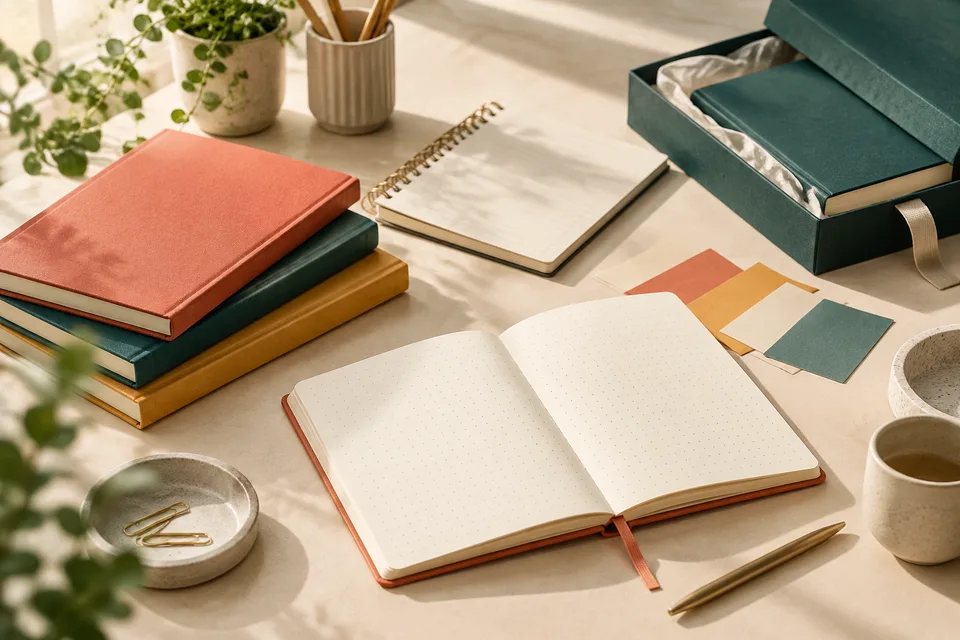
Quick answer: A successful custom branded notebooks bulk order starts with a clear specification: intended use, quantity, format, paper, binding, cover treatment and delivery requirements. Before production, approve a representative sample and document quality checks, packaging and dispatch responsibilities. Messketeers, an India-based creative studio, supports global OEM stationery manufacturing for journals, planners and notebooks, including custom covers and bindings, paper and ruling options, dated and undated planners, and private label development.
1. What should you decide before ordering custom branded notebooks in bulk?
Start with the notebook’s job, not its cover colour. A conference giveaway, employee onboarding journal, retail stationery product and executive gift each demand a different balance of usability, presentation and cost. A notebook that looks impressive in a photograph may still disappoint if it is uncomfortable to write in, difficult to carry or poorly matched to its audience.
Define the people who will use it and the circumstances in which they will receive it. Will it travel in a laptop bag, sit on a desk or become part of a boxed welcome kit? Consider writing habits, expected lifespan and whether the notebook needs to support a specific activity, such as meeting notes, daily planning or creative sketching.
Separate essential specifications from optional upgrades before requesting quotations. This makes it easier to protect the features that matter when a budget adjustment is necessary. For example, preserving suitable writing paper may be more valuable than adding a decorative closure or an elaborate outer box.
Build a practical purchasing brief
Purpose: Corporate gifting, onboarding, events, retail, education or private label resale.
Quantity: Total requirement and the split across cover colours, designs or interior versions.
Format: Finished dimensions, orientation and page count.
Interior: Plain, ruled, dotted, grid, dated planner, undated planner or custom layouts.
Branding: Cover artwork, logo treatment, endpapers, inserts and packaging.
Delivery: Required arrival date, destination, distribution plan and packing instructions.
Budget basis: Clarify whether the target includes packaging, taxes, freight and other applicable costs.
2. Which notebook format, paper and ruling options suit your audience?
Choose dimensions around actual use. A compact notebook is convenient for travel but provides less space for structured meeting notes. A larger format accommodates planning grids and diagrams, although it adds weight and may require a different gift box or shipping carton. Request finished dimensions rather than relying only on names such as “pocket” or “executive,” which are not consistent specifications.
Paper deserves the same attention as the cover. Grammage, expressed in GSM, describes weight per unit area; it does not independently guarantee opacity, smoothness or suitability for a particular pen. Ask for paper samples and test them with the writing tools your audience is likely to use. Fountain pens, markers, gel pens and ballpoints can behave differently on the same sheet.
Interior design should make writing easier rather than turn every page into an advertisement. Light ruling, sensible margins and restrained branding improve usability. For planners, check date accuracy, weekday alignment, holidays where relevant, and the space available for weekends. Undated layouts avoid calendar obsolescence, but they still need a logical structure that users can understand immediately.
Interior option | Useful for | What to check before approval |
|---|---|---|
Ruled pages | Everyday notes and meeting journals | Line spacing, contrast and writing margins |
Dot grid | Flexible planning and diagrams | Dot visibility and consistent placement |
Plain pages | Sketching and freeform thinking | Opacity, surface feel and suitability for drawing tools |
Square grid | Technical notes and structured layouts | Grid alignment and print density |
Dated planner | Calendar-led programmes and retail launches | Calendar accuracy, regional conventions and release timing |
Undated planner | Evergreen gifting and flexible planning | Intuitive prompts and sufficient writing space |
Specify pages and leaves correctly
A leaf is one physical sheet within the finished notebook; a page is one side of that leaf. State the required page count clearly and identify whether introductory pages, dividers and other printed sections are included. This small clarification prevents substantial differences between quotations that otherwise appear comparable.
3. How do covers, bindings and branding methods affect the result?
Binding determines how the notebook opens, how comfortably someone can write near the centre and how well it holds together over time. Wire-bound formats can be useful where folding pages back matters, while a casebound notebook can support a more book-like presentation. Sewn constructions may offer strong opening performance, but the result depends on the complete construction—not simply the word “sewn” in a quotation.
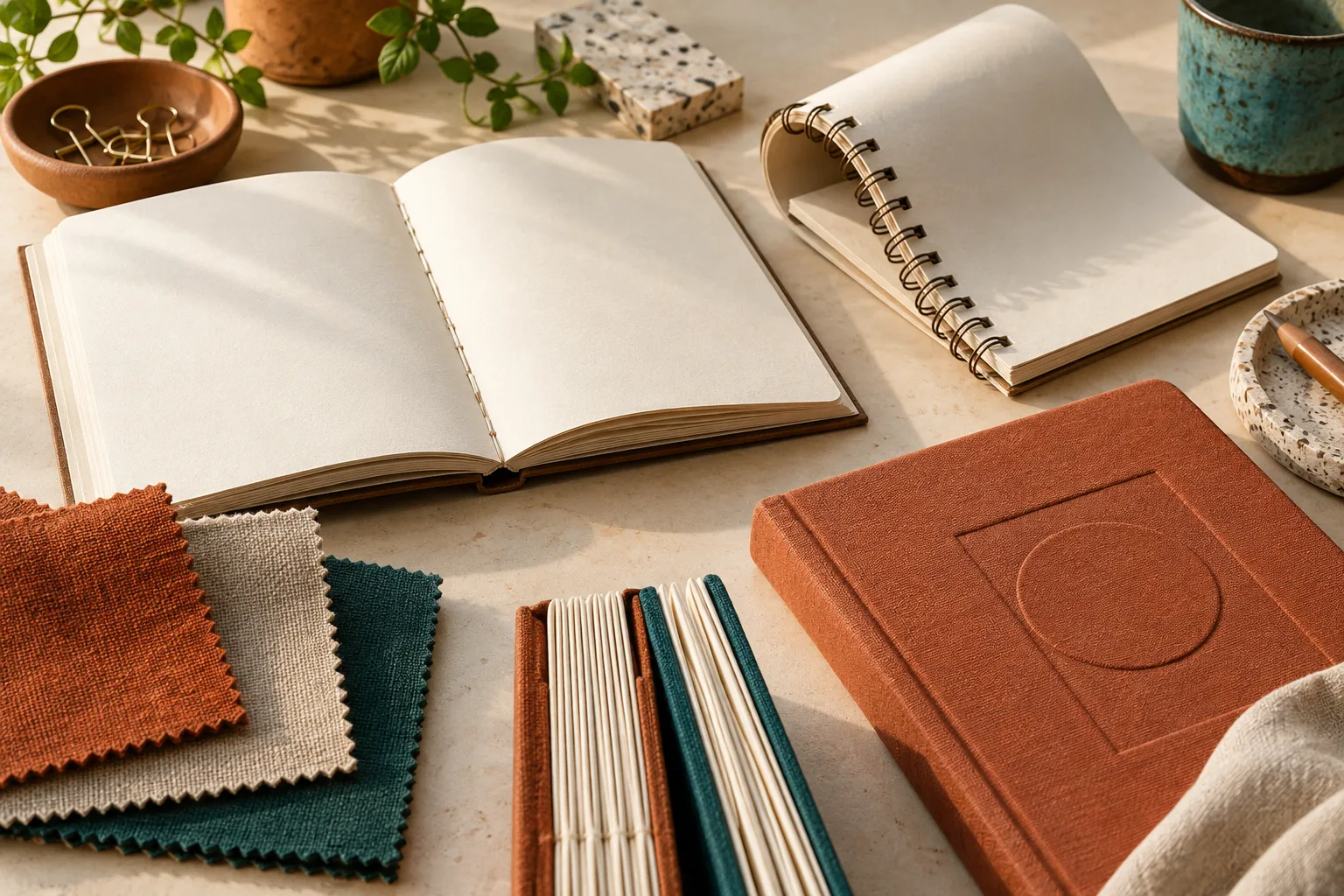
Cover choices also involve trade-offs. A printed paper cover allows extensive artwork, while a wrapped rigid cover offers a different tactile experience and level of protection. Textured materials can complement embossing or debossing, but fine details may reproduce differently than they do on a smooth surface. Test the proposed artwork on the actual material rather than approving the technique in isolation.
Ask how the finished treatment will withstand handling. Dark printed areas may reveal scuffs, foil can lose clarity in very fine artwork, and some surface combinations need careful testing for adhesion or cracking. Treat colour references as production targets to validate physically: a screen preview cannot establish how a colour will appear on textured paper, cover fabric or a coated surface.
Match the technique to the design
Printed covers: Useful for illustration, patterns, photography and detailed colour artwork.
Foil stamping: Adds a reflective accent; check minimum detail requirements with the manufacturer.
Embossing or debossing: Creates raised or recessed detail, with results influenced by the substrate.
Custom endpapers: Extend the identity without occupying everyday writing space.
Accessories: Ribbons, elastic closures, pen loops and pockets should serve a practical purpose and be tested on the sample.
4. What affects the cost and minimum order quantity of a bulk notebook order?
There is no reliable universal price for a custom notebook without a specification. Finished size, page count, paper, cover construction, printing, binding, accessories and packaging all affect the manufacturing requirement. Two visually similar notebooks can have very different costs because their internal construction or material choices differ substantially.
Minimum order quantity, or MOQ, is also specification-dependent. Material purchasing, printing setup, tooling and production scheduling can make some combinations more practical at larger quantities. Ask whether the quoted MOQ applies to the entire order or separately to each colour, artwork version or interior. Splitting one order into several variants may change both feasibility and unit cost.
Compare quotations on an equivalent basis rather than selecting the lowest headline unit price. Request clarity on sampling, tooling, packing, applicable taxes, freight and any agreed spare units. For overseas deliveries, establish the commercial terms, importer responsibilities and destination charges before interpreting a quotation as a landed cost.
Where to simplify without undermining usability
Use one interior across several cover designs where the project permits it.
Consider an available paper or cover material instead of a specially sourced alternative.
Remove accessories that do not support the intended use.
Select packaging that protects the notebook without unnecessary layers.
Ask whether a different finished format improves manufacturing efficiency.
Distinguish one-time development charges from recurring production charges.
A useful quotation should also state its validity and identify assumptions. If the delivery date, material availability or final artwork changes, ask whether the commercial offer needs to be revised. Early transparency is more valuable than discovering excluded costs after approval.
5. What artwork and private label details should you prepare?
Production-ready artwork is more than a high-resolution logo. Request the manufacturer’s templates for the exact cover and interior construction, including trim, bleed, safe areas, spine dimensions and wrap allowances where relevant. A design prepared for a softcover notebook should not automatically be reused for a rigid wrapped cover without checking its geometry.
Provide vector artwork where appropriate for logos and finishing elements, and separate special treatments into clearly identified layers or files according to the manufacturer’s requirements. Fonts, linked images, colour references and placement instructions should be resolved before release. For personalised names or multiple variants, maintain a controlled master list and establish who approves spelling and version allocation.
Private label manufacturing requires additional decisions beyond placing a brand on the cover. Specify which identity appears on the notebook, packaging and inserts, and whether retail barcodes or product references are needed. Confirm ownership and permitted use of artwork, and agree how approved files and specifications will be retained for reorders. Ask what manufacturer or origin information must appear for the relevant destination and sales channel.
Keep one controlled approval package
Final cover artwork and finishing instructions.
Approved interior file with the correct page count and sequence.
Packaging artwork, barcode files and any required product information.
Variant matrix linking each design to its quantity.
Written colour, material and construction references.
Version number, approval date and named decision-maker.
Avoid sending corrections across disconnected messages without consolidating them. A final approved package reduces the risk that an earlier cover file is combined with a later interior file or that a packaging amendment is missed.
6. How should sampling, approvals and quality checks work?
Sampling should answer specific production questions. A digital proof can confirm layout and content, but it cannot establish paper feel, cover texture or opening behaviour. A physical dummy may demonstrate dimensions and construction without representing the final print finish. Ask exactly what each sample represents and what remains provisional.
Where feasible, approve a representative pre-production sample that brings together the intended paper, binding, cover and finishing. Record any agreed differences between that sample and the final production run. If a substituted material or temporary process is used during sampling, its appearance should not silently become the acceptance standard for something made differently later.
Quality control works best when acceptance criteria are agreed before manufacturing. Identify defects that affect usability, those that affect appearance and those that require immediate rejection, such as missing pages or an incorrect interior. For larger orders, discuss an inspection sampling plan and the handling of nonconforming units rather than assuming every notebook will receive an identical inspection.
Pre-production approval checklist
Finished dimensions and page count match the specification.
Paper shade, opacity and writing performance are suitable.
Ruling, margins and page sequence are correct.
Planner dates and calendar layouts have been proofread.
Cover placement, colour and finishing are acceptable.
Binding opens as intended and pages are secure.
Ribbons, closures, pockets and loops function properly.
Packaging protects the product and fits correctly.
Variant quantities and carton labelling are documented.
Any sample exceptions are recorded in writing.
7. What does the bulk notebook ordering process look like?
Plan backwards from the date the notebooks must be usable, not simply the date they should leave the factory. An event deadline may also require time for incoming inspection, kit assembly and distribution. Retail launches may need product photography and inventory preparation before the notebooks are available for sale.
Lead time should be confirmed against the actual specification and approval schedule. Material sourcing, custom tooling, planner proofreading, production capacity and shipping arrangements can all affect the programme. Avoid relying on a generic turnaround promise that does not account for the project’s individual requirements.
A step-by-step procurement process
Define the brief. Confirm purpose, quantities, specifications, destinations and the required arrival date.
Review feasibility. Resolve material availability, construction choices, variant splits and manufacturing constraints.
Approve the quotation. Confirm what is included, payment terms, delivery responsibilities and the treatment of changes.
Prepare artwork. Use the approved templates and consolidate all files into a controlled package.
Review proofs and samples. Check content, construction, appearance and writing performance against the brief.
Release production in writing. Approve the final specifications, sample references and quantity allocation.
Inspect and pack. Apply the agreed checks, verify carton counts and confirm packing documentation.
Dispatch and receive. Track delivery, inspect incoming goods and raise any discrepancies through the agreed process.
Assign one accountable approver to consolidate feedback from marketing, procurement and other stakeholders. Conflicting comments can delay production or introduce avoidable errors. After approval, treat changes as formal revisions with an explicit review of their cost and schedule implications.
8. Which packaging, delivery and sustainability mistakes should you avoid?
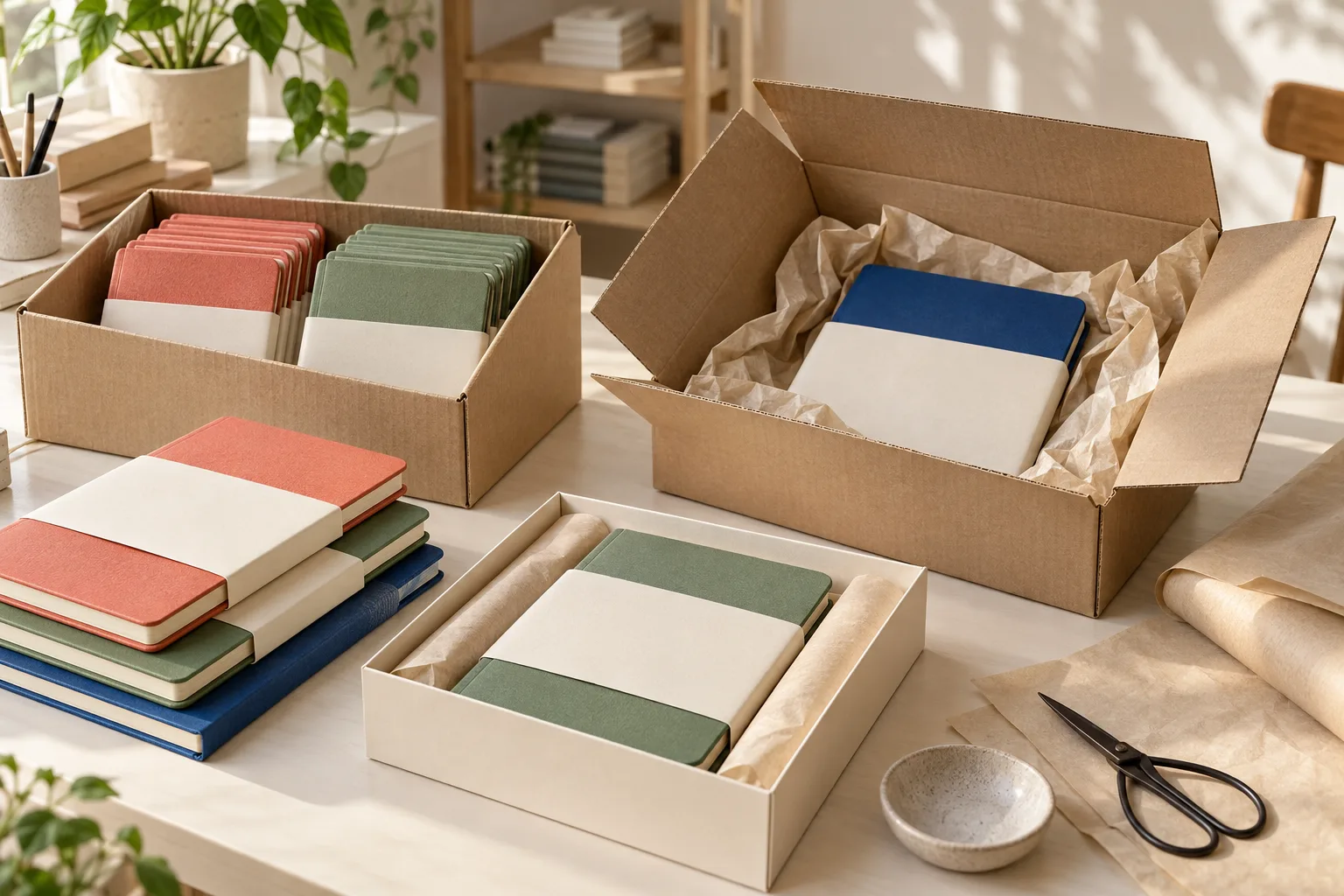
Packaging should respond to the product’s journey. A notebook being handed out at a venue may need different presentation from one shipped individually to employees. A premium box can enhance an unboxing experience, but it also adds material, storage requirements and shipping volume. Test the complete pack, including any inserts or companion products, before final approval.
For domestic or international dispatch, clarify carton quantities, destination splits, delivery access and documentation responsibilities. If products will remain in storage, discuss protection appropriate to the material and conditions. Paper-based products can be affected by moisture and handling, so neither attractive packaging nor a sturdy notebook alone guarantees safe arrival.
Sustainability claims need evidence and careful wording. Ask for documentation supporting recycled-content, material-source or certification claims, and verify that any proposed label use is authorised. Consider the whole construction: a paper notebook with mixed-material decorations, adhesives and closures may be harder to separate for recycling than its cover suggests. Durability and genuinely useful interiors also matter because unused promotional products deliver little lasting value.
Common mistakes to avoid
Comparing only unit prices: Review the full agreed cost and equivalent specifications.
Approving from a screen alone: Validate physical materials and relevant finishing methods.
Overbranding every page: Leave enough clear space for comfortable writing.
Skipping calendar checks: Proof dated planners independently of visual design approval.
Ignoring variant complexity: Confirm quantities and minimums for each version.
Ordering against an untested pack: Check fit, protection and handling performance.
Leaving delivery vague: Specify destination, deadline and receiving responsibilities.
Using unsupported environmental language: Make only claims that the available evidence supports.
Retain the approved specification and sample reference after delivery. They provide a useful starting point for repeat orders, although materials, availability and colour should still be reconfirmed. Reordering from a product photograph alone leaves too much room for interpretation.
9. How Messketeers can help with your custom branded notebooks bulk order?
Messketeers brings an India-based creative studio perspective to global OEM stationery manufacturing for journals, planners and notebooks. Its relevant services include custom covers and bindings, dated and undated planners, paper and ruling options, and private label development. These choices allow a notebook project to be considered as a complete product rather than just a cover with a logo applied.
The studio’s broader work in brand identity, custom print and packaging can also inform how the notebook connects with a larger brand experience. For an onboarding kit, that might mean coordinating the cover, welcome insert and packaging. For a private label collection, it can mean developing a recognisable visual system while keeping the interior practical for everyday use.
To begin a useful project discussion, share the intended use, total quantity, variant split, preferred dimensions, interior requirements, branding references, delivery destination and required arrival date. Include a budget target if one is available, and identify which features are essential. Ask Messketeers to confirm the project-specific MOQ, available materials, sampling approach, quotation scope and production schedule before committing.
The strongest brief leaves room for manufacturing advice while remaining clear about the desired outcome. A successful bulk order should feel coherent, write well, arrive in suitable condition and be straightforward to specify again—not merely look attractive at the point of approval.
Frequently asked questions
What is the minimum order quantity for custom branded notebooks?
MOQ depends on the notebook’s construction, materials, printing and number of variants. Ask whether the minimum applies to the whole order or separately to each cover colour and interior design. Messketeers should confirm the requirement against your specific brief rather than a generic notebook description.
Can I customise the inside pages as well as the cover?
Yes. Messketeers offers paper and ruling options alongside dated and undated planners. Your brief can identify the preferred interior structure, writing space and branding requirements. Custom layouts should be reviewed for readability, page sequence and production feasibility; dated planners also require careful checking of dates and weekday alignment.
Which paper is best for branded notebooks?
The best paper depends on how the notebook will be used and which pens users prefer. GSM alone does not establish writing quality. Compare opacity, surface texture, shade and ink behaviour using physical samples, then test the intended pens for feathering, bleed-through and show-through before approving the paper.
How long does a custom notebook bulk order take?
The schedule depends on material availability, artwork readiness, sampling, construction, quantity and delivery arrangements. Request a project-specific timeline that separates approvals, production and shipping. Work backwards from the required arrival date and allow time for receiving checks, especially when notebooks are needed for an event or retail launch.
What should I check before approving a notebook sample?
Check dimensions, page count, paper performance, ruling, cover placement, finishing and binding. Test accessories and verify packaging fit. Confirm whether the sample uses the intended production materials and processes, and record any exceptions. The approved sample and written specification should together establish the reference for production acceptance.
Does Messketeers offer private label notebook manufacturing?
Messketeers includes private label within its global OEM stationery manufacturing services for journals, planners and notebooks. Share your brand assets, product specifications, quantity and packaging requirements to discuss the project. Confirm artwork ownership, product identification, applicable labelling and the approval process as part of the manufacturing brief.